Visiting…

Nine years ago Emma gave me a Christmas present. More than one no doubt, but one of them was a little different. A World Vision sponsor child. It was premeditated. We had conspired about it beforehand.

I didn’t think too much of it after that other than sending off the occasional birthday or Christmas wish or claiming our tax deduction. When this trip came along however we knew that one of the things we would really love to do would be to visit Ramlekha. I liked the idea of making ‘real’ a person and a place that existed, for all intents and purposes, only in my imagination. I also liked the idea of making a connection between our two vastly different lives.

The visit became something of a marker point for our year. We wanted to get here before Rajasthan becomes unbearably hot. Temperatures from April sit well above 40 and regularly push 50, or so we are lead to believe. Our travels in India too are really an add-on to make the most of the visit with Ramlekha. We are fortunate she lives in the same state as so many of India’s famous attractions.

Ramlekha’s village is around 50 kilometres outside the town of Baran. Baran lies 70 or so kilometres beyond the city of Kota and Kota is about 250 kilometres south of Jaipur. The further we travelled from Jaipur the more unusual we became. Not many tourists visit Kota and I’m pretty sure no tourist ever visits Baran. All eyes in the busy cross roads at the centre of Baran fell upon us as we alighted our Innova out front of the Surya Hotel. It wasn’t long however before Mayank from World Vision appeared and we were in good hands.

I had trouble sleeping the night before the visit. No sponsor had ever visited this particular village. Only one other had ever visited the region. ‘Does the community know we are coming?’, I asked at dinner earlier that evening. ‘Oh yes’ Mayank answered. ‘They are very excited’.

We set out early the next morning. The plan was to get there around 8am so the people of the village could spend a couple of hours with us before they returned to the fields. It was harvest time and forgoing a day of harvesting wheat by hand in the hot sun to spend time with us would mean forgoing a day’s wage. All of $3.

The drive was pleasant. Rural India is quite a contrast to urban India. No dirt, minimal litter, no putrid puddles of water. Fields of wheat were the norm in the hot, parched and steadily baking landscape – a landscape eagerly awaiting the next monsoon. We crossed dry, rocky river beds and passed other little villages, like the one we were destined for.


DSC04023
Wheat cut and bundled by hand

My excitement grew as we drew nearer and I felt a little nervous. What would we say? What would we ask? What would be the common ground? Emma was equally unsure. The more I extended my mind the greater the blank it drew so I let it go and decided that what would be would be, that we would react in the moment and trust in the genuine intent that had bought us here.

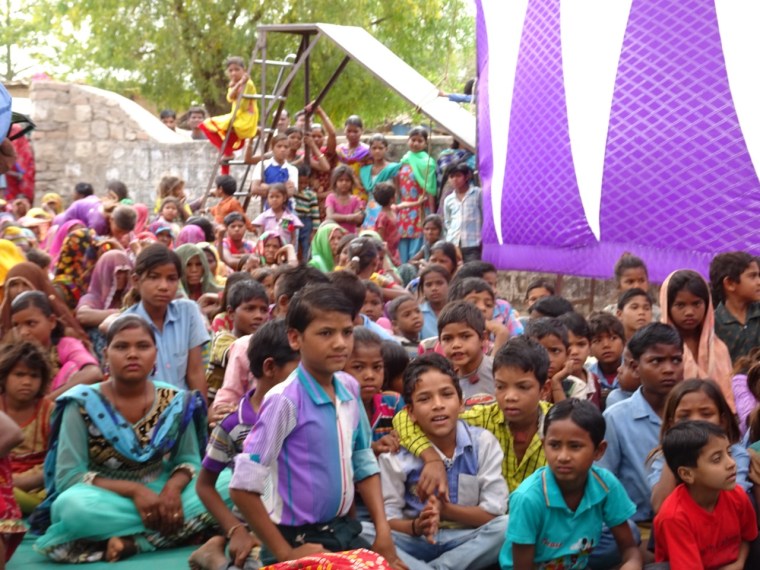
Of course when we got there it was not at all what I had expected. It never is. The first sight to greet us was a large purple and white tent like marquee set up as the staging point for our visit. We were ushered in by the World Vision staff accompanying us, there were about 5 of them and they all seemed thrilled at the chance to show off their work. A man was beating a drum and there were loud bangs of fireworks to welcome us.

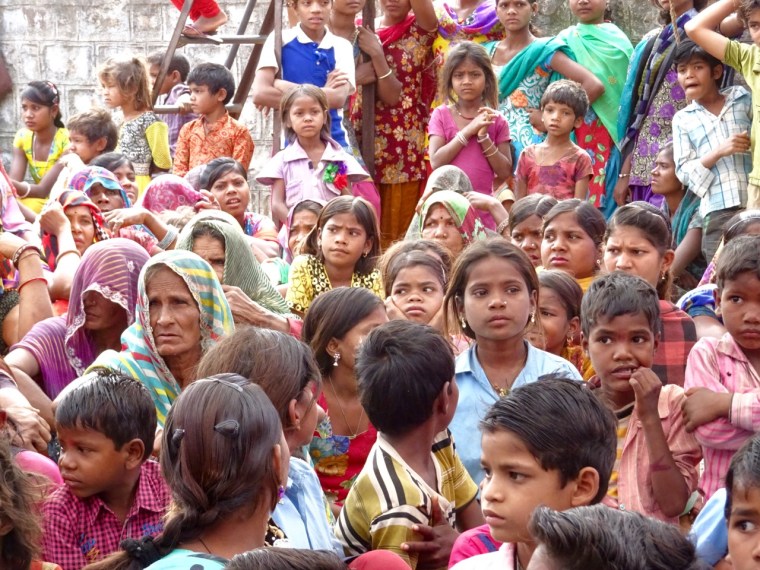
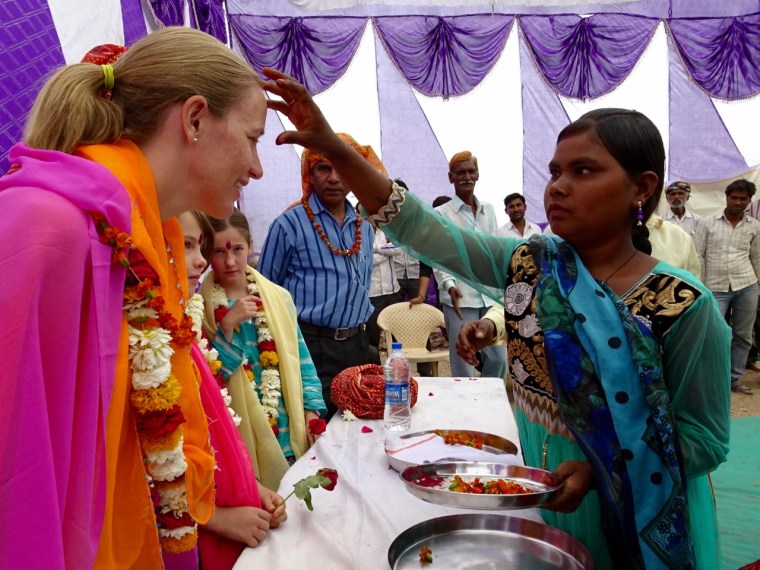
Inside we were seated as guests of honour at a table set up at the head of the area. The tent soon filled with a few, then a few more and before long the entire, hundred or so strong, members of the village. The women sang songs of love and gratitude in honour of our visit. Individual and small groups of children took turns to dance for us or to sing more songs. We were then welcomed by the head of the village. Red dots were painted on each of our foreheads, Emma was wrapped in colourful scarves and flower garlands as were Amy and Oliver while my head was wrapped with cloth to form a turban.

DSC03987
Seated before the crowd
DSC04004
The welcoming people
DSC03982
A blessing from Ramlekha
DSC03978
Amy receives her blessing
DSC03998
Ramlekha on the left
DSC03965
Oliver greeting Ramlekha
DSC03974
Greg receives a turban

Ramlekha herself was dressed in what I’m sure were her finest clothes and appeared a little overwhelmed. Not surprising. We felt much the same. The whole experienced exceeded any expectations. This was a most extraordinary reception. As we later told our hosts, the strength of gratitude that the people felt because of the work World Vision has done was palpable and it was being lauded upon us just because we had come to visit.

After all the welcoming, speeches, songs and dance we were ushered off for a private meeting with Ramlekha and her family. The World Vision folk did their best to facilitate this but the fact of the matter was that the village as a whole would not be dissuaded. We were followed by everybody on our way to Ramlekha’s house, highly curious eyes tracked our every movement, staring with curiosity, grinning and shying away if you made eye contact but popping back to keep ogling as soon as you looked away.

The village itself was simple and neat. There were no outward signs of poverty and unlike the Indian urban environments we have seen, the whole area was clean. Ramlekha, her parents and three siblings live in a colourfully painted mud-clad stone house not more than two metres wide and about six metres long. It was dark inside and significantly cooler than outside but there was also no light by which to see, I did notice a simple clay stove built into the ground. The front courtyard had been decorated with a coloured powder welcome sign for our visit. Though it was neat, it was also poor. Not poor in spirit, but poor in resources in a way I have not come across before.

DSC04005
A warm welcome

Imagine having have to choose between taking a day off work to take a sick child into town to a doctor (if in fact it was possible to get there at all) and not earning a day’s wages which would mean you couldn’t buy food to feed the family that day. That kind of poor. Ramlekha will spend her entire life in that village, the only time she might travel further would be for serious illness. The aspirations of the village families are for a light in their house or things of that nature.

Malnutrition for children in communities such as this throughout Rajasthan runs at a staggering 98%. Well it does for communities where organisations such as World Vision are not present. The Indian government does what it can, but remote communities can apparently be beyond their reach or resources or both. World Vision’s intent to focus on those communities was genuine and moving. The reality is that people suffer and die out here and there is no support, no voice to advocate on their behalf, until World Vision or another NGO steps in.  World Vision has recently commenced an ‘ambulance’ service to ensure that people can travel for help if it is needed – it is apparently used daily.

It is hard to wrap your head around the wealth hierarchy that exists within India let alone between India and other parts of the world. By Australians standards we are well off but not, I wouldn’t have said, obscenely rich. Yet here, I felt like Rupert Murdoch or James Packer. Even our comparatively wealthy and well off World Vision hosts could, I think, barely comprehend that we could travel the world for 12 months. They said little but their faces betrayed their thoughts.

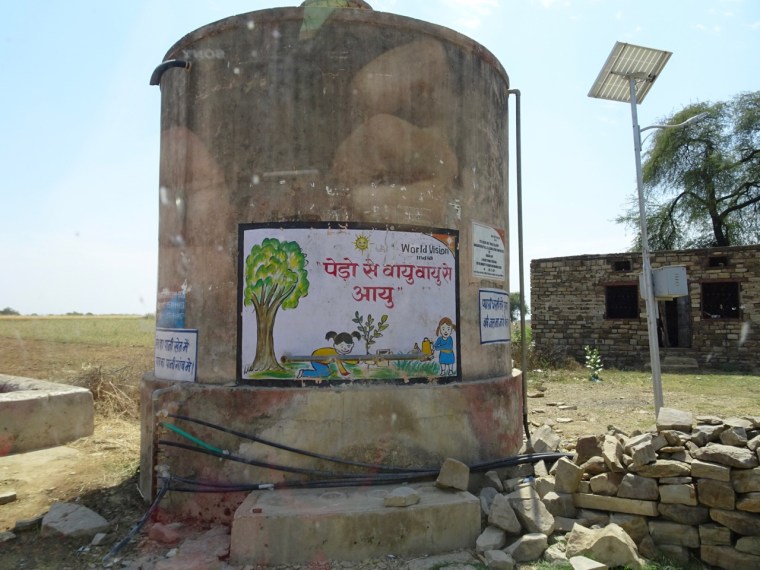
Elsewhere throughout the village was tangible evidence of World Vision’s work in the form of water tanks and filters, toilets and bio-gas systems so that cooking by dried cow dung could be replaced with gas. Solar powered street lights were also scattered around and have apparently significantly improved safety, especially for women and children.

DSC04050
A water tank, with a climate change message and a solar light on the right

The installation and use of this infrastructure represents a hard won trust and relationship that has been established between the World Vision staff and the communities. We have been brought up knowing that sanitation and clean drinking water keep us healthy. The communities here have not witnessed this cause and effect and World Vision works diligently to develop their understanding which leads to acceptance and better health outcomes.

After a short tour of Ramlekha’s home we got down to the business of meeting each other. My mind still raced and I remember turning to Emma and asking, ‘what do we say?’. Face to face, and confronting the reality of how different our lives were it was really hard to know where to begin. But for all that, it wasn’t uncomfortable. The overarching joyful mood of the family along with the helpful World Vision staff to translate made for a fun interaction.

I think I asked a few inane questions to Ramlekha’s younger brother about school and what he liked studying and then had a go at asking them to teach us some short Hindi phrases, knowing that our clumsy efforts to repeat them would probably cause amusement – which it did.

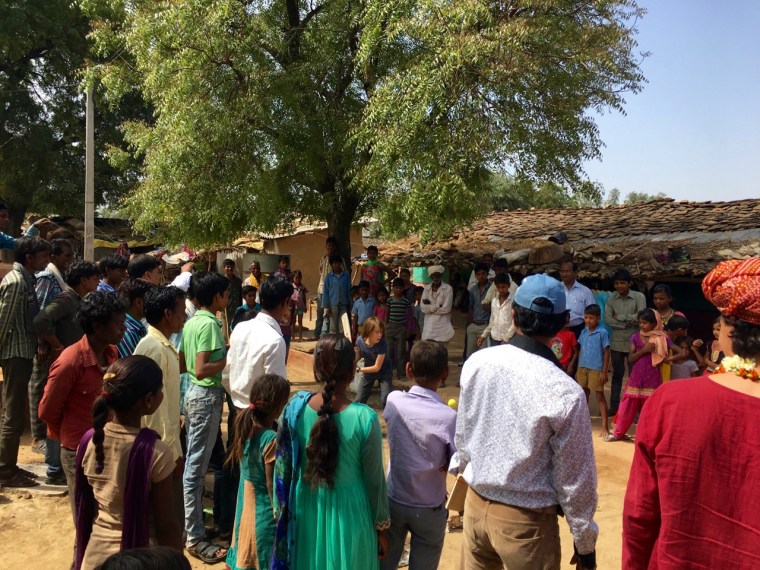
Sport, it then occurred to me, is a fairly universal language and so we asked if they played cricket. Doesn’t everyone in India? Well no actually, these guys knew the game but not the rules. They were however appeased when we made clear that really didn’t matter. The cricket bat and ball we had given as a gift soon appeared and games followed.

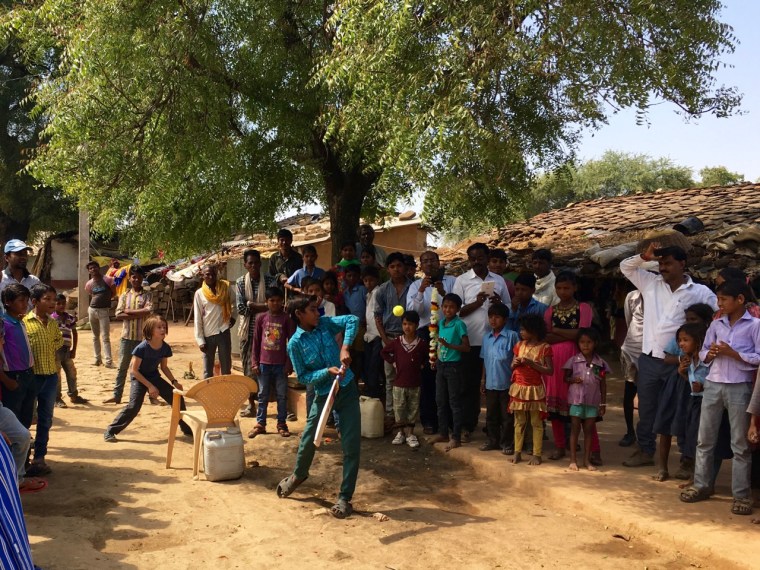
A few brave souls leapt forward to play with us while the rest of the village lined the make-do pitch like spectators lining the finish of a Tour de France stage. Oliver bowled politely to our new friends and viciously to his father, but gaining ‘oohs’ and ‘aahs’ of admiration when the chair offered for stumps was knocked clean out from behind me.

IMG_1098
Oliver in action
IMG_1103
Cricket action

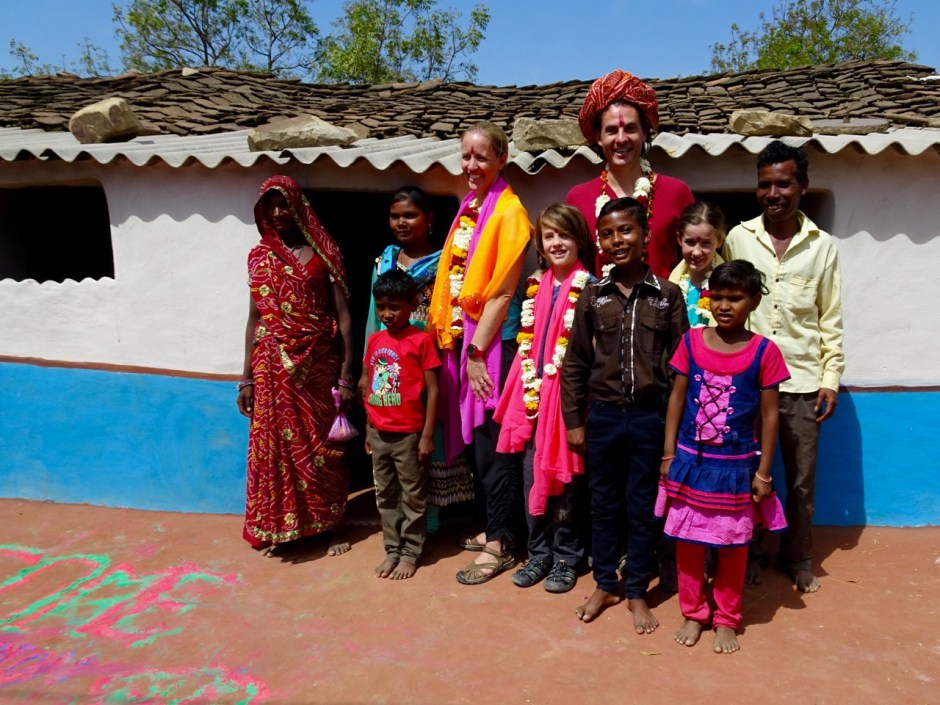
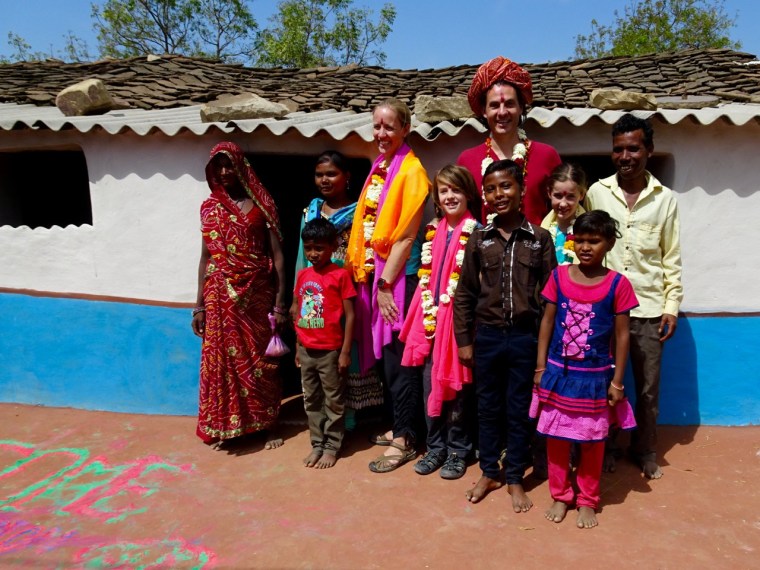
Before we knew it our time was up. We gathered in front of Ramlekha’s home for photos where Ramlekha’s dad really caught my imagination. His happiness was so vivid as he stood proudly by our side. Ramlekha herself still seemed overwhelmed and so we did not try to force interaction. The rest of the village, still hovering all around, provided more than ample opportunity for it not to matter. We walked back to the cars lead once more by the beating drum and followed by our admirers and before long we were on our way. It was a special day for us, and we hope for Ramlekha, her family and the village as well.

DSC04015
Ramlekha and family

It can be hard when deciding from home which charity or international aid agency to support. You want to think that your money is doing some good on the ground and not being wasted on excessive administration. Goodness knows we filled out a mountain of paperwork to make this visit possible, but that could just be requirements of India’s bureaucracy which we have also grappled with elsewhere.

Despite the paperwork, the commitment and passion of the staff that accompanied us on this visit was undeniable. The Christian ethos underscoring the World Vision operation was real and heart warming in a way my skeptical views of the church at large is not. I can vouch for the tangible, on the ground infrastructure which is all there only because of World Vision’s work.

More than all that I know that an entire village forewent half a day’s wages that they could ill afford in order come and see us and express their appreciation. We are only one of 45 sponsors for this village but we may have well been paying for the whole lot the way we were received. If you can, sponsor a child. If you already have, sponsor another. We will be. You’re doing a world of good.

Fish out of water

Like fish out of water. That’s us in India. Flip, flop, flap… gulp. Official sources on such matters (the Cambridge thesaurus) suggest that fish out of water feel awkward because they are in a situation that they have not experienced before or because they are very different from the people around them. One might have thought it was because they can’t breathe.

In any case, we landed in a nice comfortable goldfish bowl at Kolkata. The airport was modern and the immigration officials friendly, jovial even, as they processed our visas. Thanks to Emma’s intelligence gathering we even felt confident as we found the pre-paid taxi window and purchased our taxi voucher avoiding other touts and ‘helpers’.

Our taxi had character and I was initially enthused. It looked decidedly British which I guess makes sense given Kolkata is an East India Company town. It was battered and bruised and shook like an aftershock as it rumbled us off into the night.

Colours swirled, lights flashed, sounds blared and unfamiliar smells intruded through the open windows. We four fish had jumped out of our pond. I don’t think I can quite describe the sensation associated with this taxi journey. It was disarming. I felt like a babe in the woods as we rattled through the streets.

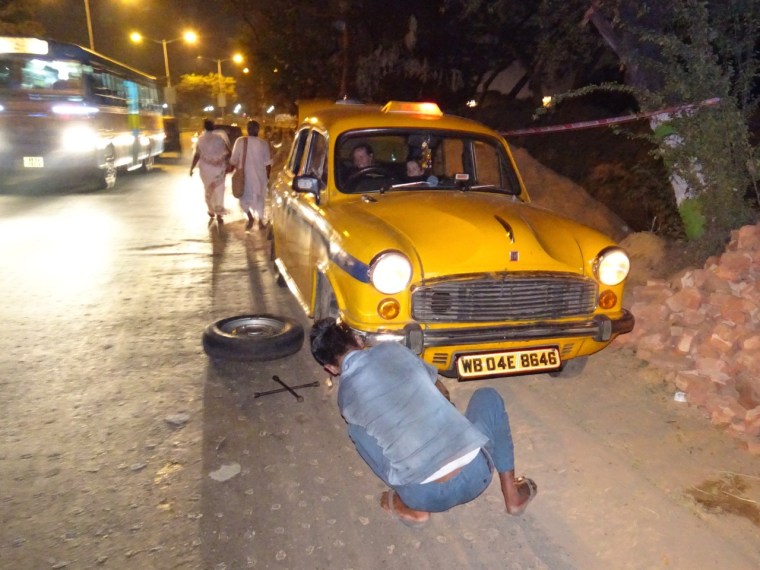
And then there was a really loud BANG! The front right hand side of the car dropped. Our driver said nothing, but pulled the steering wheel to the left as the car limped off to the side of the road. I jumped out with him to inspect the damage, hoping like mad that this clapped out old car had a spare.

It did and our driver silently got stuck into to affecting the fix. Nothing unusual here. Old tyre off, I inspected the cause of the ‘pop’. Tyres don’t usually just go ‘pop’. This tyre however had nowhere else to go. It was completely bald. Like someone had sanded the tread to make it smooth.

DSC03492
On the streets of Kolkata

Tyre changed we dashed back off into the night. On and on we went. Amy and Oliver snuggled into Emma in the back seat for support as we swerved, dodged and scraped our way down roads and through tiny backstreets and lanes, the traffic governed by no discernable rules and therefore more chaotic than Hanoi’s river like flow. We could have been headed anywhere.

An hour and a quarter later and with a collective sigh of relief we turned a final disorienting corner and saw another goldfish bowl. Our hotel was serene and western looking. We hurried in, took a deep breath, ate dinner and quietly contemplated what on earth we were doing here (at least I did) before dropping off to sleep.

The next day started slowly. No one was rushing back onto the streets after the previous night’s taxi ride. India is a little bit different to Australia. Just a little. Early afternoon however we ventured forth – metaphorical aqua lungs on. Amy clung to my arm like she hadn’t since our first day back in Bangkok. Oliver appeared less phased. Emma summoned internal fortitude and moved bravely on although I got the sense she would have been just as happy to remain in the hotel. How wonderful I told myself that there are still places where just stepping outside is an adventure!

The scene was less chaotic than my imagination. Daylight has a way of slowing things down, or maybe the street just moves more slowly in the light. We gained some confidence, or at least I did, I’m not sure about the others. The streets of Kolkata bear no resemblance to home although it is quite beyond me to describe how. Urban India has a texture about it that is dirty, gritty, colourful and enthralling all at once. To our foreign eyes there is a constant abundance unfamiliar sights, and many more moving parts than we are accustomed to. The streetscape, for example, includes pigs, horses, cows and the occasional camel, all equally a part of the place along with the usual motorised vehicles.

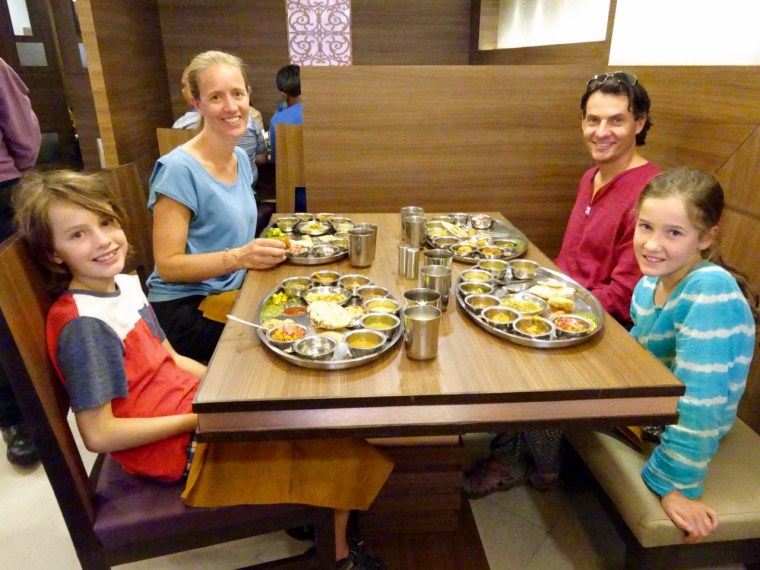
We soon happened across an Indian ‘Thali’ restaurant that looked like the kind of place four Australian fish might take a breather. It’s a good thing we are all so good-looking because otherwise it could have been awkward when all eyes turned curiously towards us as we were shown to a table.

DSC03496
Thali in Kolkata

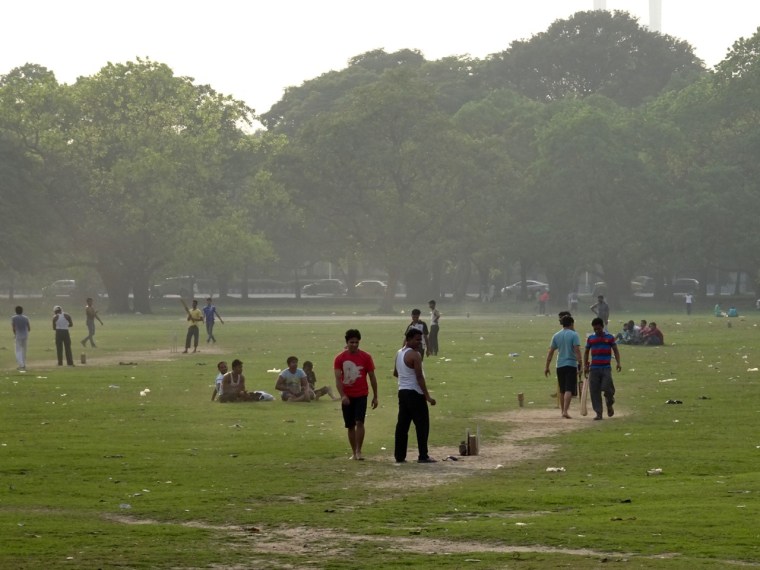
Thali involves a small sample of may different kinds of curries and breads and other bits and pieces and was a culinary treat. We may be fish out of water but we do like the food. After lunch, and with what air we had left in our lungs, we explored Kolkata. Strolling through parklands on our way to the Victoria Monument, we stumbled across dusty cricket games, kids flying kites high above the city, other kids doing head stands on bikes and locals racing up to us on horse back to offer us rides.

DSC03528
Many many cricket games in Kolkata open space

We flew to Jaipur the next day where we met Naresh, our driver for the next two and half weeks and undoubtedly the best decision we have made about travelling to India. Naresh’s white air-conditioned Toyota Innova is a like a goldfish bowl on wheels, moving us through the Indian landscape without quite being part of it. Naresh also knows where all the foreign fish like to eat and what we like to see. He says you need three things to drive in India. ‘Good luck, good brakes and a good horn’. Naresh has all three and in his capable hands we all started to relax into our Indian journey.

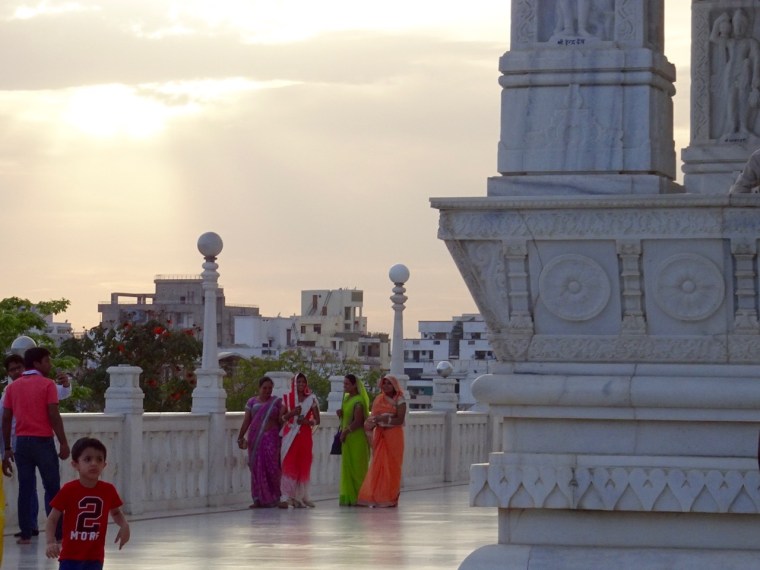
We were a little less like fish out of water at Jaipur’s highly trafficked tourist attractions, although on one occasion a group of cool looking twenty something’s sidled up to us phones out and snapping selfies by our side. On another, I flashed a smile at a group of ladies in brightly coloured saris sending them into a huddle of giggles. Nothing unusual here of course, I have that effect on all the ladies. On a couple of other occasions, we turned the tables on our Indian admirers requesting our own photos of them.

DSC03674
Some of our fans
DSC03692
Beautiful saris

The truth be known, it is Amy and Oliver that are the stars. There are other ‘western fish’ here to be sure, but very few of them under the age of 30 and many more in the grey nomad age bracket. When Amy and Oliver decide they have had enough being the centre of attention and opt out of a photo shoot a look of disappointment invariably passes the face of their adoring fans. I dutifully offer myself up as a consolation prize but a consolation prize probably best describes how I am received.

DSC03797
With some more of our fans

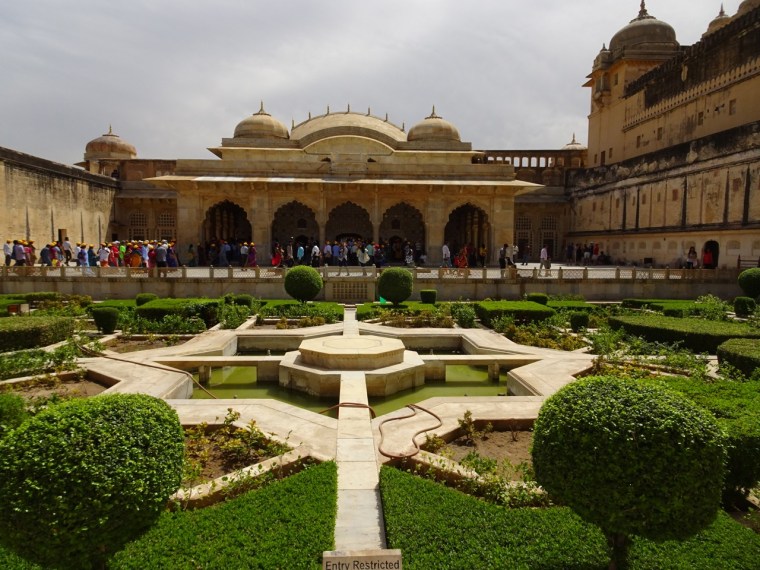
Jaipur’s list of attractions was unexpectedly wonderful. The Amber Fort is perched halfway up a hill on the outskirts of the city. It was the main hangout for Raja Man Singh the first and his twelve wives. Man Singh was the Kacchwaha or King of Amber, a state later known as Jaipur and when he wasn’t off conquering other lands spent his time entertaining his twelve wives, and a bunch of mistresses by all accounts, all of whom seemed bound up within the strict limits of their status and gender.

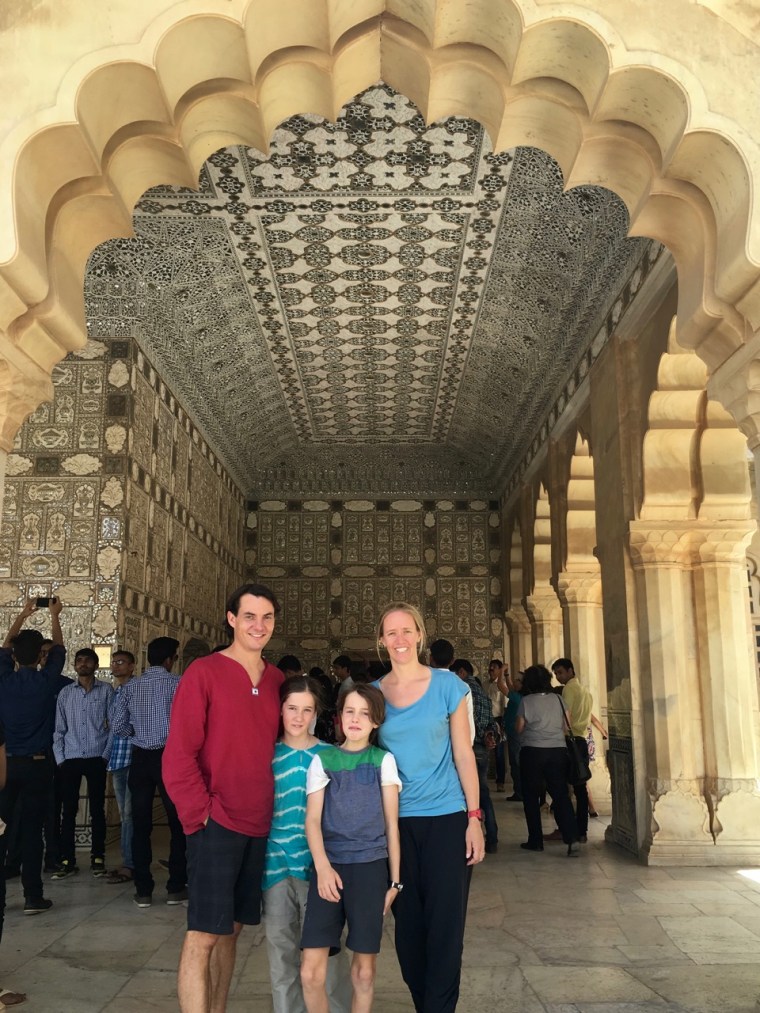
One of Man Singh’s wives loved gazing at the stars but rules dictated that it was not appropriate for her to sleep in the open air. Humans are so random. Anyway, instead of changing the rules the Man Singh put in a mail order for the very finest glass tiles available which just happened to be from Belgium. Ten months later they arrived and Man Singh built the ‘Sheesh Mahal’; a stunning bedroom plastered with thousands of sparkling glass fragments. Just one candle is enough to make the whole hall sparkle like a starlit night.

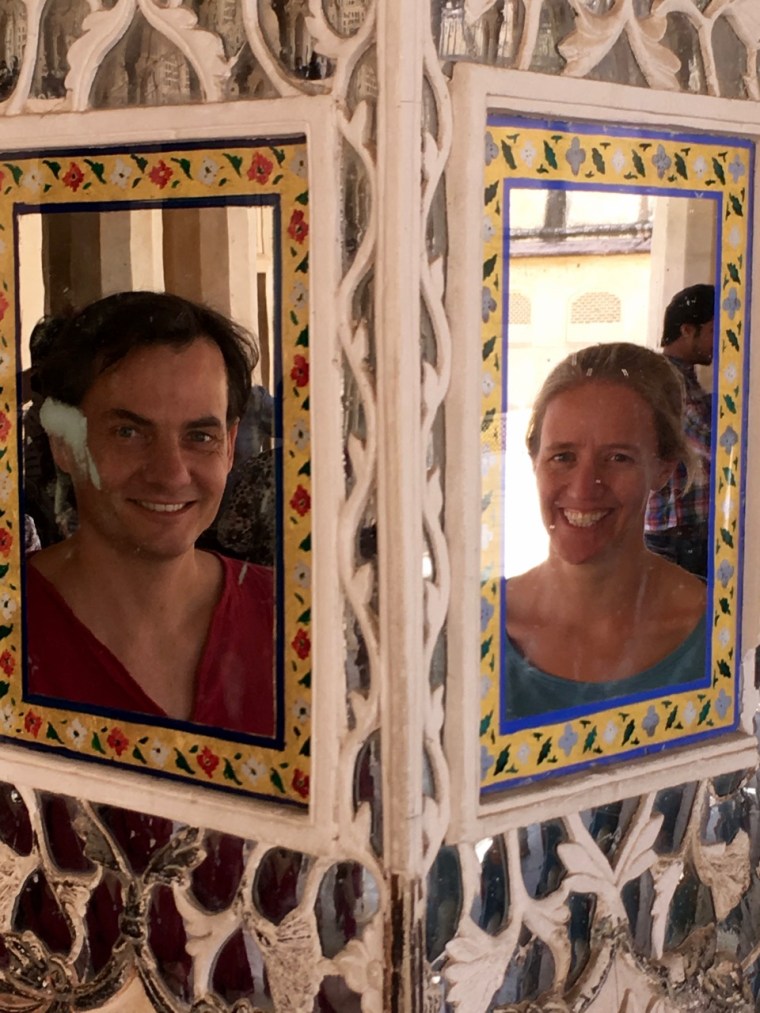
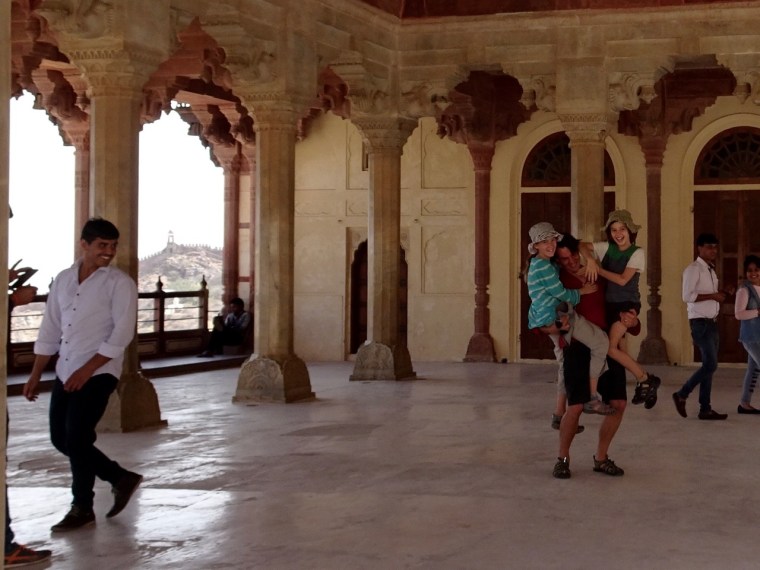
Today, shining an iPhone torch on the ceiling of the Sheesh Mahal creates the same star-lit night effect, even in the middle of the day.  Our guide showed us how to take some tricky photos with the mirrors that other tourists just couldn’t figure out.

DSC03600
Original paintwork made from crushed gemstones
DSC03638
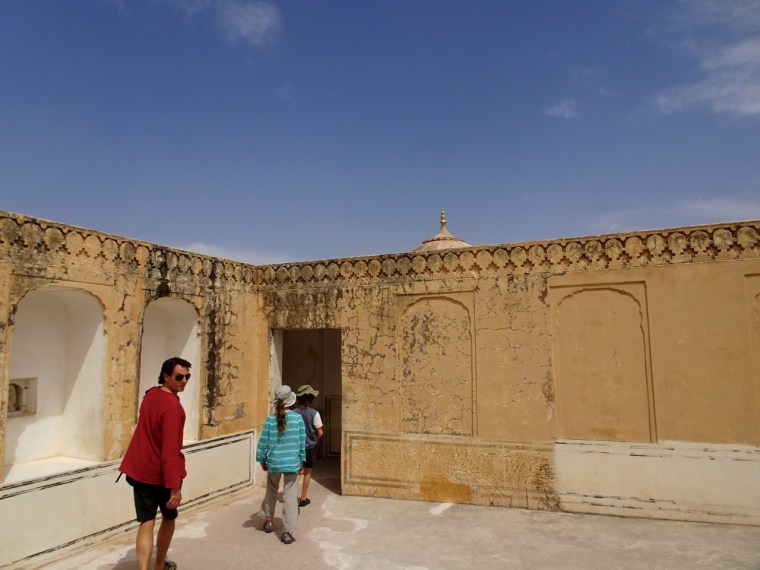
Inside Amber Fort
IMG_1073
Sheesh Mahal
IMG_1077
Sheesh Mahal mirror tricks
DSC03616
The king would sit in the middle watch musicians and dancers
DSC03594
Working on getting the kids in the photos

At the Jaigarh Fort we played round two of a new game that is emerging for us as we travel. We call it, ‘How to ditch the dude’. Round one was played back at the Beng Mealea temple back at Angkor where we unwittingly picked up a local who appeared intent on inserting himself into our little party as a guide. It was a little awkward because we really weren’t looking for company on that occasion. Unsure quite how to avoid making a scene we sat quietly as he moved on ahead urging us to follow. As we sat we quietly discussed, ‘how to ditch the dude’.

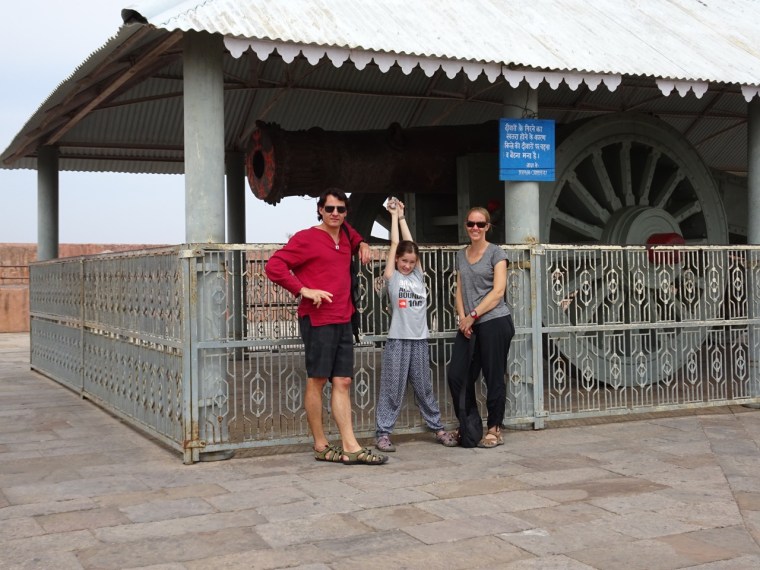
At the Jaigarh Fort we turned a corner in the maze like interior corridors of the huge complex and were again picked up by an unsolicited helper. This may have been fine except that 15 minutes before yet another helper had already taken it upon himself to explain to us the history of the ‘worlds largest cannon on wheels’. This was great but when the unsolicited tour ended it became abundantly clear it was not free.

‘Tip, as you like it sir’, he indicated to me confidently. ‘Oh, oh ok’, I said as I fumbled through my wallet for some rupees to buy our freedom. The same thing had happened back at Kolkata airport with a guy who jumped in uninvited to load our bags into the taxi and when we were boarding the train to Bangkok back in Thailand. We still haven’t mastered the best way to approach the whole unsolicited help thing yet.

DSC03760
Worlds largest cannon on wheels – towed there by 4 elephants

We followed our next helper along, quite unsure whether he worked for those charged with looking after the Fort or not and just what this bit of guiding was going to get us into. We all looked at each other and whispered something under our breath about another game of ‘how to ditch the dude’. It turned out to be easier than we expected when drums started beating elsewhere in the fort and he dumped us and ran off without a backward glance. We did an about turn and retreated the way we had come before he re-emerged. Another dude successfully ditched without diplomatic incident!

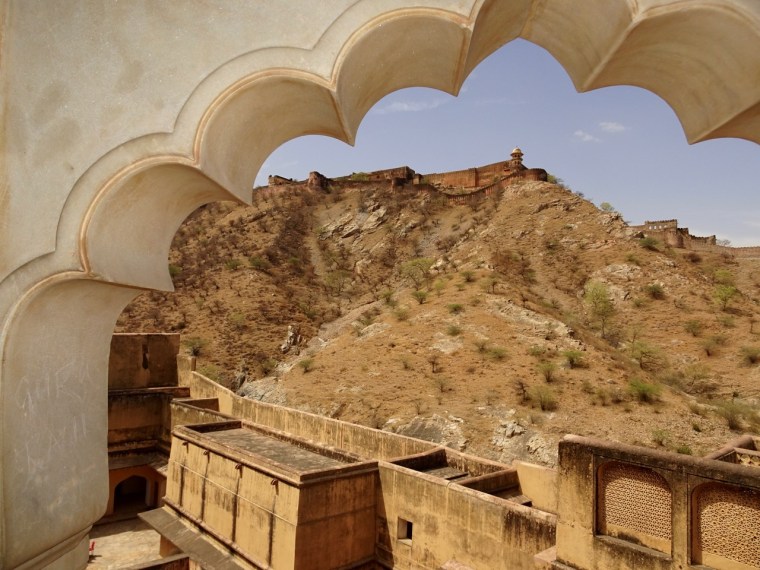
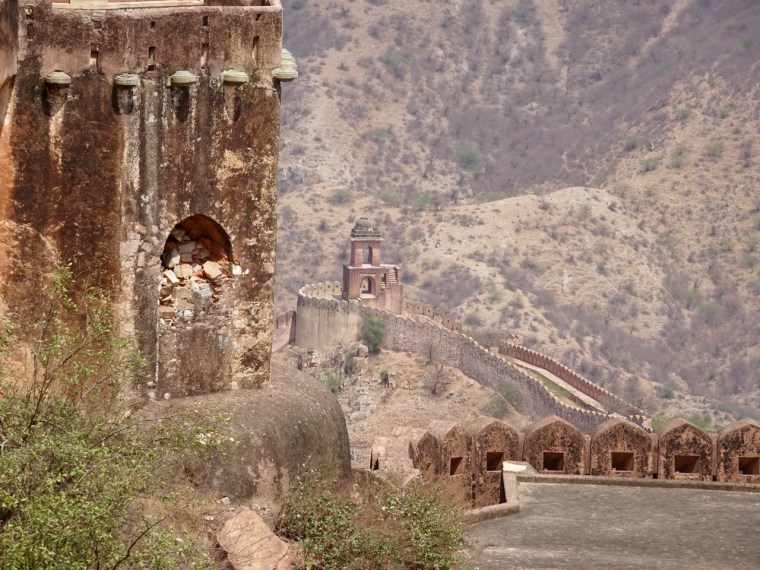
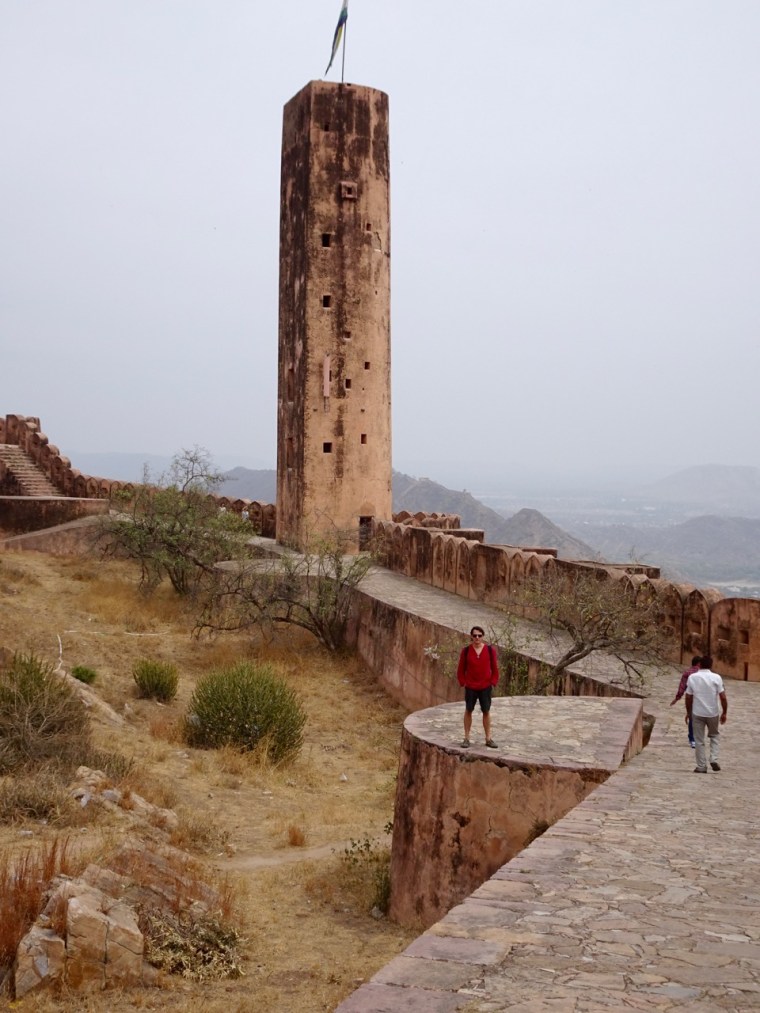
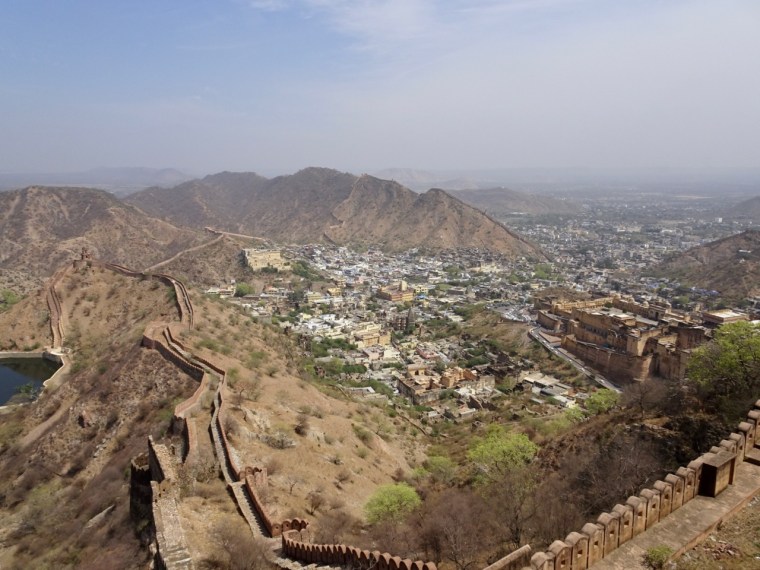
The Jaigarh and Amber fort’s are really part of the same complex despite being built some 500 years apart. Perched high on the hills above Jaipur, Jaigarh is around a thousand years old, Amber roughly 500. Even today they evoke the romantic image I have in my head about India of bygone times. Gorgeous archways frame magnificent views over the countryside and Great Wall of China style defences encircling the complex for 12 kilometres below. These were halls of royalty, wealth and privilege and visiting them even 500 or a thousand years later felt like taking a sneak peak into the goldfish bowl of the Indian elite from another time.

DSC03630
Looking up at Jaigarh Fort from Amber Fort
DSC03848
Jaigarh Fort
DSC03771
Jaigarh Fort
DSC03772
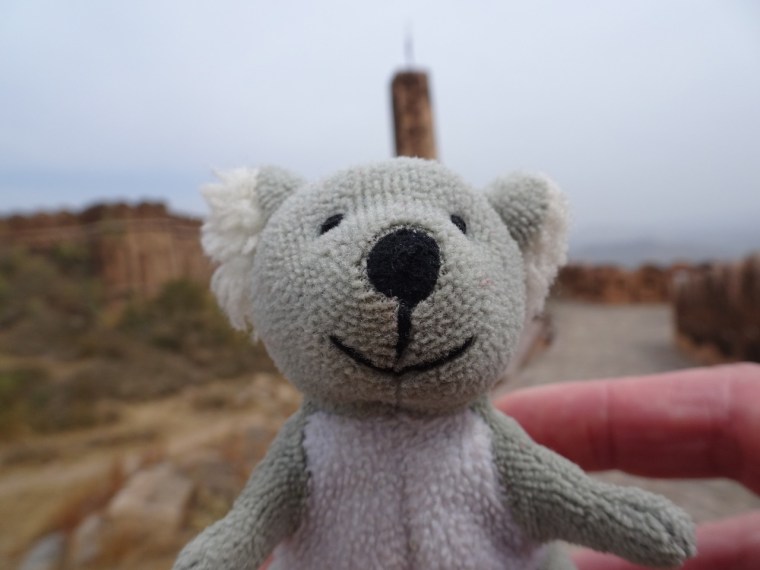
Kwalee enjoying Jaigarh Fort
DSC03799
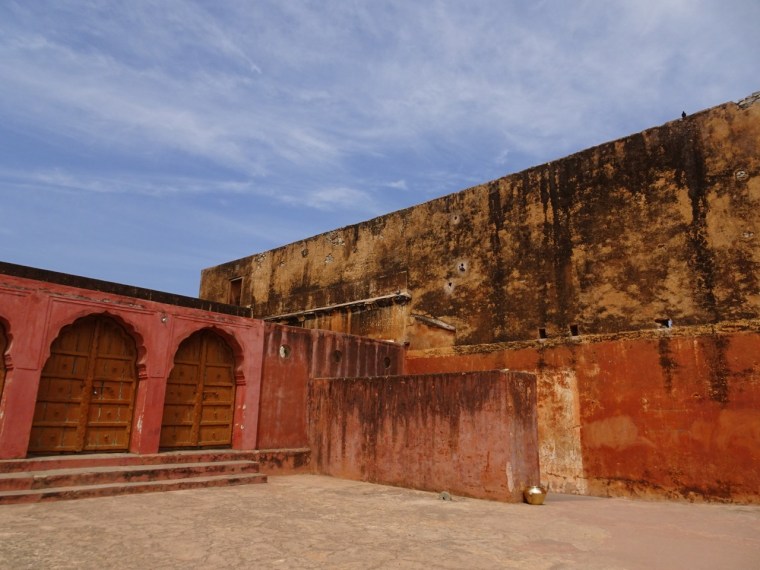
Beautiful colours in this courtyard
DSC03826
Some of the wall
DSC03844
Fancy gardens in Jaigarh Fort

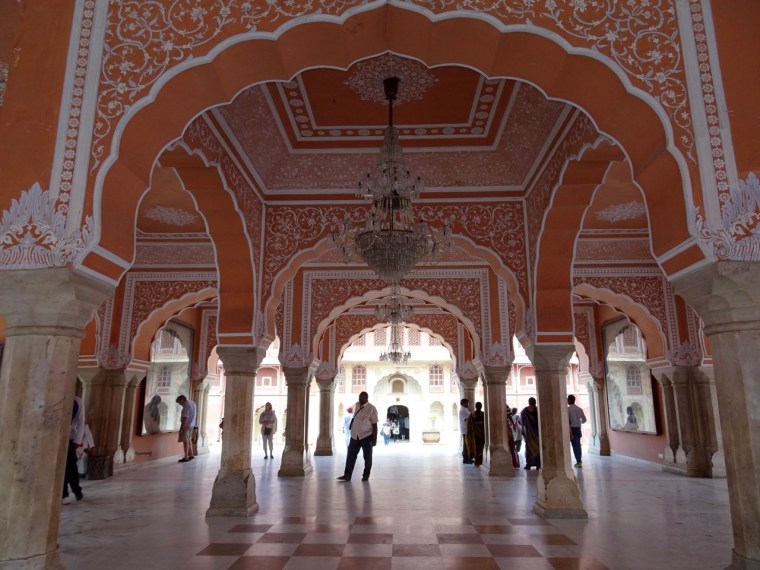
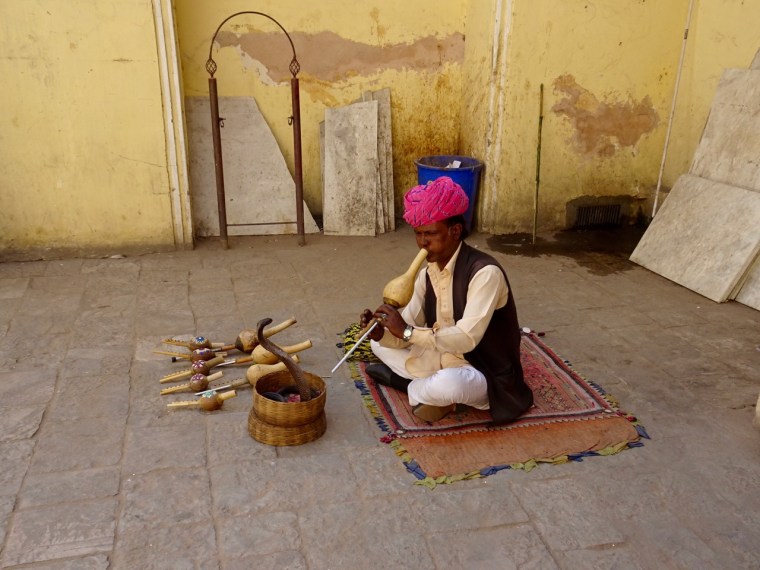
The Jaipur City Palace I found to be somewhat less impressive although there was a snake charmer at the front entrance. I couldn’t quite believe my eyes. Really, I thought. They actually do that? Apparently so, because there was a live cobra, hood extended and twirling away out of a little wicker basket as its master played his Indian thing-a-ma-jig. I couldn’t help but snap a photo although I’m not really sure I ought to have been encouraging the practice.

DSC03723
Beautiful doorways at City Palace
DSC03727
Inside City Palace
DSC03710
Snake!

Four days in Jaipur done, on our next stop we will be further from the goldfish bowl than ever before. We’re off to Baran to meet Remlekha, a girl we have been sponsoring through World Vision for the last nine years. We will be the first World Vision sponsors to visit her villiage and I’m really excited to meet her.

Angkor observations

Angkor Wat. Long has it loomed in our imaginations and as our tuk tuk circled the entrance I whispered in Emma’s ear that I couldn’t really believe we were here. It was one of those moments where I become acutely aware of time. A place like this fires the imagination and motivates you to get out and see the world. It’s the sort of place that inspired us to stop work for 12 months and pack up our lives into a shipping container and a few backpacks. And there we were, looking at it. Briefly. So long in the imagination, how quickly the visit goes.

DSC03049
Angkor Wat

Many of you have probably been to Angkor yourselves or will have seen documentaries about it. So you don’t need me to tell you it is a wonder of the ancient world worthy of the title ‘wonder’. It is a monumentally large collection of stones; each, as far as we could tell, individually crafted to fit seamlessly next to the ones that surround it to produce a building that is hugely impressive.

I have come to think of Angkor Wat itself as a monument to the equally monumental insecurity complex of King Jayavarman VII. Jayavarman VII, you see, came to power by dubious means; murdering his uncle the rightful king to seize power at the tender age of 14.

Knocking off your uncle to become King however doesn’t tend to inspire others to keep following you for long and so the young Jayavarman needed a way sure up his reign. Of course the best way to do this is to have your minions build something so big and impressive that your god-like status becomes unquestionable. It worked and 800 years later here we are ‘oohing’ and ‘aahing’ along with a couple of thousand others as we crawl all over the legacy of Jayavarman VII’s ambition and insecurity.

When I feel insecure I mostly tell myself to ‘suck it up’ and get on with it or dump my worries on Emma who tells me ‘she’ll be right, we’ll work it out’. Maybe it’d be better if I built something. Well not me of course, but my minions. No, wait. I don’t have any minions. ‘Suck it up’ is better.

Where was I…

Oh yes, ‘oohing’ and ‘aahing’. Emma and I were ‘oohing’ and ‘aahing’, along with our new friends Andrea and Peter from Canada. We really have met some wonderful people on this trip. Amy and Oliver along with Andrea and Peter’s kids Sydney and Tobin were melting and dare I say it, moaning. Not that I hold that against them. Siem Reap is really hot. It was 37 degrees as we explored today’s temple and this place may have fired mine and Emma’s imaginations, but that makes it our dream, not theirs.

We towed Amy and Oliver through the temples like they were our minions (maybe I do have some after all) doing our best to explain why it was all so great. Before we arrived we had all watched a few documentaries about Angkor and so I think they got it to a certain degree. Despite our best efforts however I suspect that from their perspective one stone pile soon began to look much like the next especially as they felt like they were slowly roasting in an oven on low heat.

IMG_0963
Amy and Sydney find a place to chat
DSC03105
Oliver and Tobin found a shady spot to ‘play’

On another family’s travel blog we recently read what one of their children reflected in his journal about his experience of Angkor Wat:

“Mom took us to see an impressive, large, ancient, temple ruin filled with exquisite stone carvings… and then, she took us to see five more.”.

That probably about sums it up for Amy and Oliver I think. The same family said if they made a movie of their visit it would be titled, ‘Angkor Wat and the search for shade’.

We caught our first glimpse of Angkor at around 11.00 am on the day after we arrived. Andrea and Peter had arranged a tuk tuk driver and we figured we would grab another and follow along. Of course arriving at this time is completely the wrong thing to do. According to the Siem Reap, Angkor Visitors Guide:

‘The visual impact of Angkor Wat, particularly on one’s first visit, is awesome. To maximize this effect you should make your first visit in optimal lighting conditions, after 2.00pm when the sun is on the face of the temple. Do not make your first visit to Angkor Wat in the morning when the backlighting obscures the view.’
Yep backlighting is a problem. It ruins the photo and photos after all are why we come – right?

DSC03186
Backlit at sunrise too

If you were a visitor from outer space observing the scene you could reasonably discern that touring Angkor is not permissible unless accompanied by some form of photographic device. They’re everywhere; looped around wrists, hanging around necks, go-pro strapped to heads and phones strapped to selfie sticks.

DSC03223
Some of the eager photographers just after sunrise

If you can permit a small diversion from the story, back in Bangkok we were squeezed into a minibus like sardines on one occasion and couldn’t help but look over the shoulder of the lady in front of us as she reviewed the photos on her phone. She went through what surely must have been more than a hundred selfies in front of various attractions. There wasn’t one in which she did not feature.

It is astounding the extent to which Angkor and all the surrounding temples are photographed. Equally astounding can be the behavior of people in search of a photo. Just today, Amy and I were happily looking over a parapet at a fallen tower of Jayavarman, taking in the crumbled piles of moss covered stones within the still standing skeleton of a once huge temple when we were tapped on the shoulder and asked to step aside.

‘What for?’, I asked in a disgruntled tone of voice.

‘Photo’, the man replied gesturing towards his camera as the obvious reason why it was important that Amy and I instantly move out of the way to make room for his significant other to stand where we were. I confess to being annoyed, though Emma quickly counselled me not to let it ruin my day.

DSC03293
Waiting for the ‘photo spot’ at Ta Prohm Temple (of Tomb Raider fame)

It was indicative of the extent to which cameras dominate so many peoples experience, including ours. I confess to being snap happy too, though I try as much as possible to point the camera at the scenery rather than myself or even Emma, Amy or Oliver. If touring ‘five more temples’ in the baking heat after the first ‘really cool’ one isn’t enough to try your patience, then being asked to smile or turn so you face the other way while someone else points a camera at you certainly will.

Nobody ends up happy. The photographer is frustrated by an un-cooperative subject while the subject is frustrated at being used as a prop to enhance the scene. It’s not really as bad as that may make it sound, it just plays out as an unspoken tension simmering below the surface of everything else that is going on as part of your visit right at that moment.

The problem with cameras is that after a while you start to look at everything for its photographic potential, or as illustrated above, just being rude because the photo is more important than being polite. A photographic mindset undoubtedly distracts you from being present, while you are present, in this place that you have wanted to see for so long.

At one point during our visit Amy made a comment to me, the exact wording of which I cannot remember, but to the effect of, ‘all you do is take photos’. It was said in the disgruntled voice of an 11-year-old who thought the first temple was ‘really cool’ but then had to look at five more and who would really rather have been in the pool back at the hotel because it was 35+ degrees.

Her comment made me question what impact my snap happy ways was having on our overall experience. Do I really want the lasting impression I leave from this trip to be ‘my dad was busy taking photos’? Would I be better off focusing my attention on our collective experience of the place and might this in fact have helped others to have enjoyed it more? I couldn’t help but wonder. After Amy’s comment I stowed the camera and started kidding around with Oliver, bouncing him on my back and pretending to be an elephant. This undoubtedly helped lift his experience for a while.

We like taking nice photos and we do use them to share on this blog. I know we have also looked back fondly at the photos from our previous travels from time to time, so they are not a wasted effort in that sense. Still there has to be a happy medium and Angkor Wat has made me think I need to reign it in at least a little bit – it’s not all about the photo and backlighting shouldn’t be allowed to diminish the experience.

DSC03112
Angkor Wat exploring
DSC03063
One of the many amazing carvings depicting Hindu mythology
DSC03072
Emma bought the guide book

So on our last day of visiting the temples I didn’t take a single shot, an over reaction for sure. We took a drive through the Cambodian country side to a temple called Beng Mealea. It’s about an hour and half away from the main complex of Angkor. Emma, admittedly, seized the chance to be photographer for the day, but in a more genteel and subtle way perhaps than I. It was here that Amy and I were interrupted from our non-photo minded observations by the photo hungry hordes.

I don’t know if the lack of photography had anything to do with it but this temple was probably everyone’s favourite. It was more wild than the others and there was more opportunity to scramble over rocks and climb vines, so that no doubt also played a part.

DSC03462
Taking time out from being photographer at Beng Mealea
DSC03446
Enjoying the vines
DSC03479.jpg
Selfie!

There is however nothing better than a pool and we did only visit Angkor every second day which ensured Amy and Oliver had plenty of time playing with their friends. In fact, thanks to Andrea and Peter, Emma and I actually got to spend 4 hours looking at Angkor on our own while Amy and Oliver played back at the hotel.

Amy and Sydney spent most of their time in the pool while Oliver and Tobin bonded over games on my phone. Not ideal perhaps but they were having so much fun. Unfortunately, the pool did nasty things to the girls hair. I’m pretty sure Cambodia does not apply Australian pool chemical standards and we were going through a bottle of conditioner a day for a while, trying to repair the damage.

At least we had a pool though. Chatting with our driver on the way to the Beng Mealea temple was something of an eye opener. Cambodia may once have been the centre of a vast and wealthy empire overseeing the better part of south east Asia, but that of course is not its lot today. Peiron (our driver) dropped us at the gate of our hotel after the day out and looked on almost wistfully as we disappeared to get into our swimmers. ‘Very hot’, he had earlier told us, ‘Cambodians no have pools’.

Siem Reap exists today to service fly in fly out tourists visiting Angkor. It and our hotel is a world apart from the real Cambodia we caught only a glimpse of through the window of our air-conditioned car. Alas we are out of time to see more. On the positive side we did enjoy the Phare Circus one evening. The circus is part of a social enterprise formed after the fall of the Khmer Rouge. As the website says:

“… formed 20 years ago by 9 children and their art teacher when they returned home from a refugee camp after the fall of the Khmer Rouge. As survivors of the war, empowered by the creative self-expression learned through their art-making, the group wanted to share this gift of the arts with the underprivileged children of Battambang. They founded an art school and a public school quickly followed to offer free education. A music school and theatre school were next, and finally, the circus school. Today more than 1,200 pupils attend the public school daily and 500 attend the alternative schools.”

IMG_1047.jpg
Phare Circus

The Pol Pot – Khmer Rouge era and its horrors have not been a major feature of this visit for us. We got closest through the personal recollections of another wonderful driver (Mr Khorn) who told us something of his personal experiences as a young boy, including villagers being tricked out to welcome back the king only to be mown down by guns.

DSC03396
Greg with Mr Khorn 

This evening we are off to Bangkok for a night before we leave SE Asia. Our minions have caught up on another dose of school work today and are now building a cubby house in the cupboard of our hotel room.

Enjoy the photos!

DSC03118
Within Angkor Wat
DSC03269
Chau Say Tevoda
DSC03437
Vine swinging at Beng Mealea
DSC03425
Oliver loves to climb
DSC03313
Greg on steps at Pre Rup
DSC03318
Pre Rup posing
IMG_0974
Bayon Temple shady spot
IMG_1200.jpg
Bayon Temple – Angkor Thom
DSC03393
Preah Khan
DSC03246
The best photo