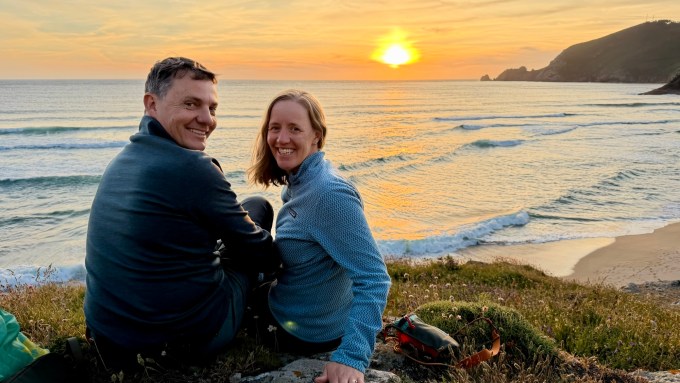
Santiago de Compostela may be the major goal, but for many it is not the end. Count us amongst them (Emma and I in any case). With all due respect to Saint James, we came… More
Our travel words and pictures
Santiago de Compostela may be the major goal, but for many it is not the end. Count us amongst them (Emma and I in any case). With all due respect to Saint James, we came… More
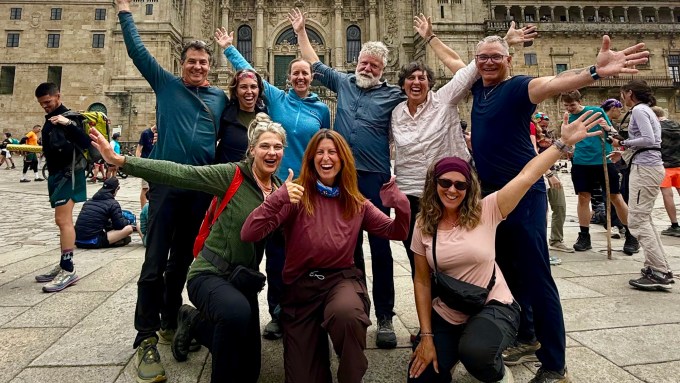
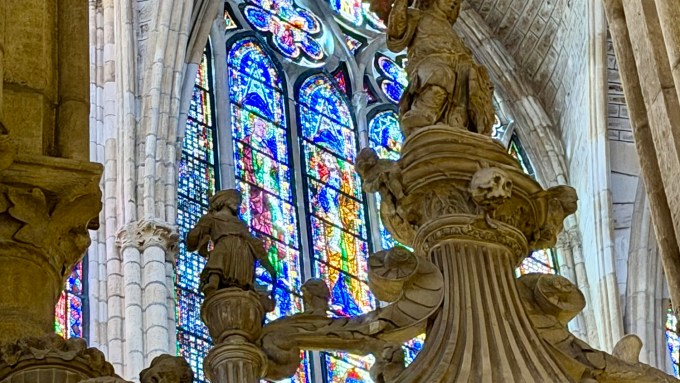
I don’t have much to say. For completeness however, an update seems appropriate. Leon was lovely. The cathedral in particular. It was my favourite of all the cathedrals and churches we have visited so far.… More
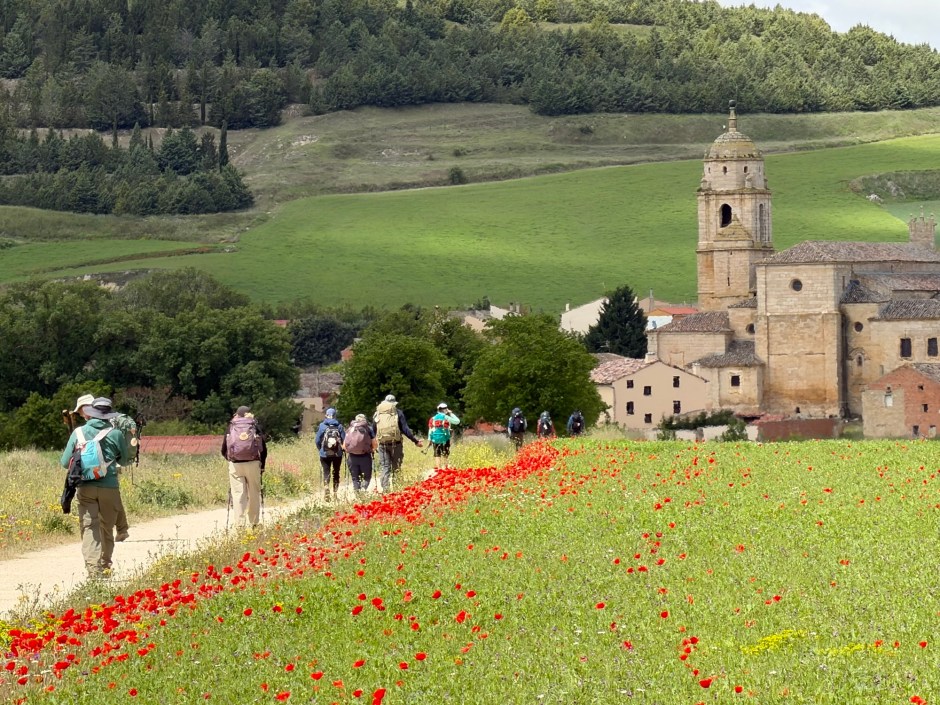
The Meseta was not as advertised. For those who haven’t heard of the Meseta, let me explain.
The Meseta Central is Spain’s vast, high-altitude central plateau, covering over 210,000 square kilometers across the interior of the Iberian Peninsula. More specifically for us and the few hundred thousand peregrinos that pass this way each year, it refers to the 200 odd kilometres between Burgos and Astorga, on the other side of León.
Essentially, the Meseta is mythologised by pilgrims as a long, straight, stretch of, well, nothingness really. Dry, featureless, with a seemingly endless road always stretching beyond the horizon. It is said there is nothing to do but go within and keep on walking.
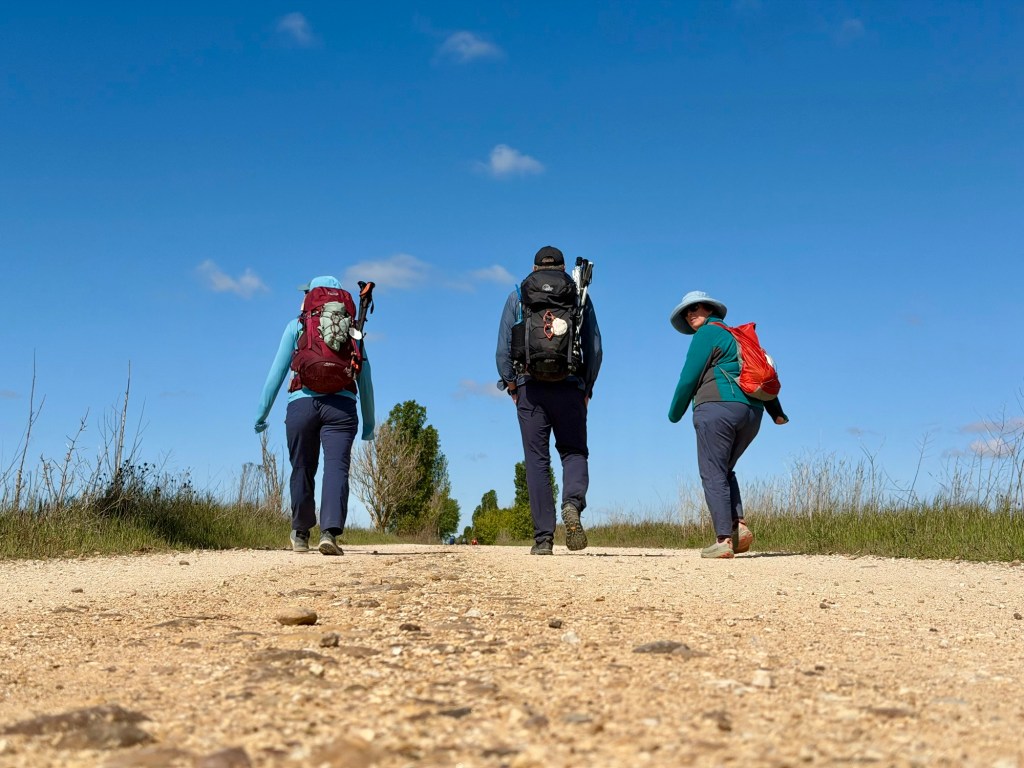
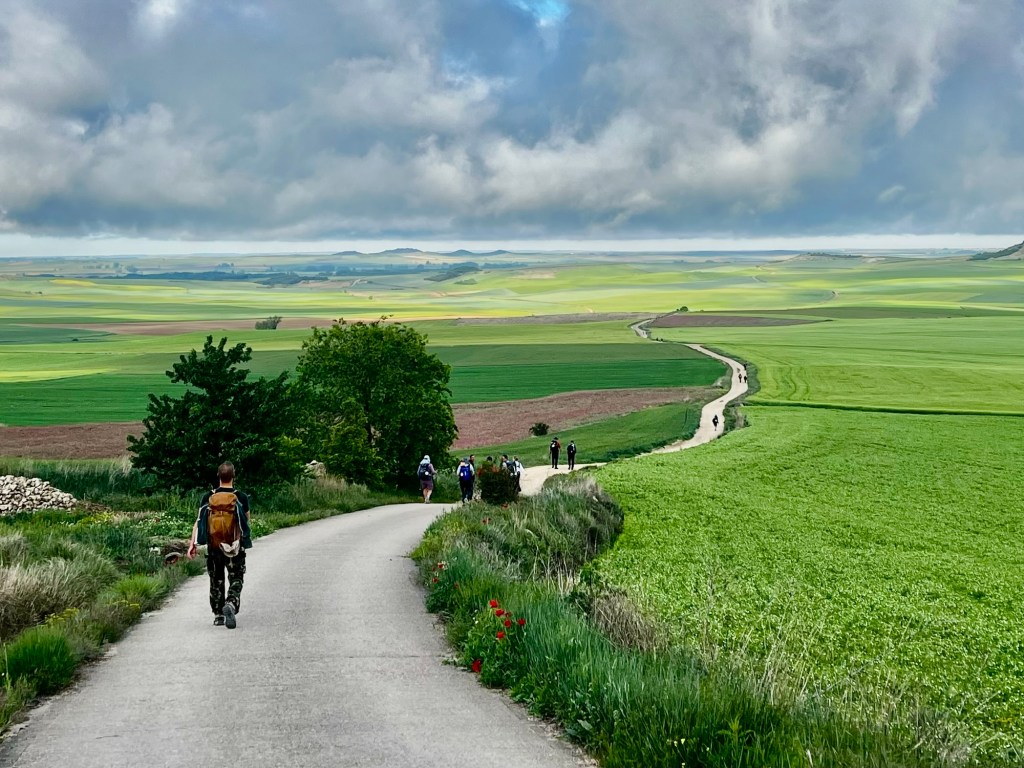
Maybe we’re odd, but this was not our experience. The Camino undulated (gently) up hill and down dale. I don’t think the rest of the world really understands what flat means. They should drive across the Nullarbor. Then they’d get it.
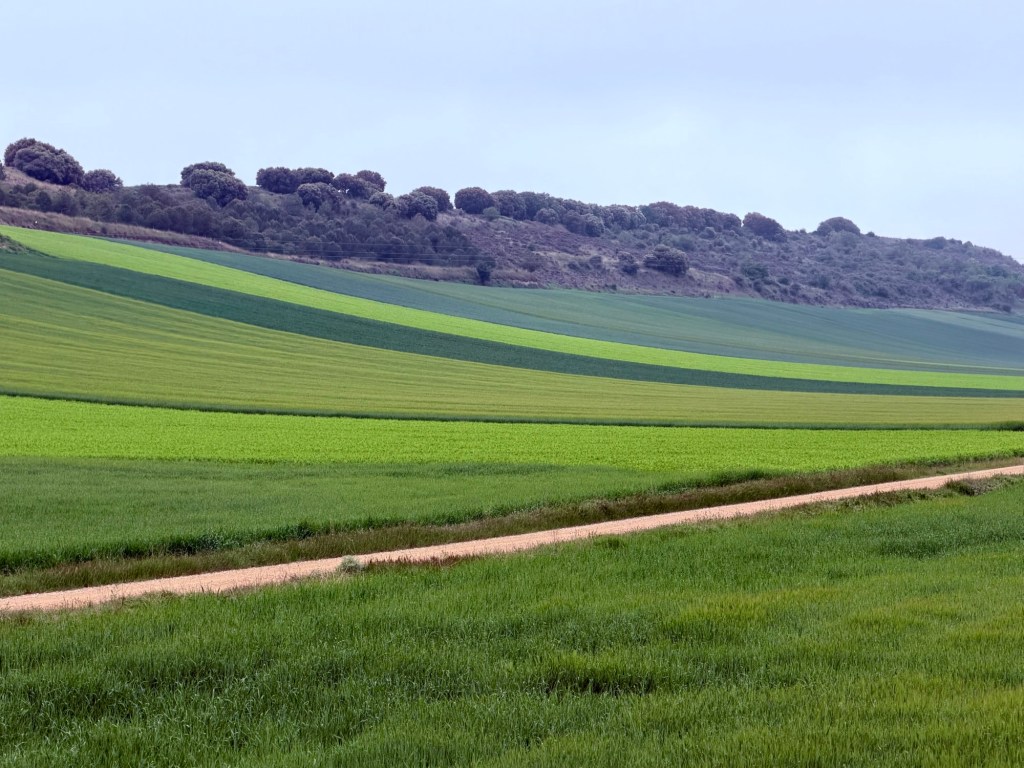
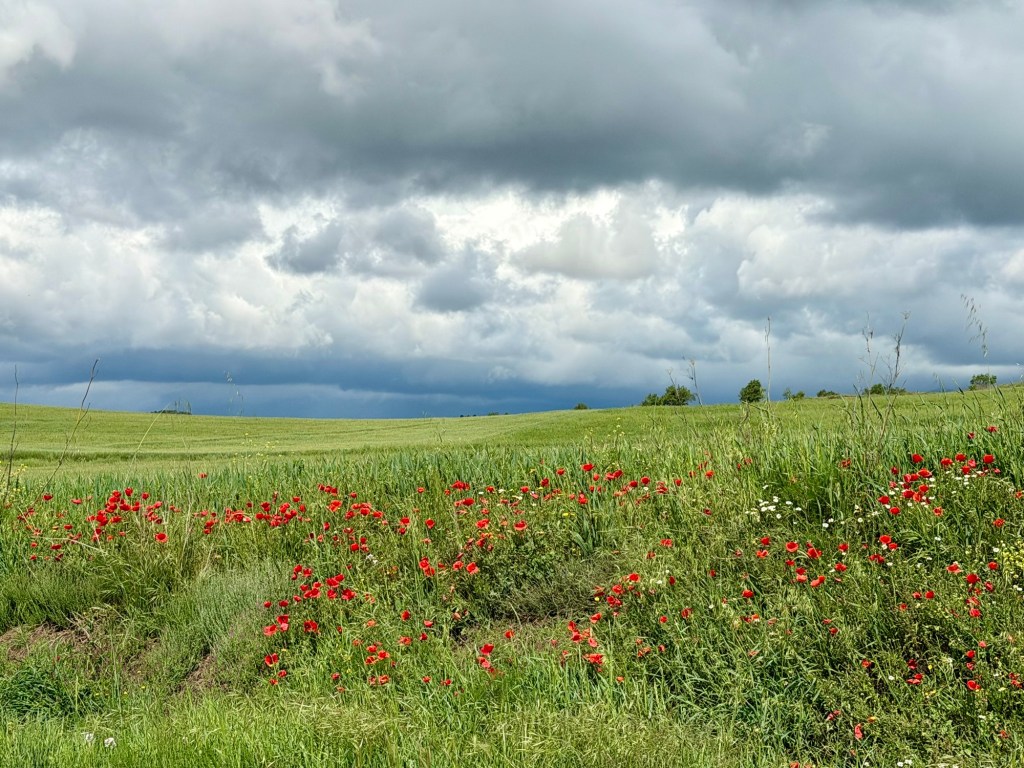
It is also spring, so it turns out the Meseta is vibrant and green, not barren and dry. We were a little early for the sunflowers and corn but the wheat, barley and oats were in fine form, set off by the ever present verge-side flower show to which we have now become accustomed.
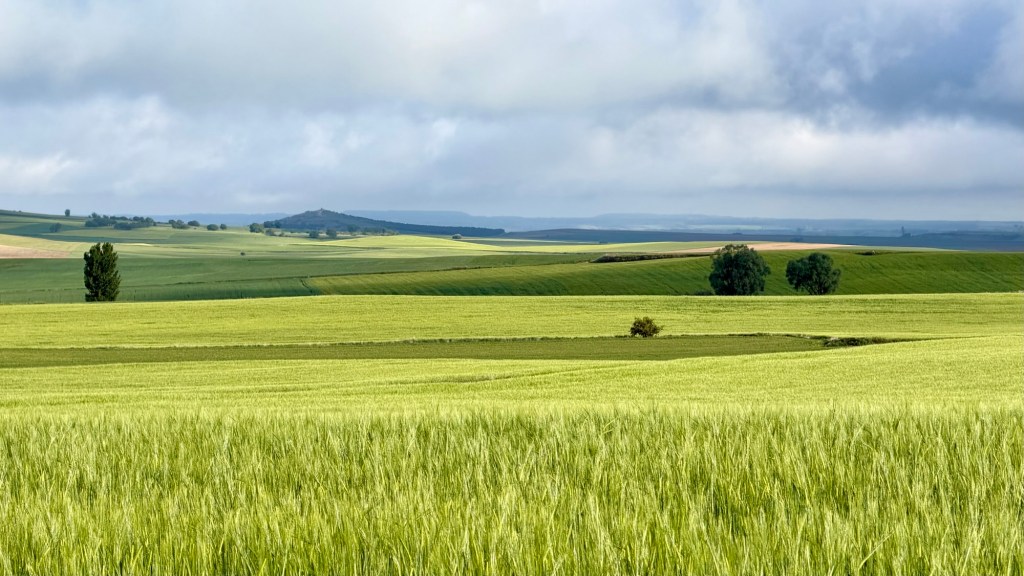
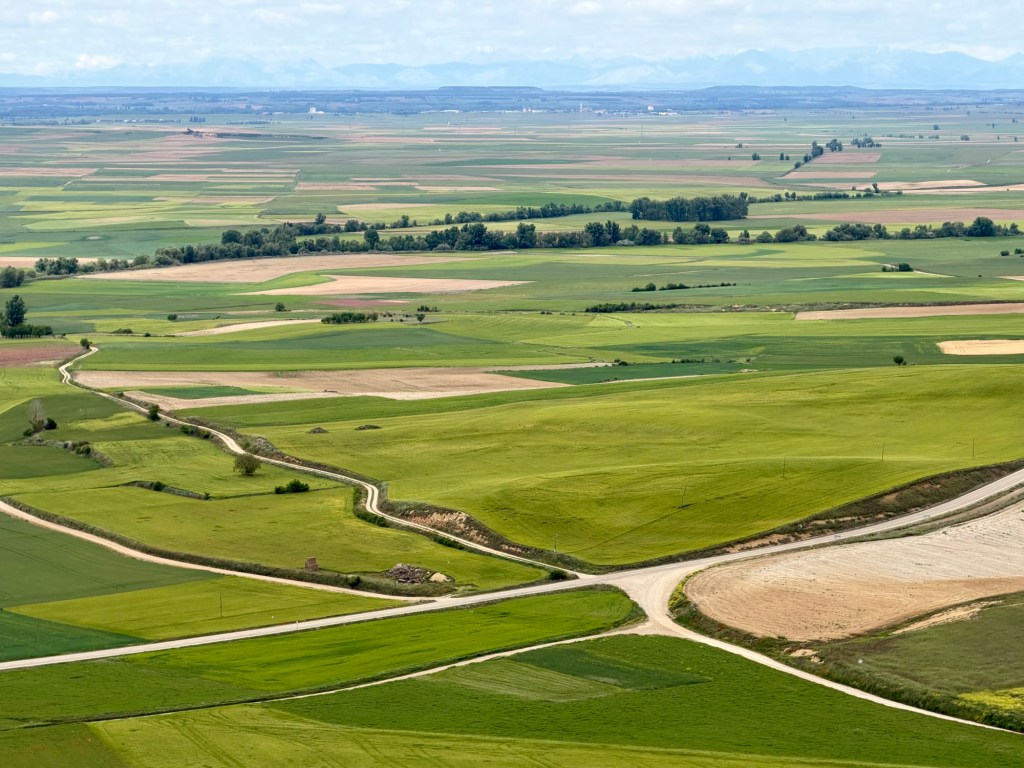
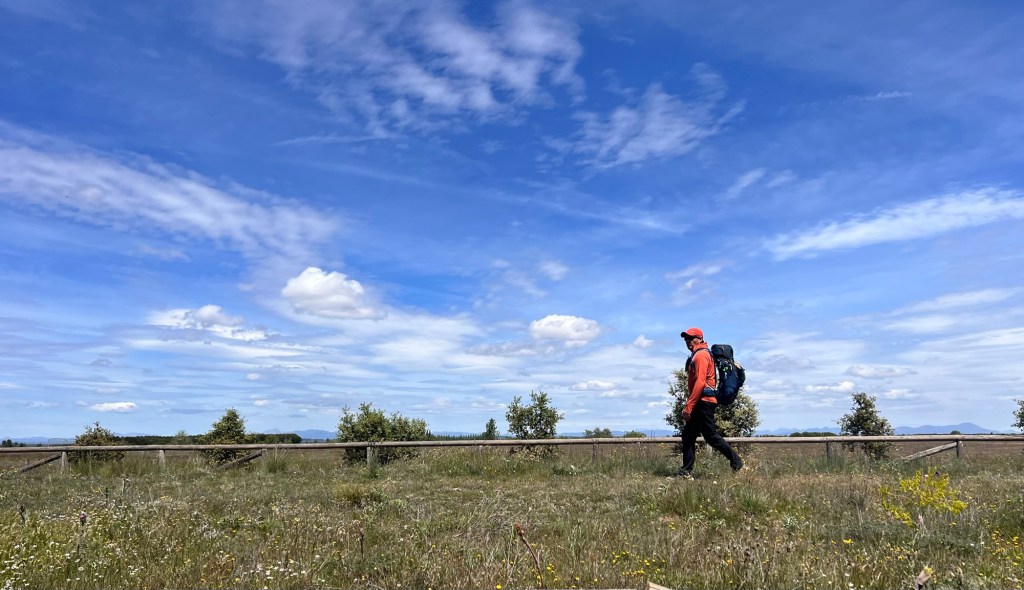
And as for nothingness, well nobody mentioned the Europa Peaks, a snow capped mountain range off to our north. They constantly drew my eye and my adulation as a scenic sliver to accompany the horizon-to-horizon dome of sky. Throw in a conversation with an Anglican minister; the unexpected ruins of the San Anton Monestary; a hilltop castle (complete with with ramparts, groovy stone stairways and vistas as far as you can see); an old Roman road upon which to walk and ponder the union of space and time; and an evening sing-a-long with the nuns of San Augustin – and rather than a long and lonely stretch of road with which to focus on introspection, I felt I barely had time to gather my thoughts.
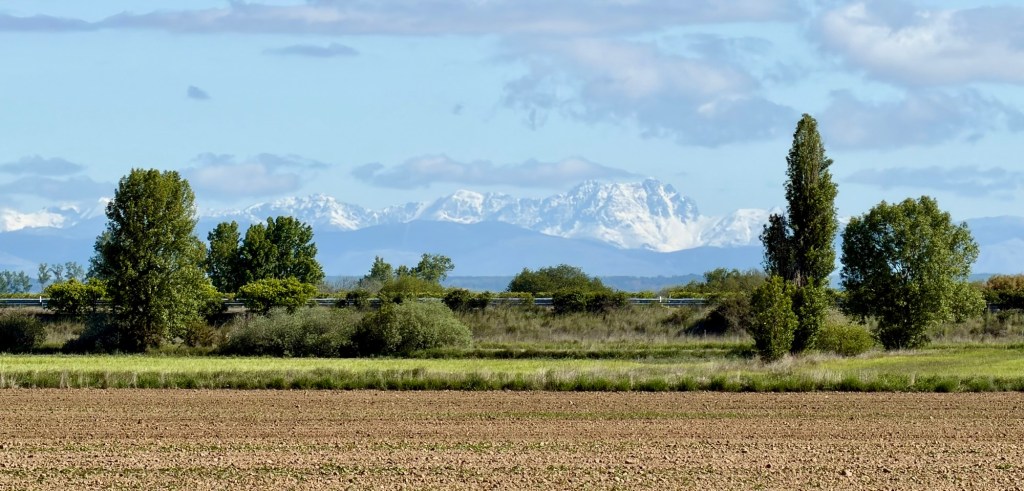
That said, I did find myself humming songs with references to lonely stretches of road… The long and winding road, Hotel California, Country Roads, Life is a Highway, On the Road Again… Highway to Hell. Nah, that would be inappropriate.
In Carrión de los Condes we attended the aforementioned sing-a-long held each evening by the San Augustin nuns.
(It started at 6.00. A detail of no consequence other than the fact that we found ourselves on the opposite side of town at around 5.45. We’d had a long day of walking and Khia advised us all that she was, ‘in no shape to run quickly towards the nuns’. Words Paul promptly pointed out he never thought he would ever hear Khia say out loud.)
The San Augustin nuns handed out a song sheet with the lyrics to various tunes in a range of languages. It also included poems one of which was for pilgrims on the Camino.
‘Nobody went yesterday, Nor goes today, nor will go tomorrow, towards God, along the same path that I do. For each man [or woman – let’s be fair] the sun holds a new beam of light and a virgin path. (Leon Phillips)
In essence, a few hundred thousand people may walk this path every year, but none of them have the same experience.
A bit like at our very first night on the trail back at Borda, the nuns kicked off their understated event by inviting each of the 30 to 40 people there to talk briefly about where they were from and why they were walking.
The sister’s themselves were warm and engaging and surprisingly young. They made it their business to see pilgrims, ‘as more than the bed numbers ascribed to them’. It was touching, as was their blessing and the stories of those present.
One woman’s son had died walking the Camino. She was clearly grieving. We felt her pain. She was walking with her father, presumably as part of the process of coming to terms with the loss. Another lady had a scare with cancer. She and her husband had decided that when and if she got free of the disease they would get out and walk. She choked up and she tried to explain this to this group of strangers. Her husband gently clarified once she had finished. Then there was this thread of stories oscillating around the notion of change and transition. People laid off from their jobs, relationship challenges, and other life shifts. Some were just in it for the adventure. They were all here taking a pause from regular life, walking the Camino.
While everyone’s rationale for being here was different, they all seemed to have one thing in common. On the Camino, people wear their struggles on their sleeve and ask, ‘why are you walking’, before they get anywhere near ‘what do you do’, if that even comes up at all.
We all struggle from time to time, even if our struggles are different. Viewed this way, are we as individual and alone as we often feel? And is our experience of the Camino as different as the poem above suggests? Furthermore, are each of us one element of a bigger whole to which we all belong?
Paul and I had been contemplating this question for some kilometres beforehand, including whether it was ‘God’ or some other unifying whole to which we all belong. It’s hard not to contemplate God and the church when walking the Camino, it is after all a Christian pilgrimage and the reminders are everywhere.
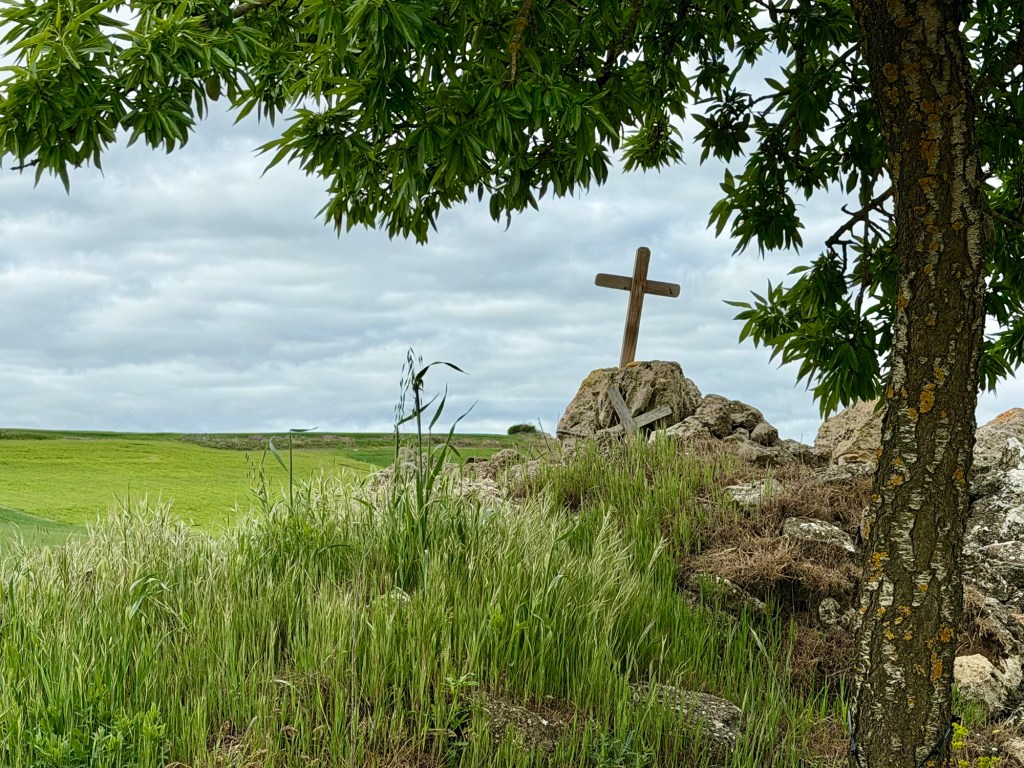
I posed this same question to Nigel somewhere between Hornillos del Camino and Castrojeriz. We first met Nigel and his wife Nikki on the flight out of Sydney. We had spotted each other as likely pilgrims from amongst the hoards of travellers boarding the plane. When finally crossing paths on the Camino and with a chance to chat, it turns out that Nigel is an Anglican minister.
I decided that if I could not ask blunt questions about God, Jesus and the Church of a minister while walking the Camino, then there was nowhere that I could. So I asked Nigel what he thought of the idea that we were individual and collective beings all at the same time. That, however, was just the warm up and it wasn’t long before I was quizzing him why he even believed in God to begin with?
I dived in boots and all, like an episode of ‘You can’t ask that’, laying out all my problems with the existence of an interventionist God. If God exists why would he look after the prayers of some but let whole populations starve to death? Why would God inflict pain and suffering on innocents? Why would God make some people sick and not others? Why did God set up a system where people were even tempted to sin if he had such a problem with that? And why was the church so damn good at making people feel bad about themselves?
We must have walked and talked for an hour or two and to be honest it felt good to ask these questions freely – as opposed to my usual stance of projecting respect for another’s beliefs while quietly thinking them quite mad. I’m still processing Nigel’s responses to my questions. I’m not sure he convinced me (or even that he was trying to do so) but he made me think and was open and thoughtful in his responses. I very much appreciated the manner in which he engaged with my scepticism.
Our conversation was interrupted by the unexpected sight of the rather grand ruins of the San Anton Monastery, which seemed to appear out of nowhere down a hill and round a corner of the trail. The monastery had also served as a hospital many hundreds of years ago. People thought that the Tau (T) symbol the monks baked onto their bread would cure them of the wheat disease that had seen people dropping dead left right and centre around that time. The Monestary was quite a fantastic sight, with a bell, which has a story I’ll save for another day.
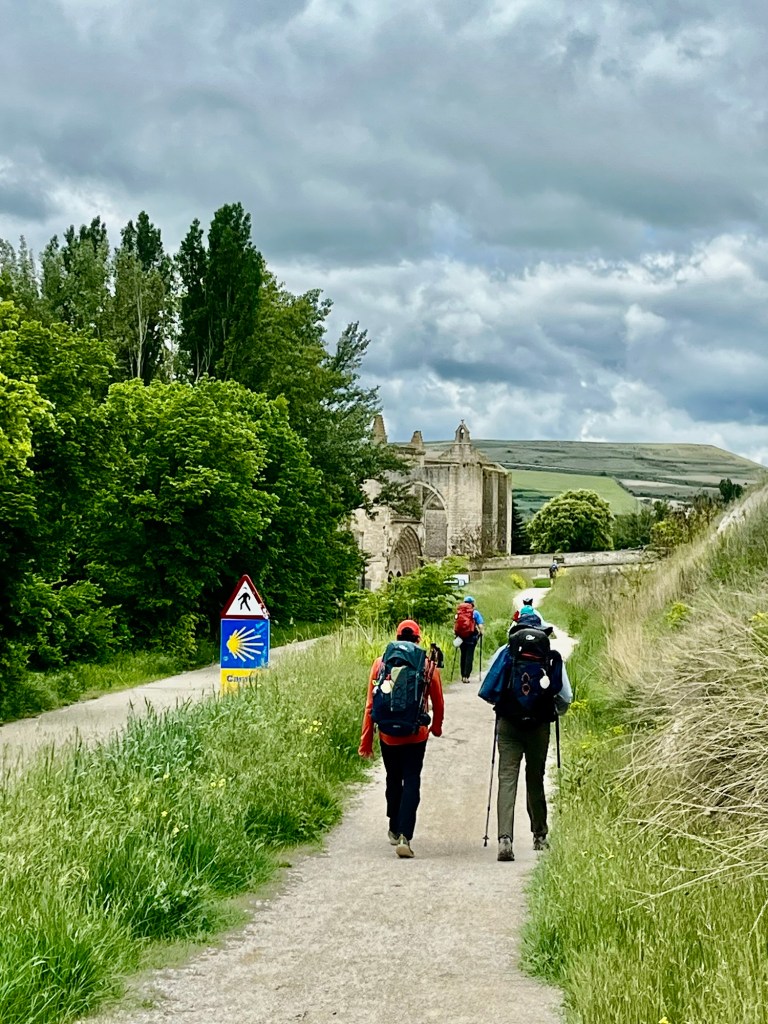
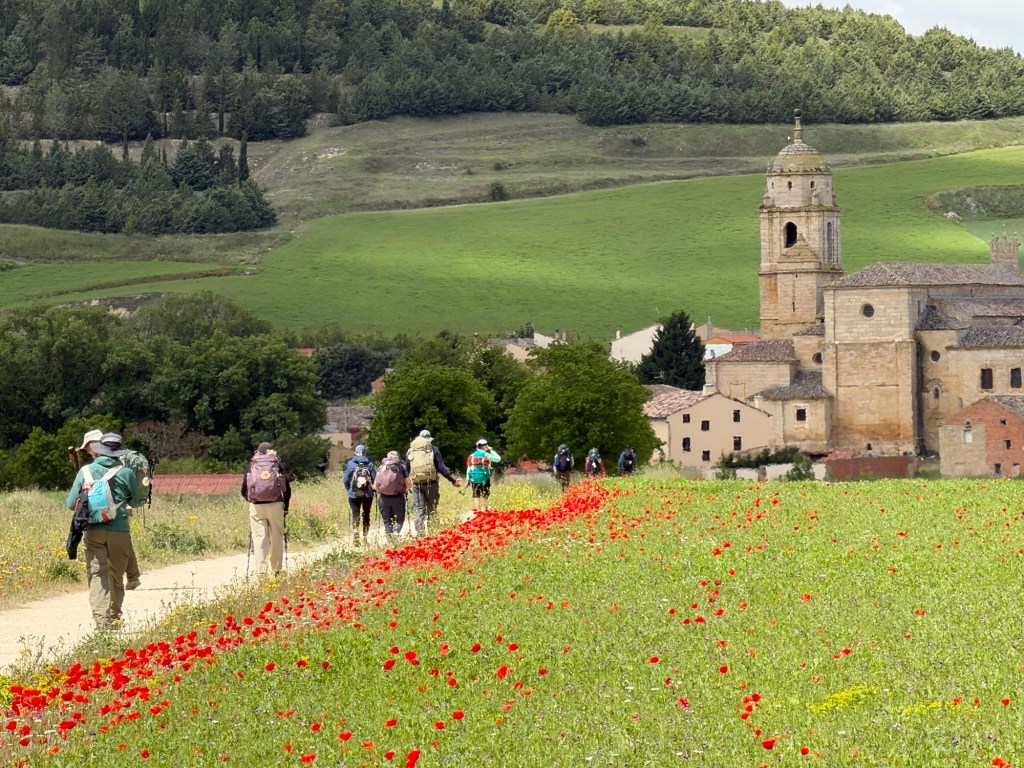
A little further on and one of the most picturesque sights of the Camino stood before us. A long straight stretch of trail, lined on one side by trees, lead a long line of pilgrims towards Castrojeriz with its cathedral nestled at the base of a hill which was topped by a castle ruins dating back to the 9th century. Next to the trail were fields of grain scattered with red poppies. If I have taken one picture to represent the Camino so far on our journey it would be the one below.
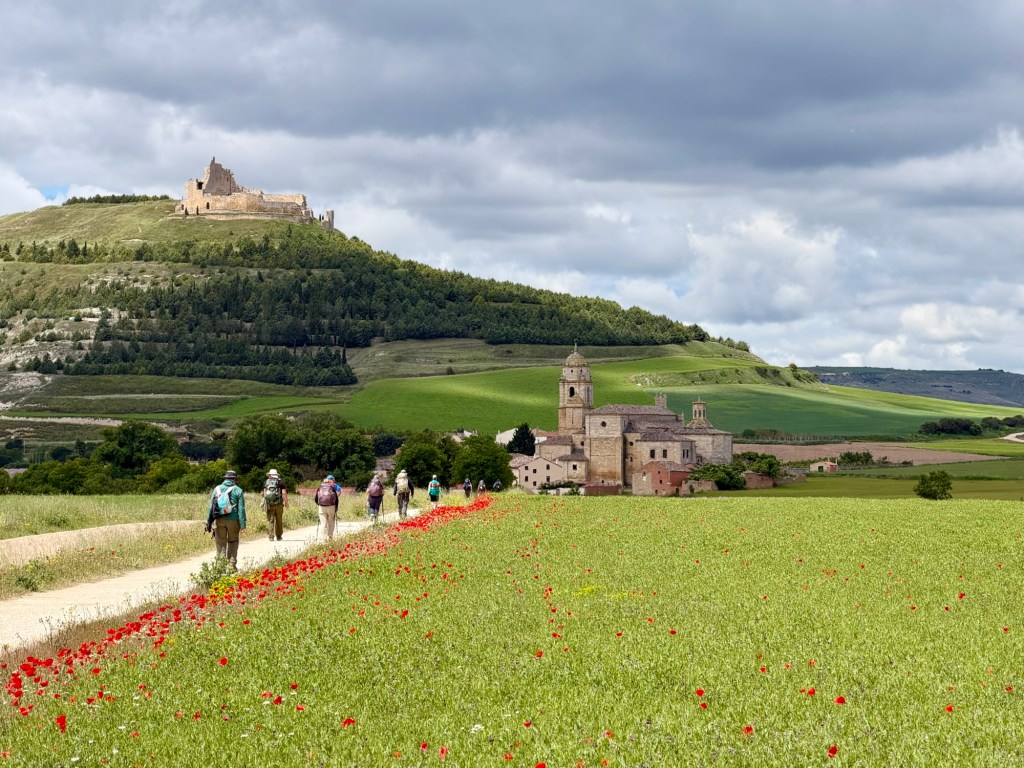
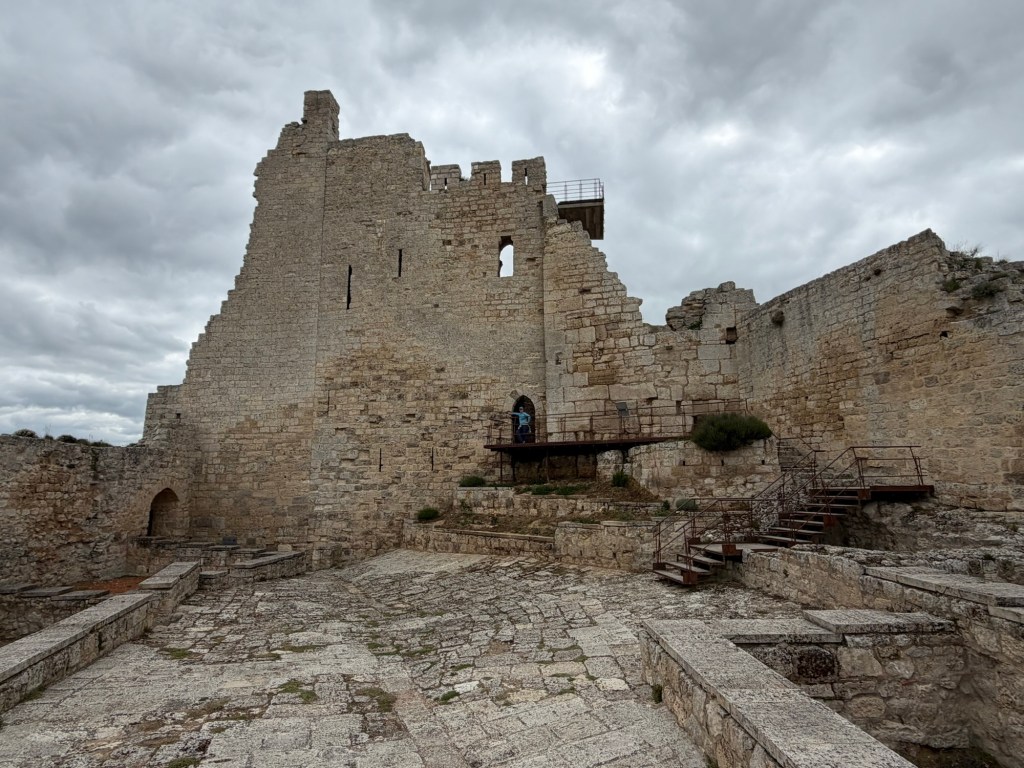
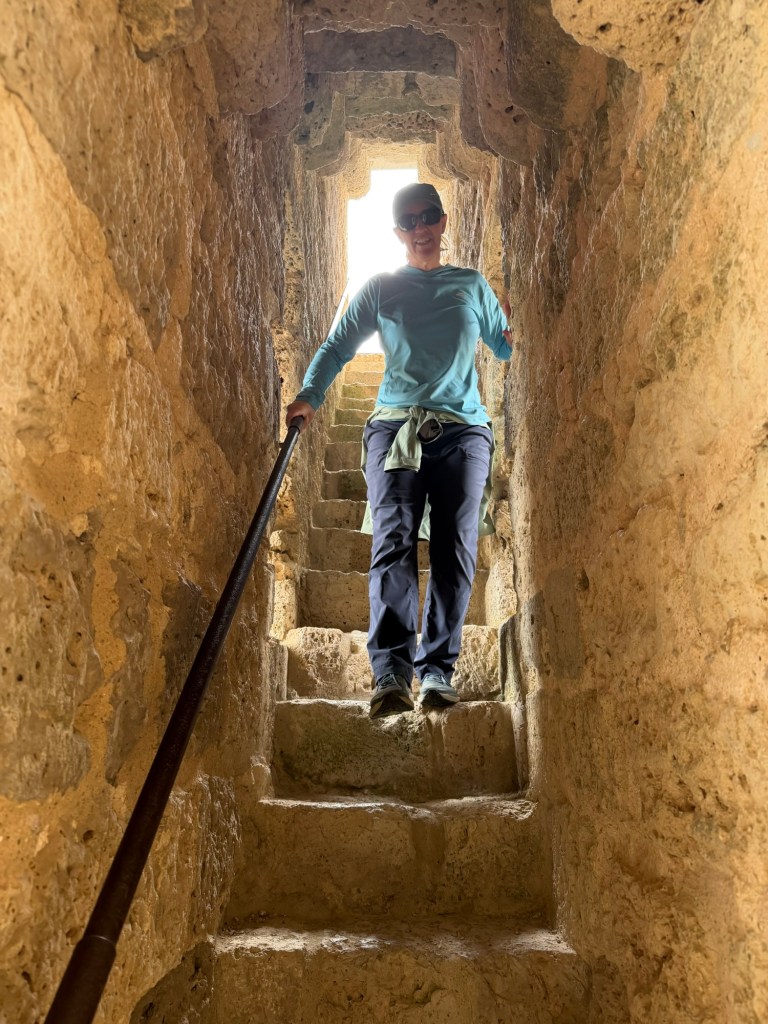
After settling in that evening, Emma and I made our way up the hill to the castle which had proper castle walls, a proper castle courtyard, and the ruins of a castle keep with intact stairways that made their way up through the walls themselves. It was exactly the stuff of the fantasy novels I read when I was much younger.
Somewhere along The Way, the next day, a curious emotion came over me, which gave me cause to ponder, what is this thing that I am feeling? A short time later I said to Emma, ‘I think I feel the absence of stress’.
She thought for a brief moment before replying, ‘You mean you feel relaxed’.
‘Yes!’ I said. ‘That’s it!’.
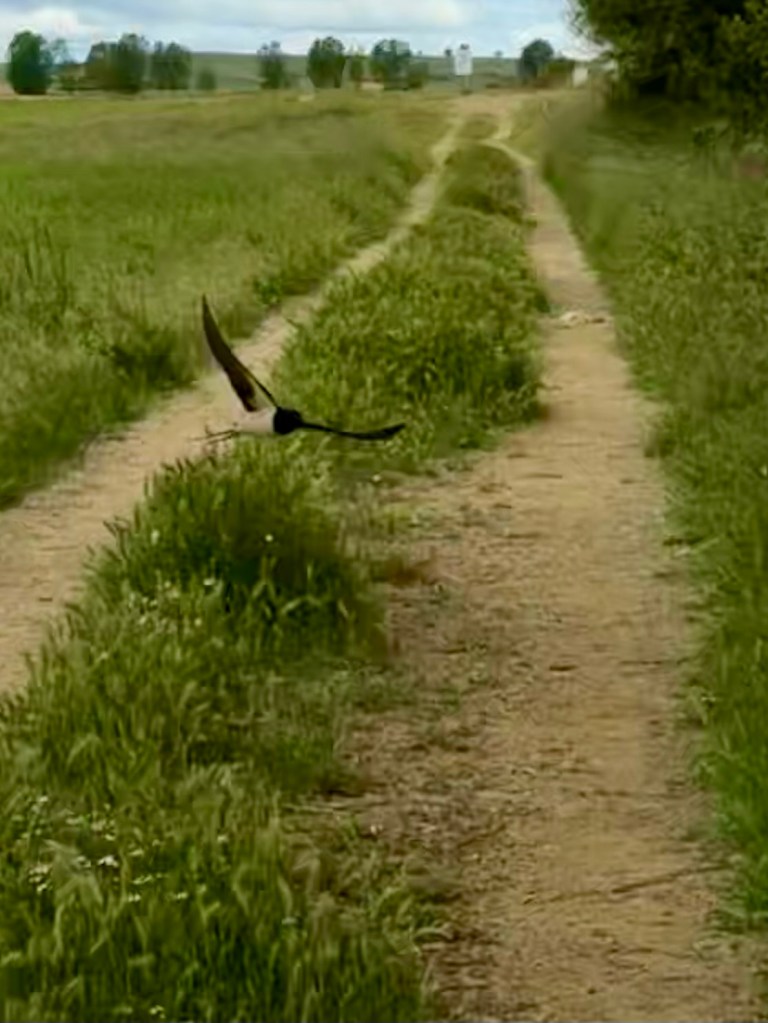
Bugger me, I am relaxed. How did that happen. We wandered along a canal and then along a river side and it further occurred to me that perhaps I ought to be using my time on the Meseta to think about something meaningful or at least useful. Maybe about life, or life at home, or what I/we wanted to do next etc. But then it occurred to me that I didn’t really want to think about any of those things. I didn’t want to think about anything. So I didn’t. I just walked, watching the wind rustle in the trees and swallows flying at us at high speed while pursuing their evening meal at high speed and chatting with Emma about this that and the other.
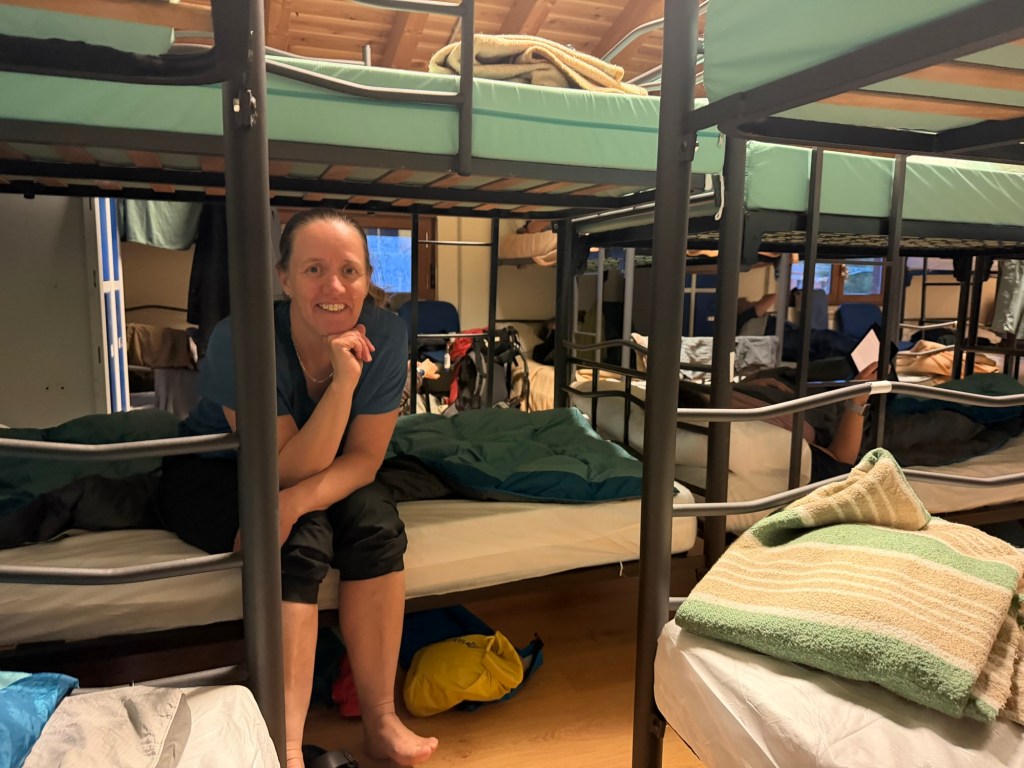
Our bed that night brought relaxation to an end. By and large, dorm rooms on the Camino aren’t too bad, provided you have a good set of ear plugs and an eye mask. Our bunk bed in Frómista was an exception. It made a highly irritating squeak every time one of us moved our big toe or any other larger body part.
‘Don’t come knocking if the bunk beds rocking’, I laughed to Paul on the bunk opposite as my inner 13 year old was set free.
‘You’re in there on your own Greg’, he replied with a chuckle before we both started giggling. A lady (who we ended up chatting with a few days later) in the next bunk over joined in and then we were all laughing. The other people in the dorm ignored us.
An ancient Roman road took us most of the rest of the way into León. Isn’t that fun? I still love seeing ancient stuff even if it is just a 31 km stretch of packed stones a few metres wide. The fact that these stones were put there by the Roman Empire and were subsequently marched upon by legionnaires makes my head spin with delight. We were walking in the foot steps of legionnaires! Separated not by geography, just the passage of 2000 years. So cool.
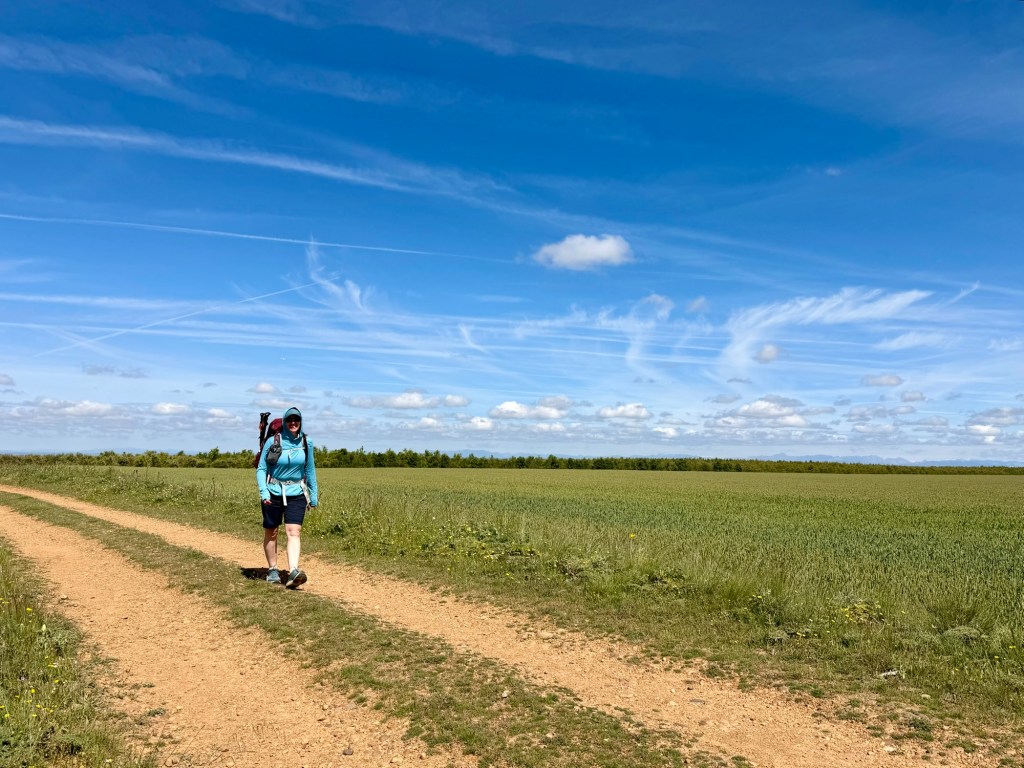
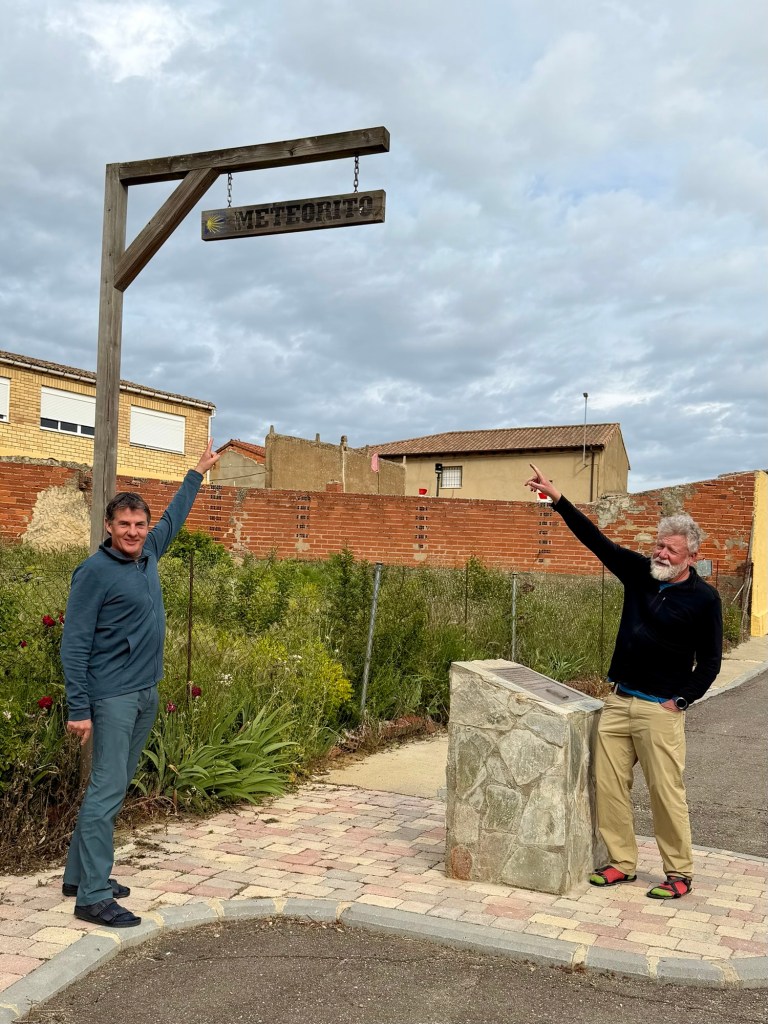
Another thing worth mentioning is a visit to the most famous bar on the Camino. Bar Elvis in Reliegos. Only when we got there it was closed. Not to worry, Reliegos had a second major attraction, it was the sight of a meteor’s crash landing back in 1947. Emma lead us to the site, which had a plaque and a sign swinging from a post overhead. ‘That’s a little underwhelming’, Paul stated dryly.
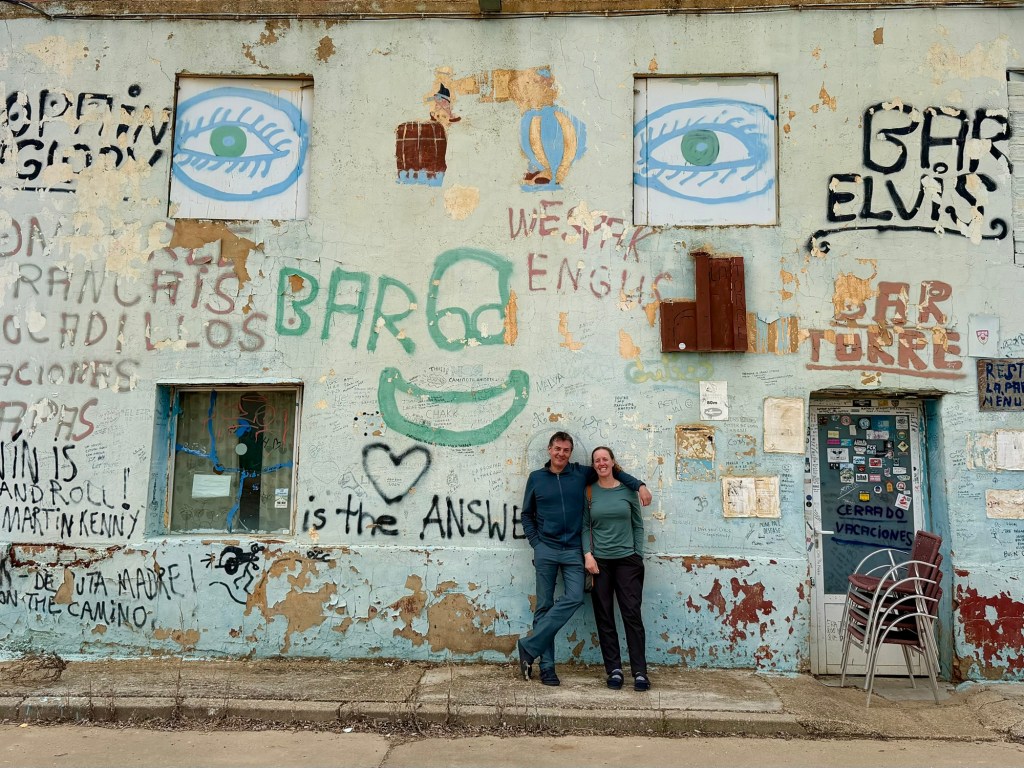
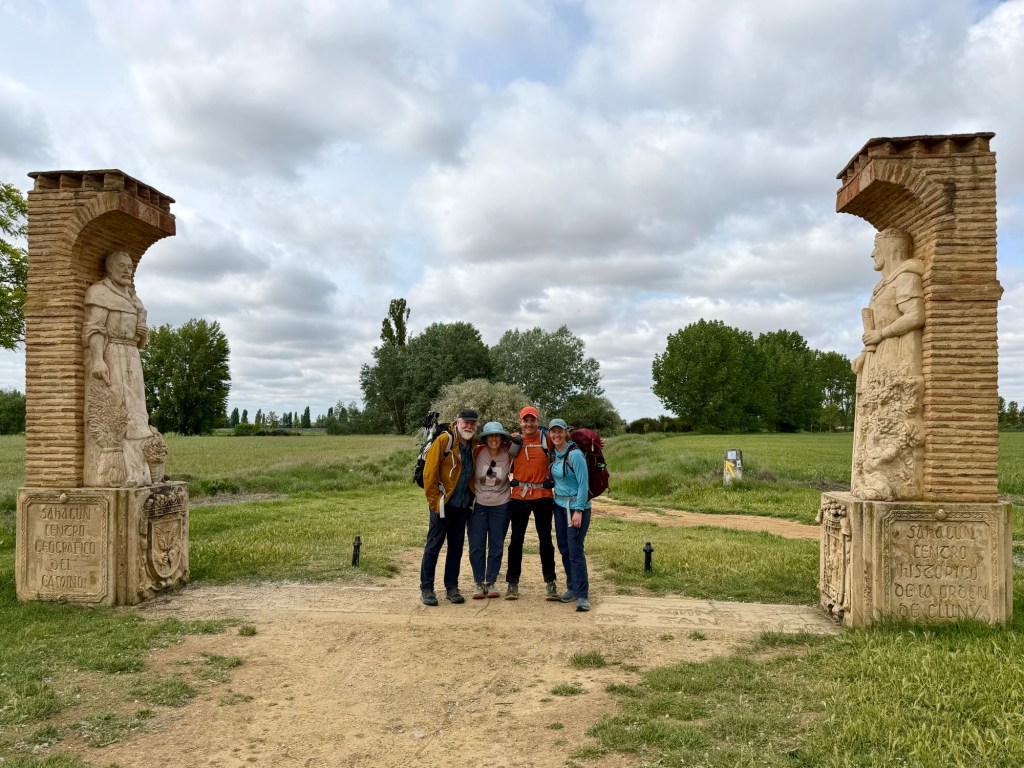
And now we are in León. Which has my favourite cathedral of all the cathedrals we have seen since arriving in Europe. We’ve crossed the half way mark. In fact we are now two thirds done with ~470km behind us. 16 more days and all going well we will be in Santiago de Compostela.
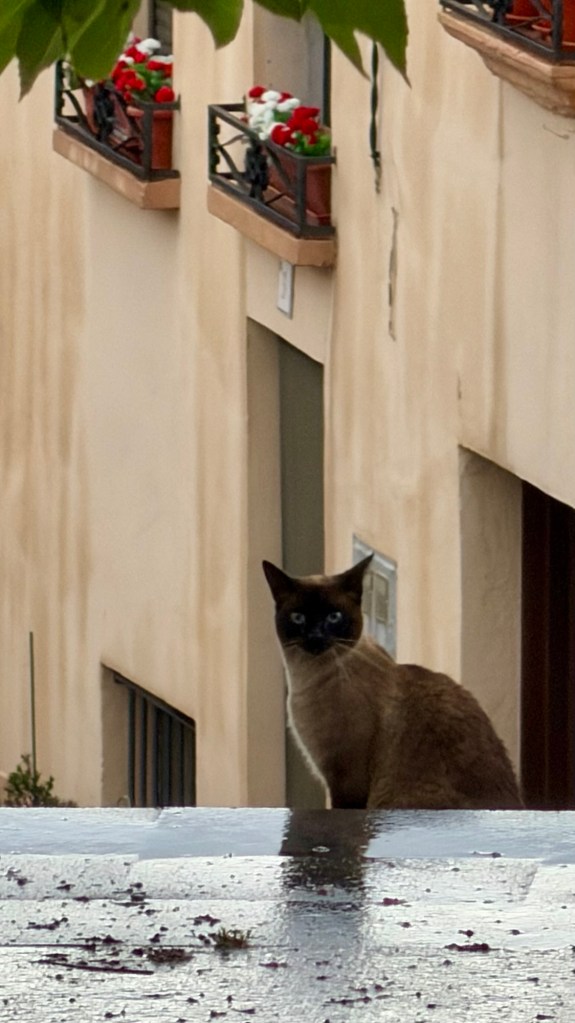
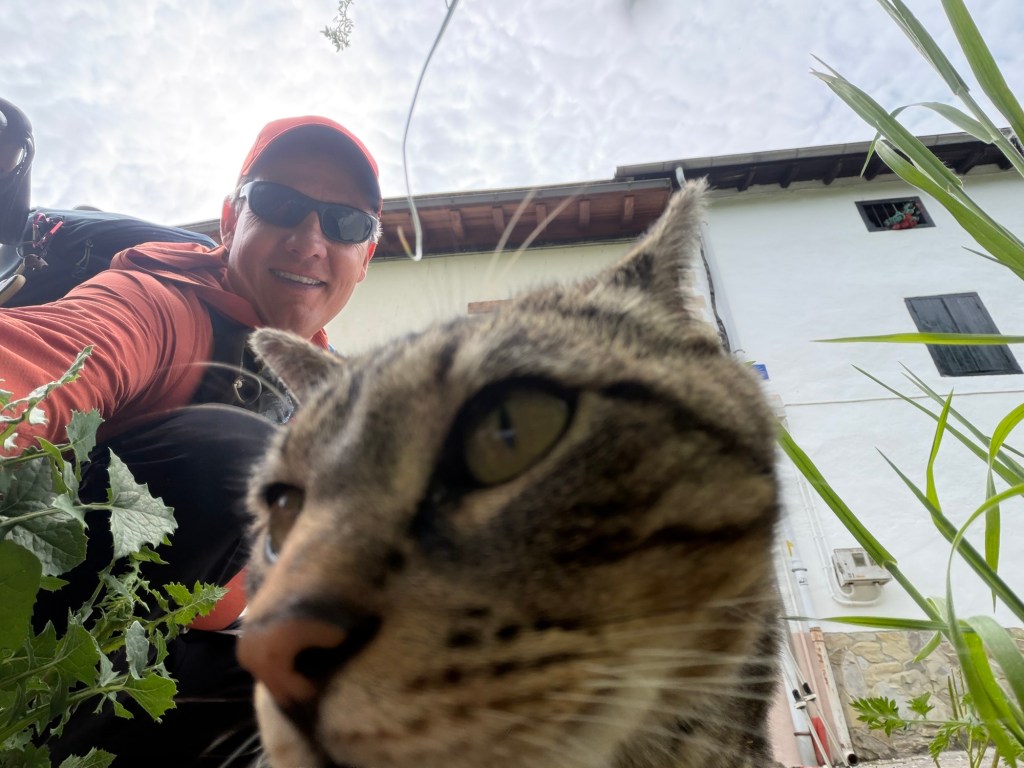
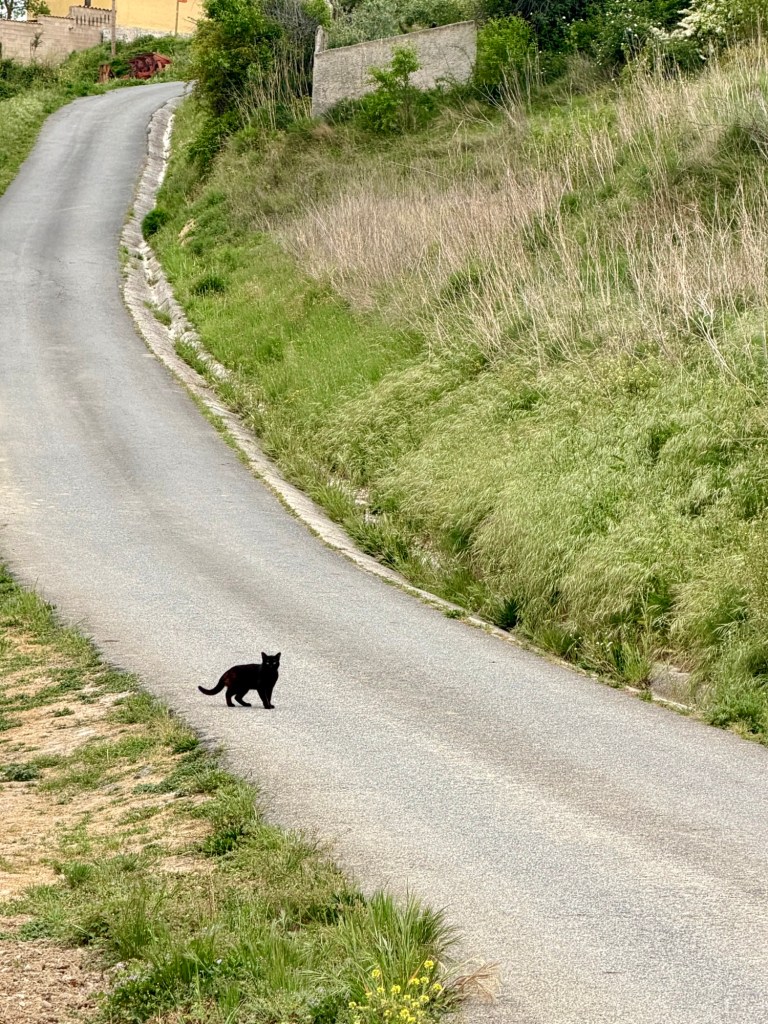
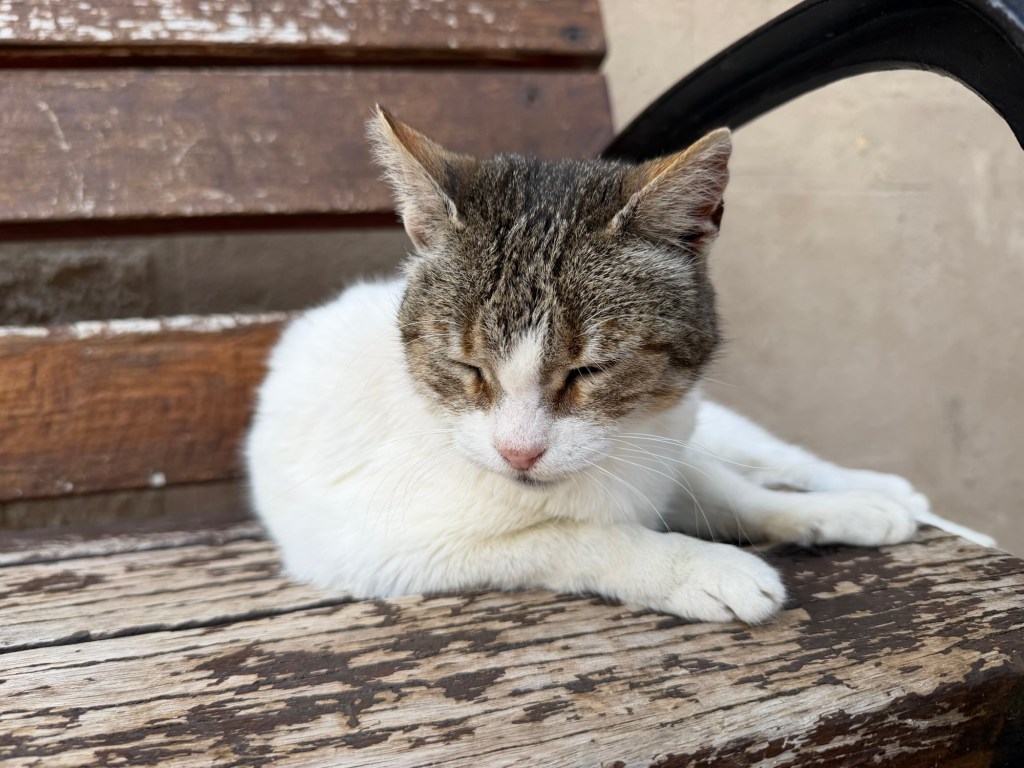
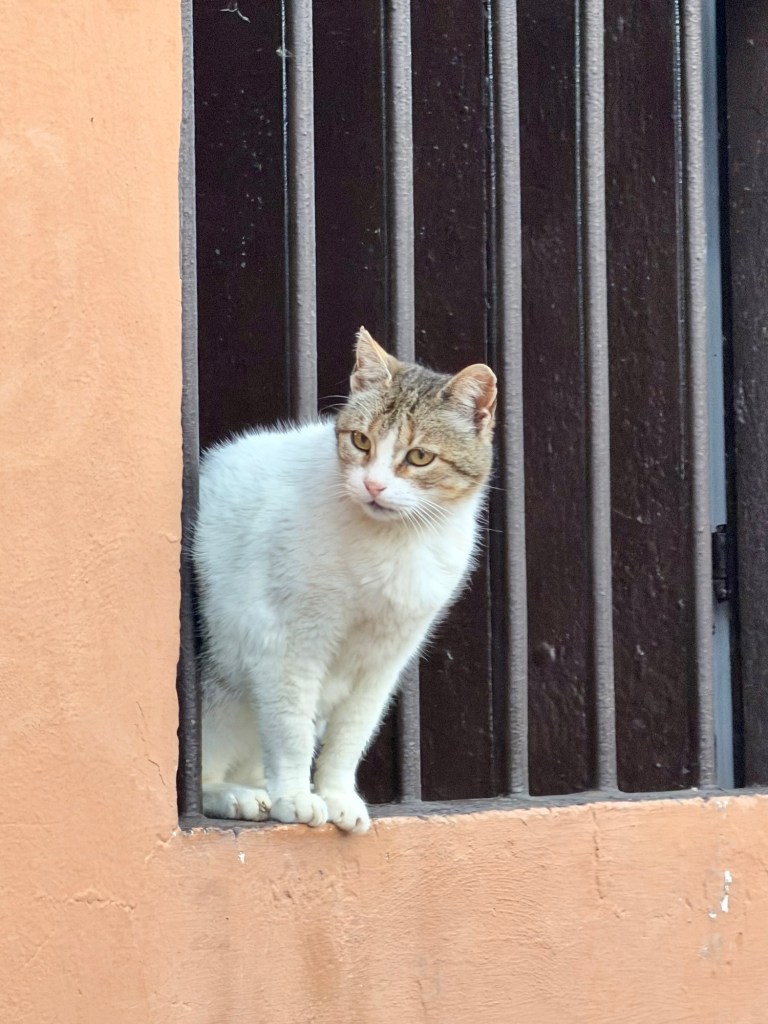
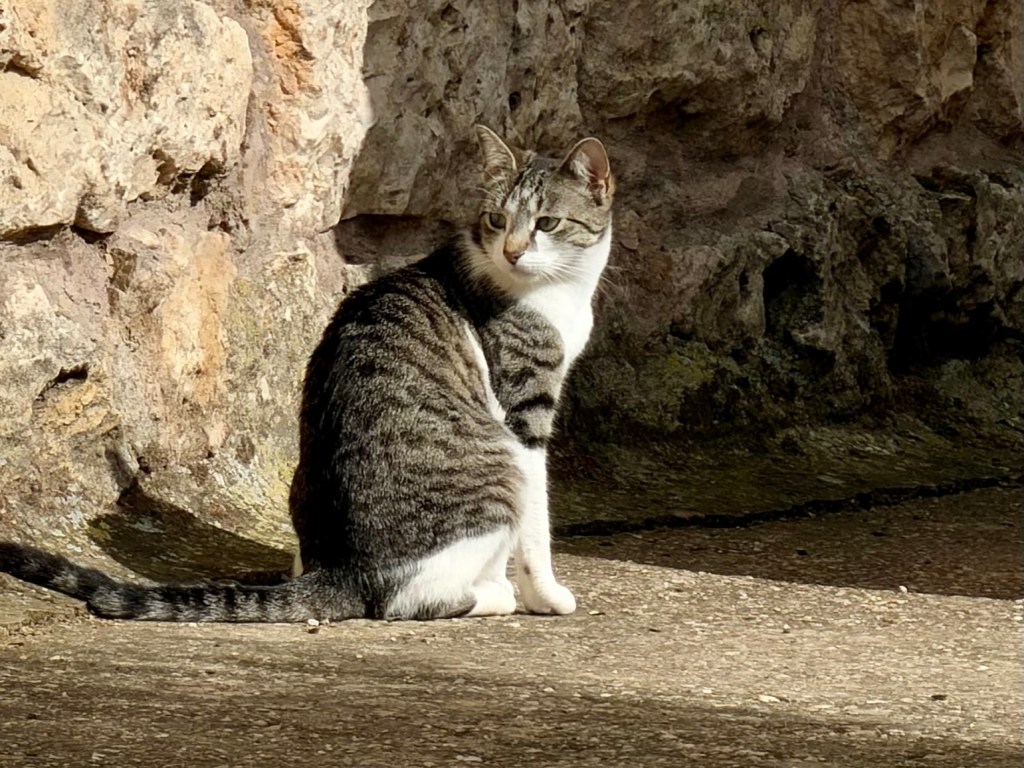
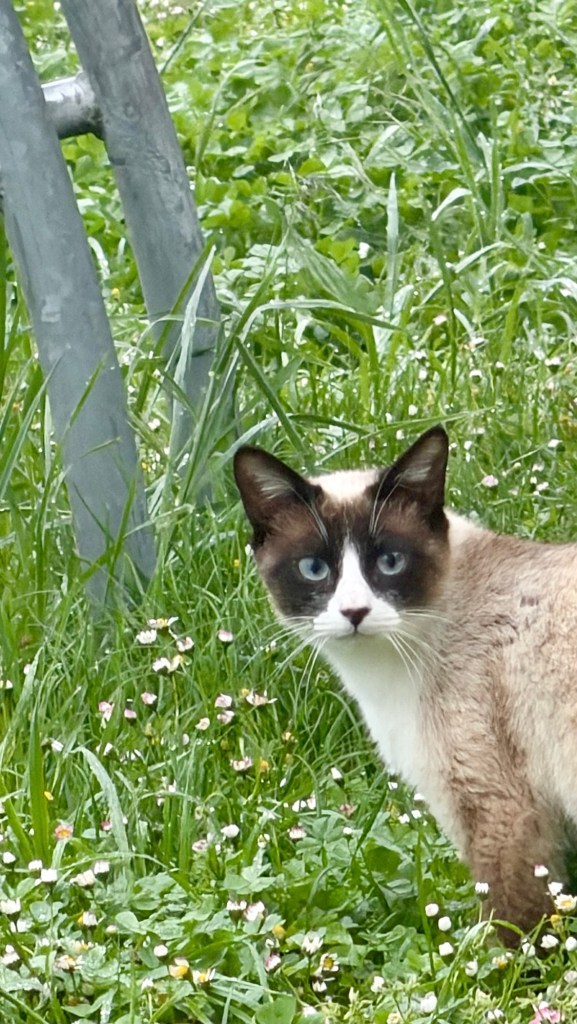
And now for Cats of the Camino… it’s a bumper edition this time with many excellent felines along the way.
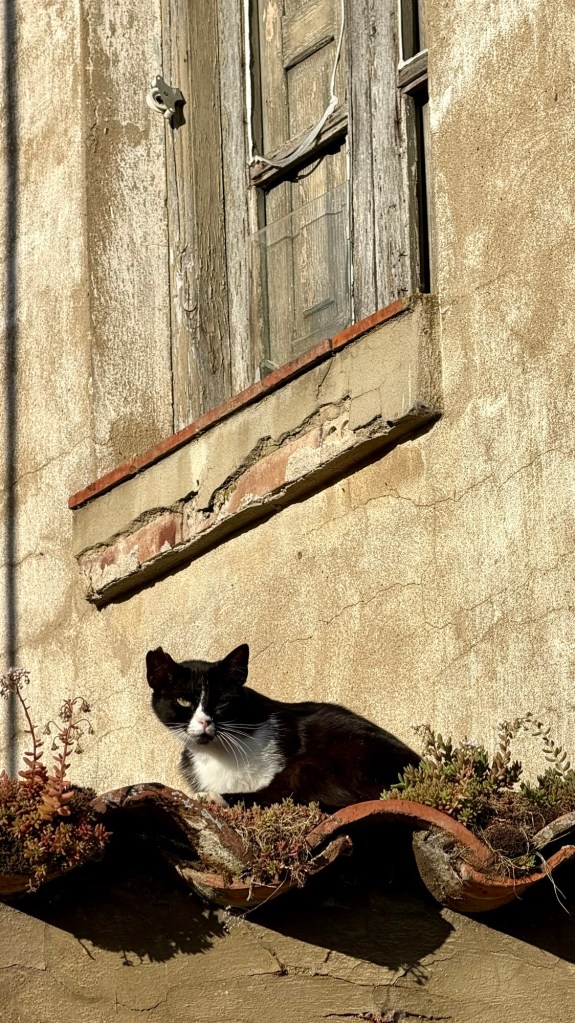
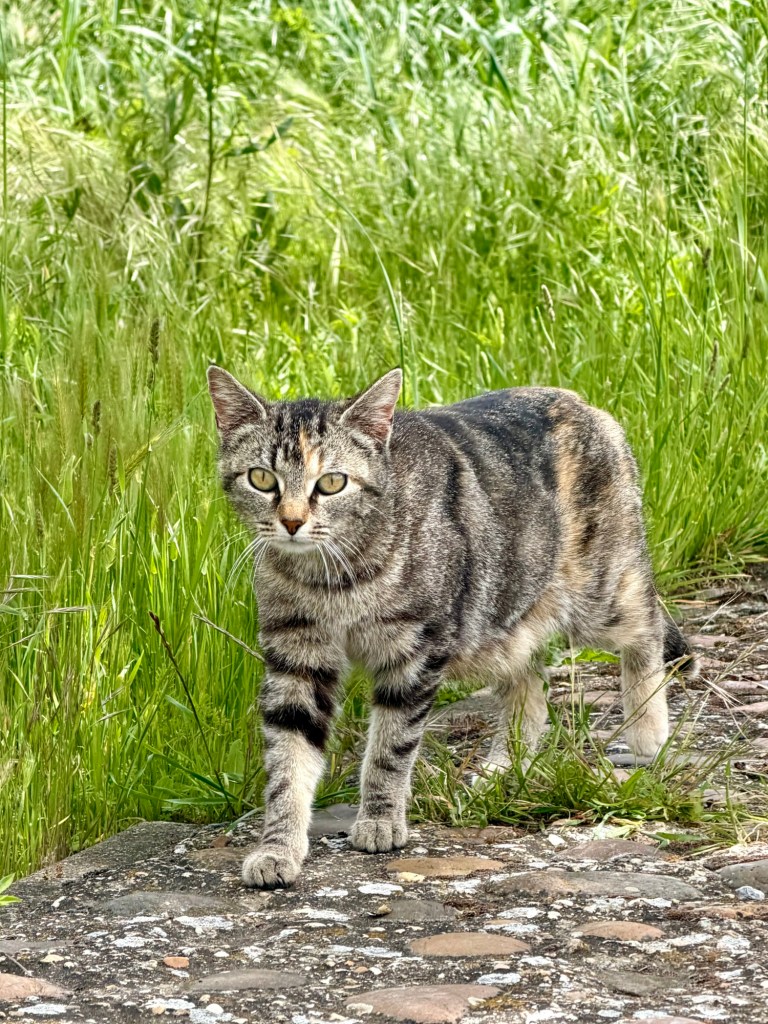
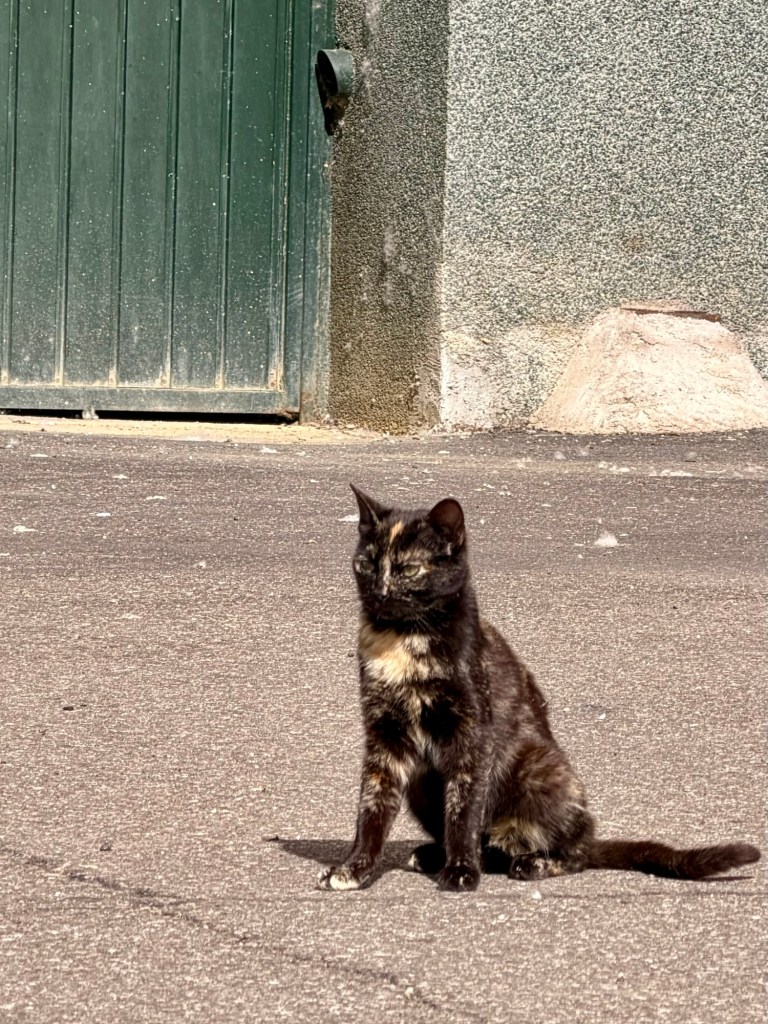
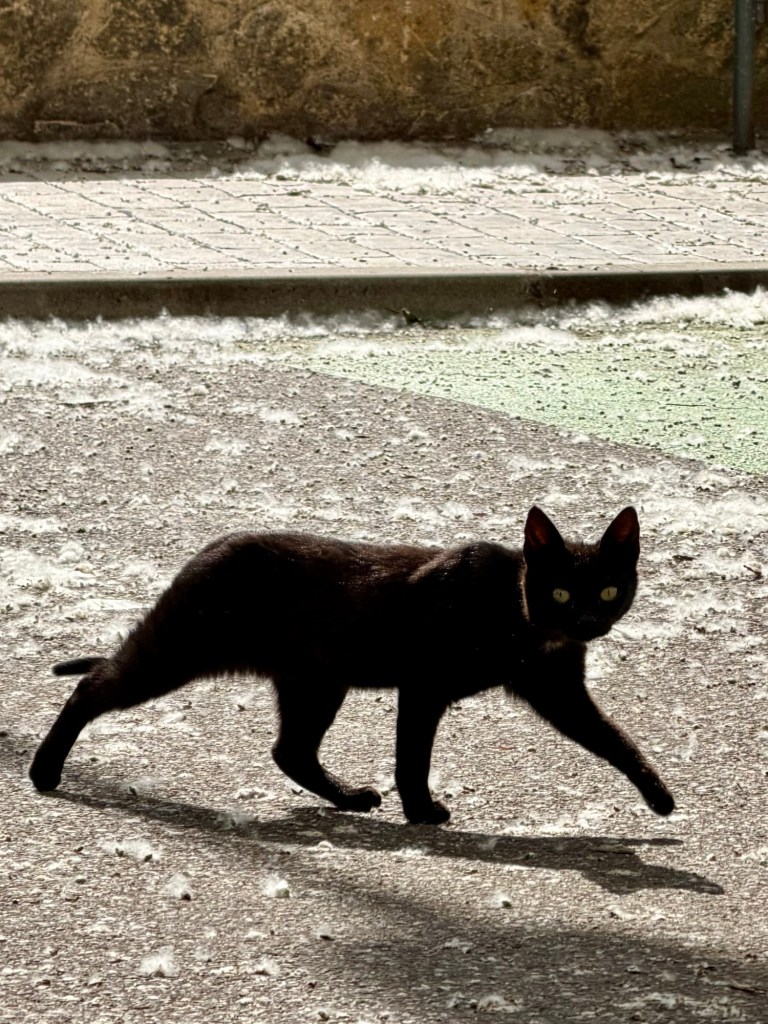
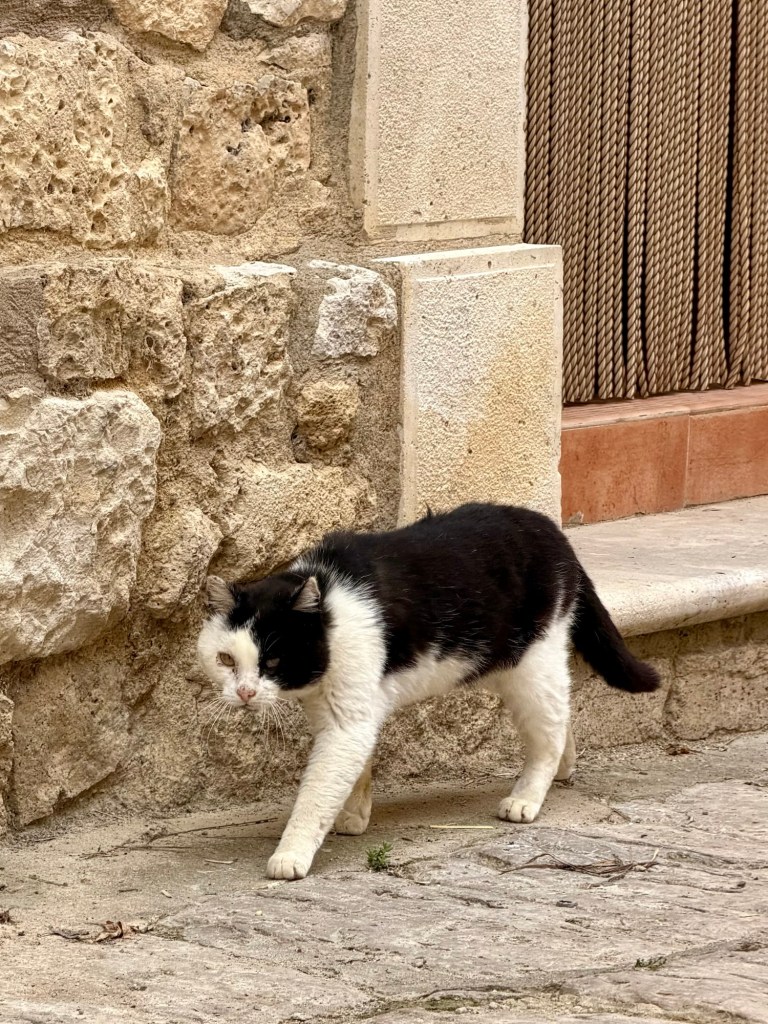
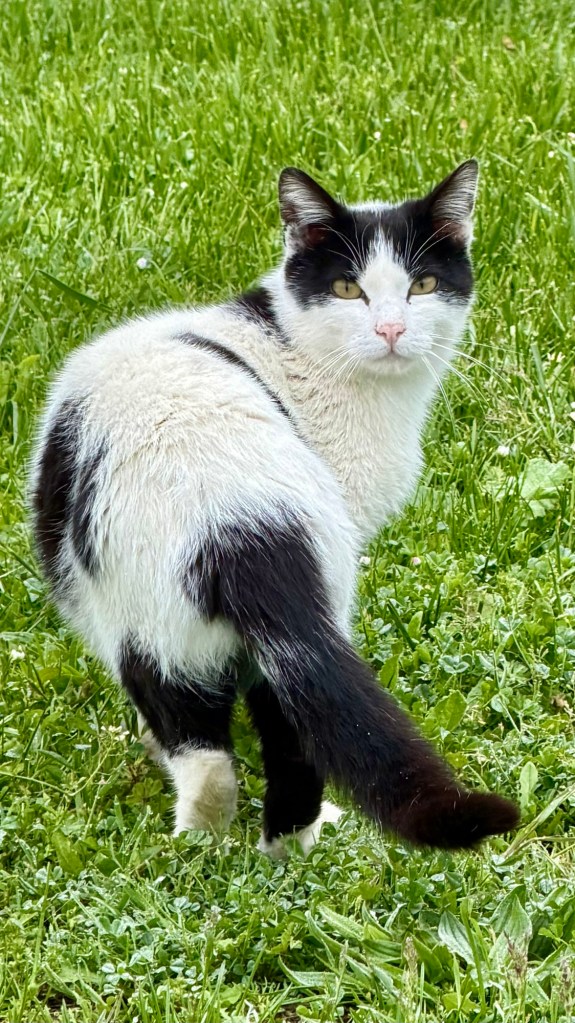
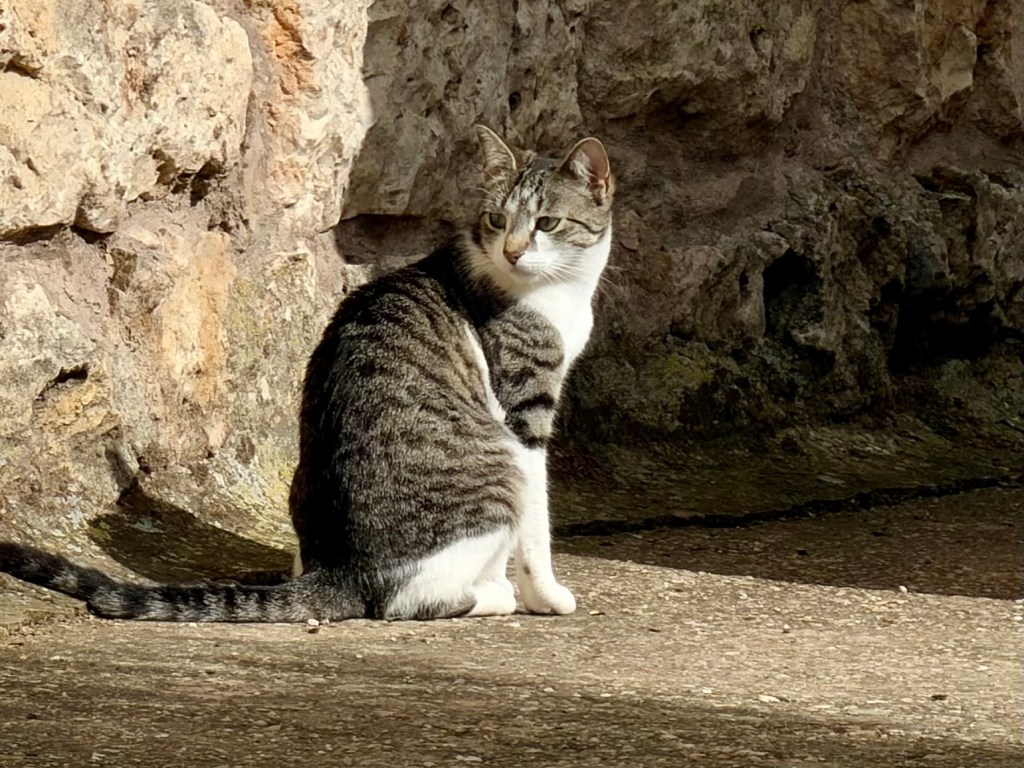
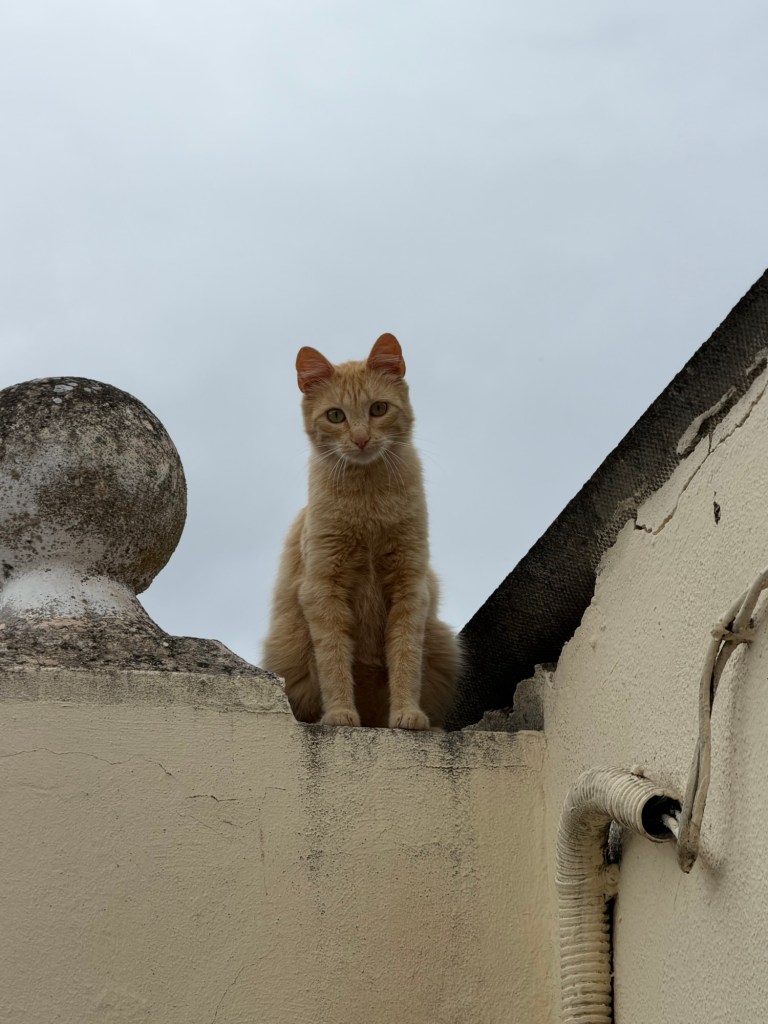
And a few extra photos because choosing your favourites is hard.
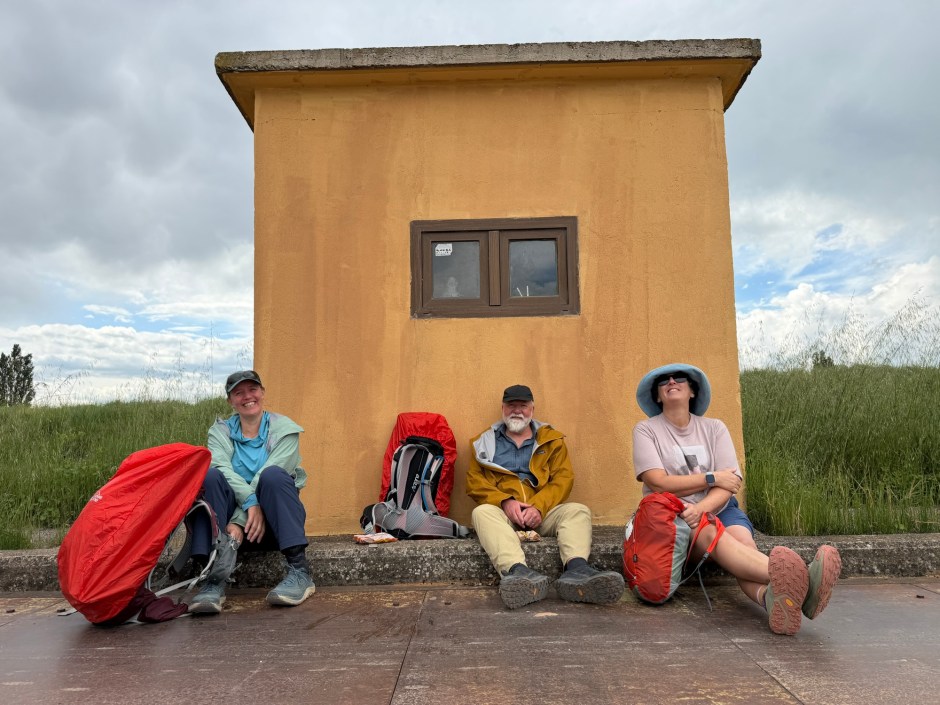
We have walked 282 kilometres. 282! That’s like walking from Canberra to Sydney. I just measured it on Google Maps. Canberra to Sydney is 284 kilometres. And it’s taken us 16 days. 16 days to go the same distance we would normally go in three hours in a car. We’ve never walked this far. Not in one go. My feet get tired sometimes.
It’s strange. It’s a strange way to travel. Slow. Yet each day seems to have little spare time. We wake around 6.30. Pack our bags and begin walking by 7.30. The first five to ten kilometres seem easy. We prefer to eat before we go, but that may or may not be possible. This is Spain and while this whole thing is set up to support pilgrims, there is a lack of urgency about it.
On a Sunday, your albergue will feel no compulsion to provide breakfast before sending you out the door. And the next three towns may or may not have a cafe. If there is one, it may or may not be open. We always seem to find something sooner or later though. Cafe con leche, tortilla de potatas (potato and egg slice) and a chocolate croissant being our preferred morning stop.
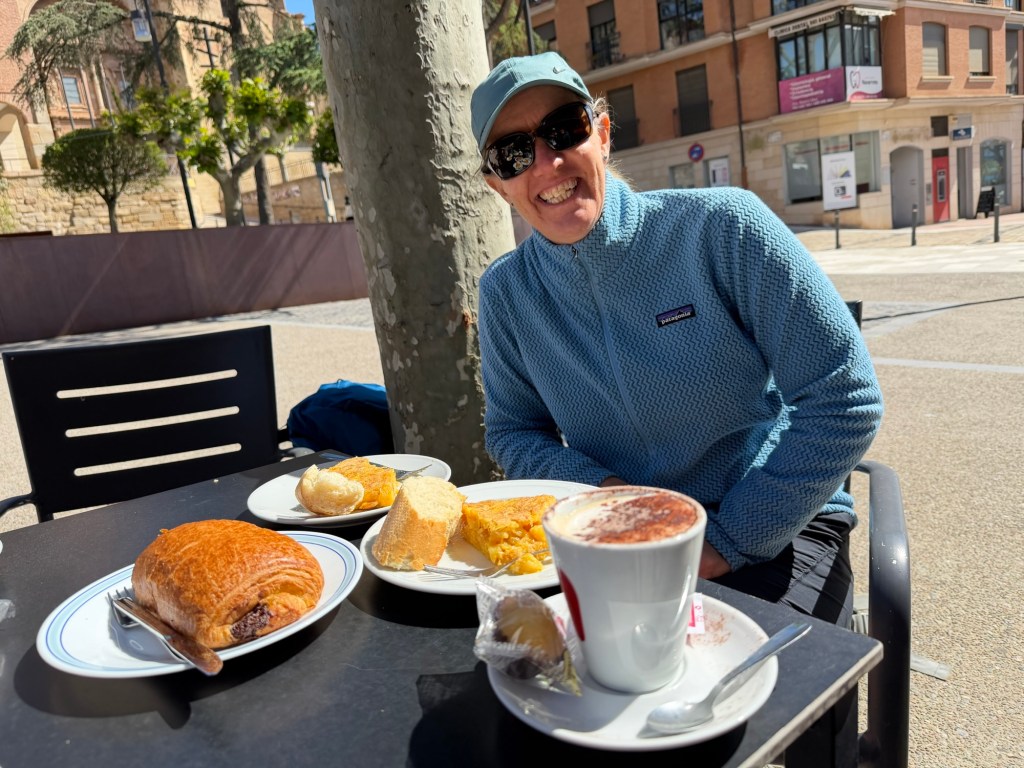
Kilometres ten through twenty are not too bad either. My energy surges after we’ve eaten and it carries me through. I’ve been noticing these things when normally I would not. After that it gets a bit harder. By twenty kilometres, four to five hours will have passed, but I don’t seem to notice. All of a sudden its mid afternoon. I can also tell because by this time my feet are tired.
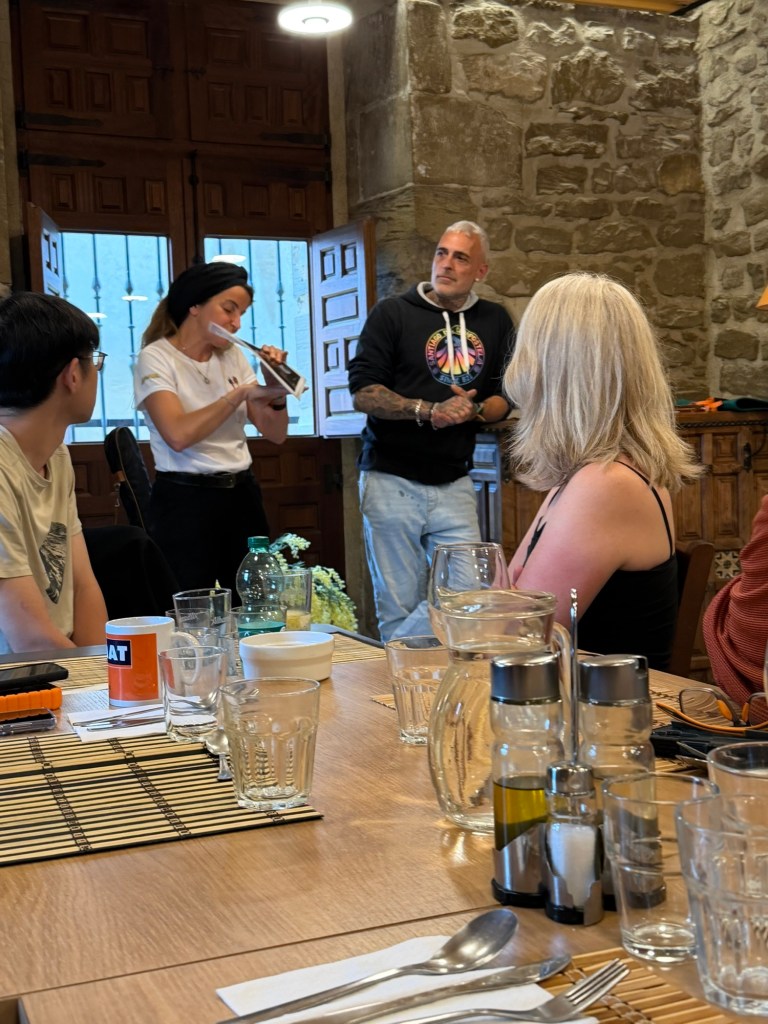
By 25 to 30 kilometres everyone is ready, or a bit past ready, to stop. We find our albergue. Check in. Shower. Poke about town or the local church or find a beer and a glass of wine. Maybe we play a little cards. Maybe we don’t. Eventually it’s dinner time. Pilgrim meals are fun. Sometimes too loud. Sometimes hard to chat across language barriers but always upbeat and cheery.
I loved our host in Sansol. She was an Italian lady who had fallen in love with a Spanish man when they walked the Camino a year or so ago. They weren’t sure what they were doing with their lives but some connection to the Camino was important to them. They sent emails to hundreds of albergues looking for opportunities. The email reached the owner of the Palacio in Sansol the same week she had decided she would close. Her father had spent years restoring the place, he had died and she took it on for the next few years but now she felt she was done. The rest as they say, is history.
The two lovebirds stepped in and took the place on (only about a month ago). I got the impression however that they had little background in hospitality. She had a penchant for swearing and taking the Lord’s name in vain, with occasional cries of ‘Jesus Christ!’, as she grappled with multiple pilgrims arriving all at once or when accidentally serving bread to a gluten free peregrino. ‘Jesus Christ don’t eat that!’, she cried on that occasion, racing out of the kitchen and across the dining hall to pluck the bread away from a pilgrim who no doubt would not have eaten the bread anyway.
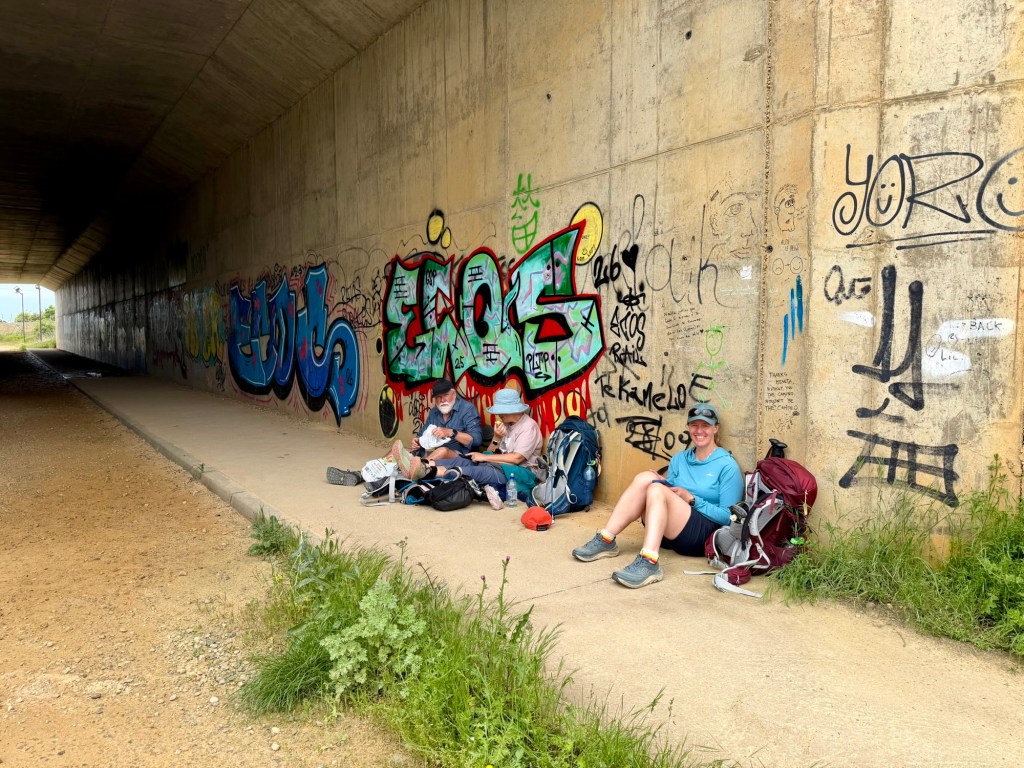
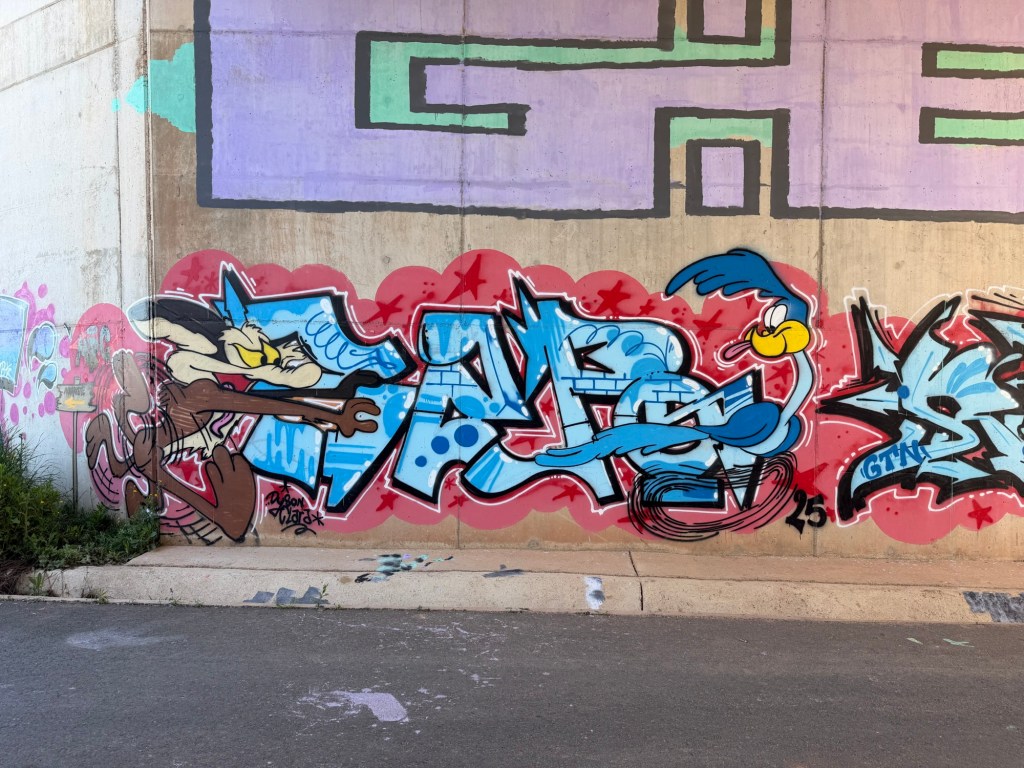
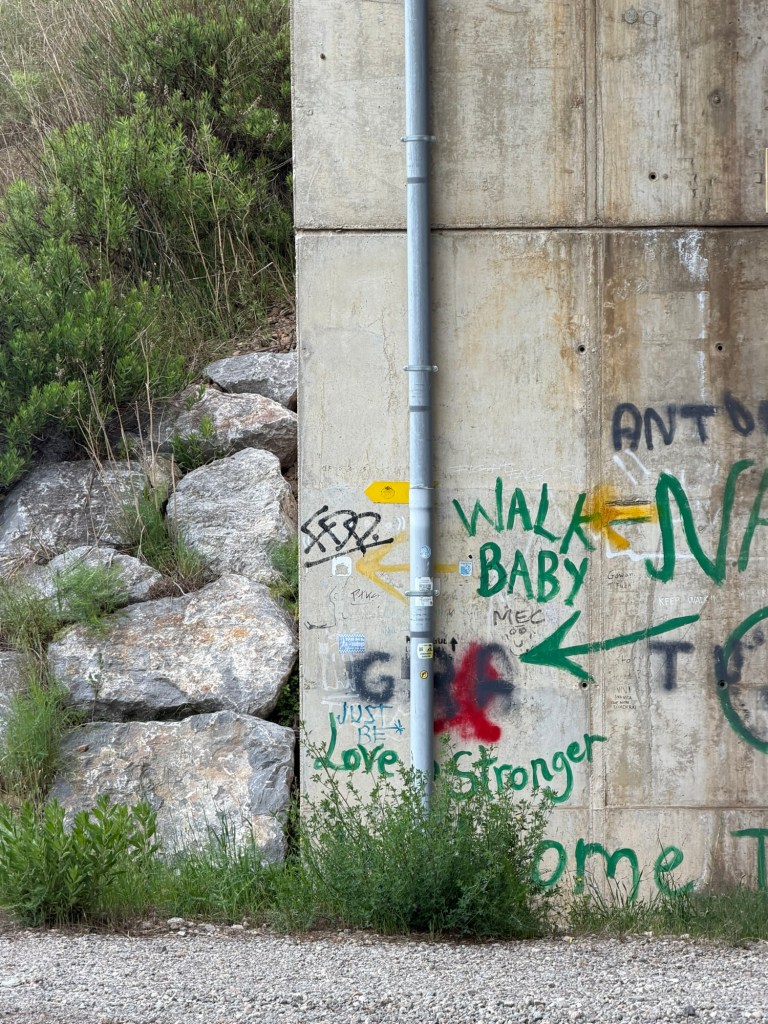
We’ve seen so many wonderful things already. Beautiful things and yet at any given moment the reality of the Camino is as likely to be a gritty, graffiti ridden underpass, or a stroll past an electrical substation or noisy highway as it is to be through the gorgeous byways of county lanes, villages, vineyards, forests and fields. Generally speaking it is more of the latter than it is the former.
We’ve walked for 5 days now since leaving Logrono. Staying in Ventosa, Cirueña, Belorado, and San Juan de Ortega before arriving here in Burgos for another rest day. We’ve picked up our mileage too, covering more than twenty kilometres each day. The day into Belorado was our longest at 29.85 kilometres according to my watch. That bothered me, so Emma and I walked around the block before stopping at our albergue, just make sure we could say we had walked a full 30km.
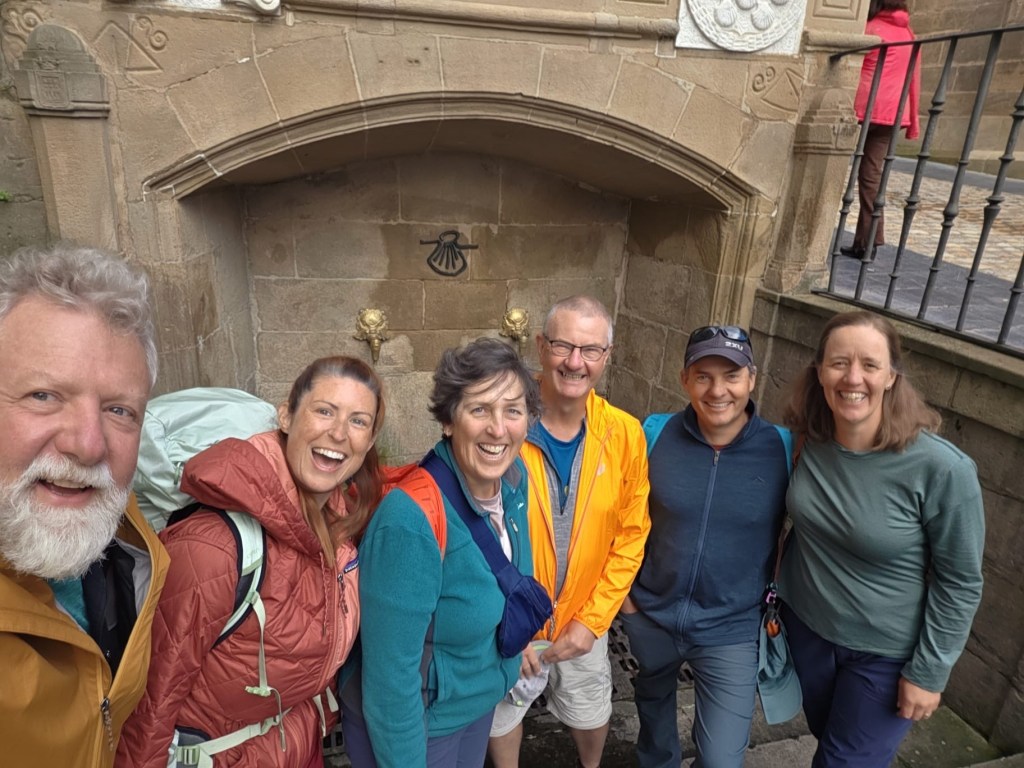
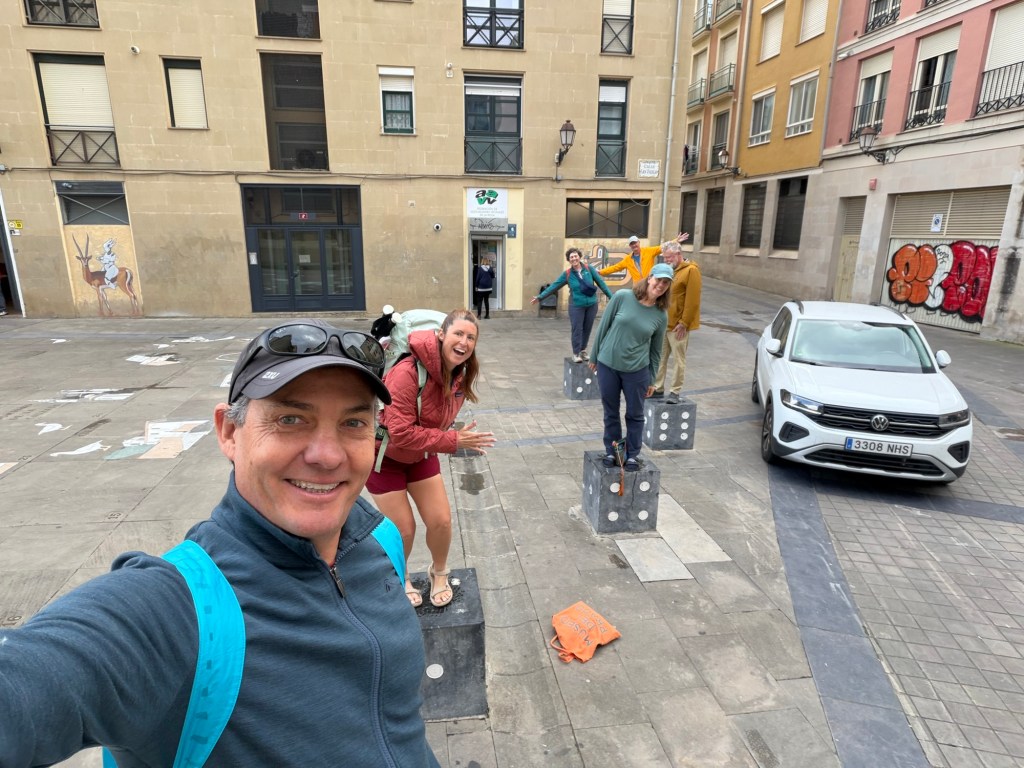
The day we left Logrono we walked with Guy from the UK and Danae from the US. We had spent the morning with them the day before, exploring Logrono itself. The only reason we did that of course was because Paul had lent across the table at a bar we had stopped at for lunch days before and started chatting. The Camino is fun like that.
We had explored the cathedral, the pilgrims fountain and the pilgrims square. And then we walked with them for a splendid day. I stopped taking photos and listened to Guy share his story. He has been on quite the journey. It’s not my place to reveal that story other than to say he had discovered that when he is walking, the voices in his head run out of things to say. Guy seems to have a way of collecting friends as he goes. I’m very grateful to him for sharing the way he did. His story gave context and scale to my own. It reminded me that while I am the centre of my own universe, there are so many others making their way through life in so many different ways.
The days walk from Logrono flew by. Kilometres melting into the background. We went past a wetland, over a busy highway, past the ruins of an ancient pilgrims hospital and into the heart of La Rioja – Spanish wine country.
Vineyards started appearing and then increased in number, interspersed with the endless ocean of wheat and barley. The countryside is so neat. We’re told that at other times of year it is all brown, but now it is a festival of colour, a patch work of loveliness set to the chirping birds who never seem to tire of their cheery disposition.
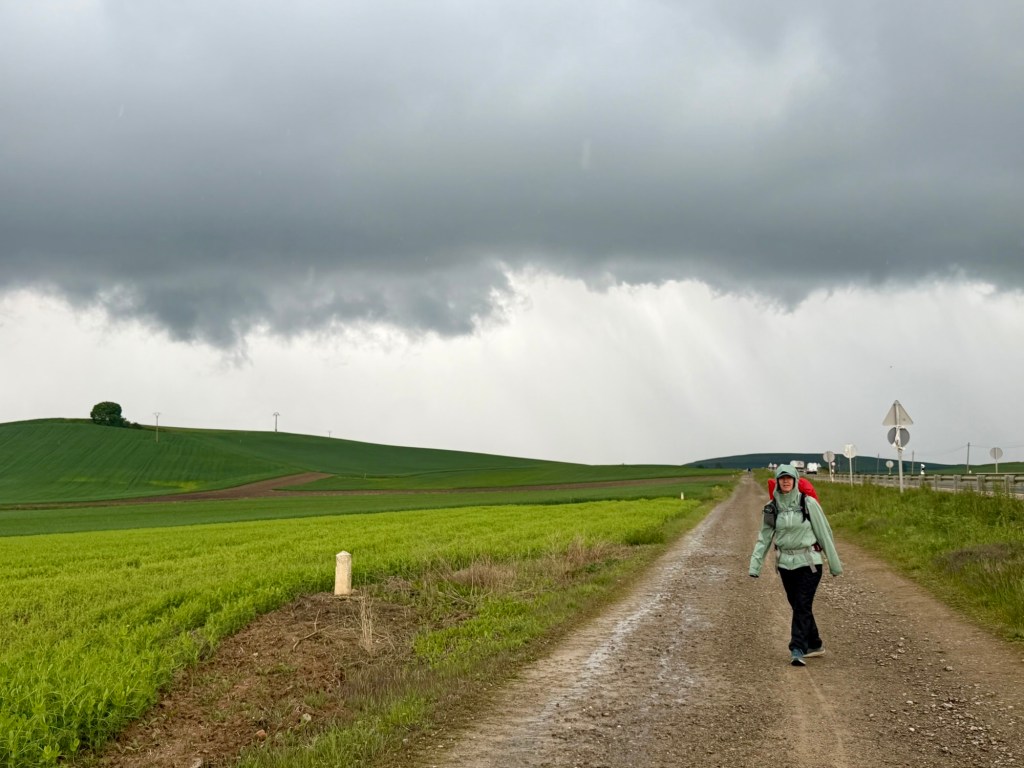
The second day out of Logrono the sky decided to put on a show. Thunderheads appeared on the horizon, to our left and to our right. They grew steadily as we walked until their shadow consumed us. The scene played out slowly, only to be observed at all because we weren’t whizzing by at 110 km per hour. I was reminded of a concept I had read about which I think was called slow or deep time, where life and activity pass at the pace of the natural world rather than driven by the clock.
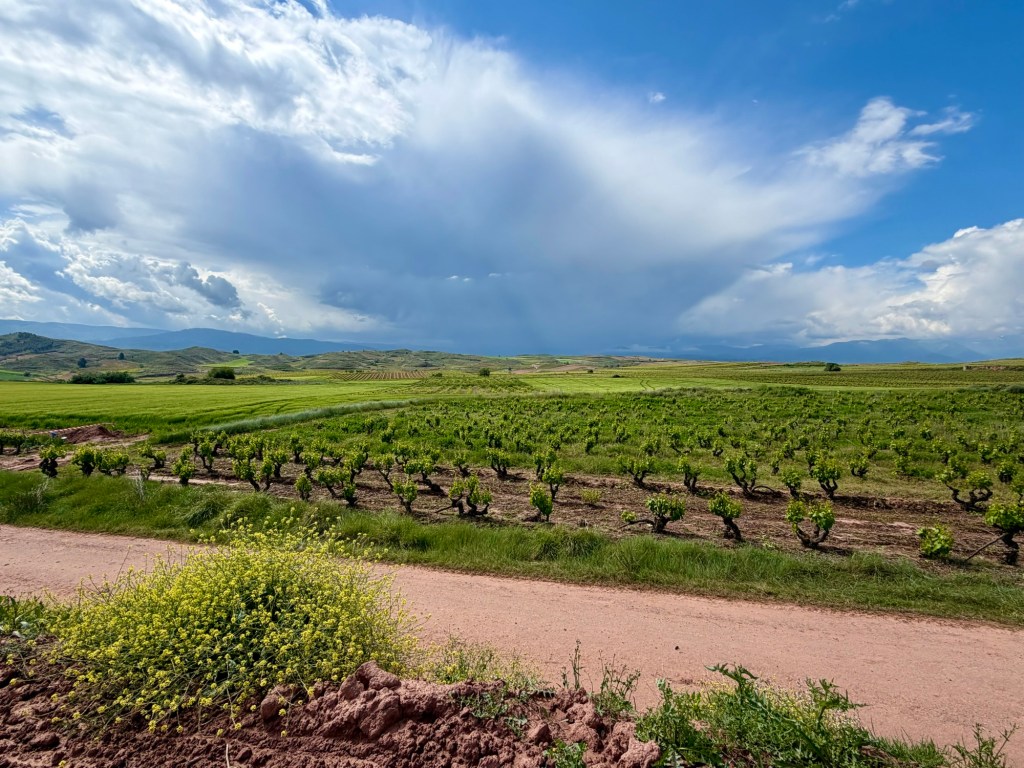
I felt overwhelmingly well on this day. All was right in my little world and the scenery and company was filling me up. There was a lightness in my chest that has been absent a good long while. We kept walking.
The third day out of Logrono started with a gorgeous show of early morning light. Khia discovered the first blister of our trip on her big toe, as if she didn’t have enough other ouchy bits to keep her challenged. She’s a trooper though and there is resolve in those legs to be admired.
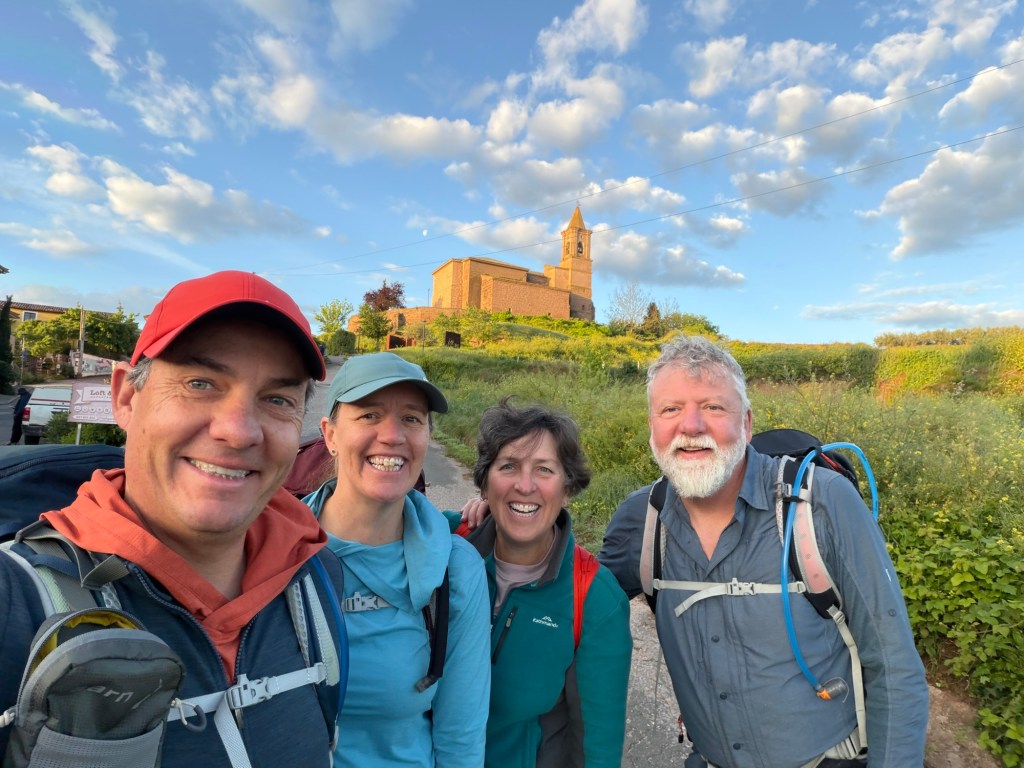
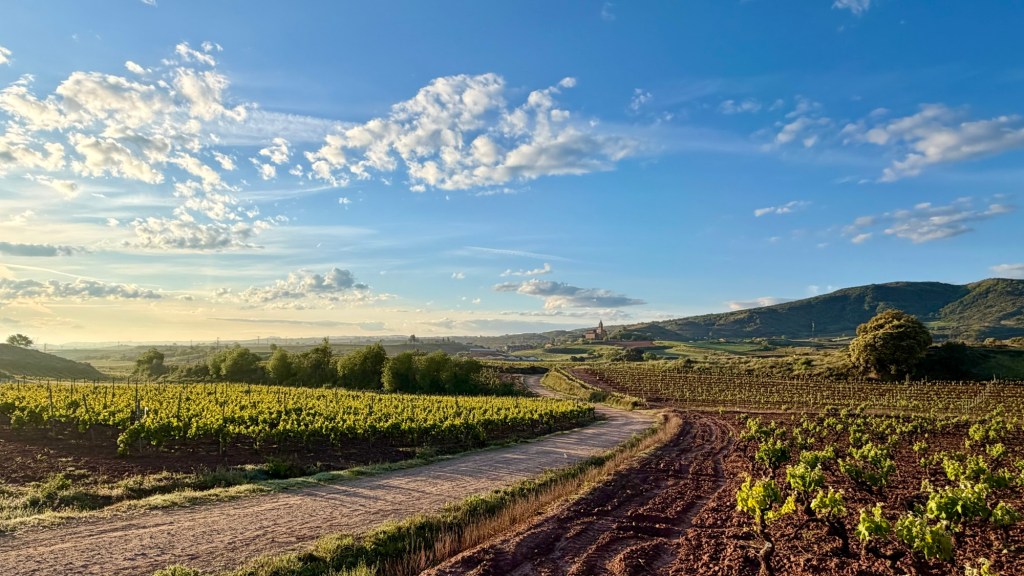
The day ended in Cirueña. A town with an eerie history. Just before the financial crisis in 2008 the developers had swept in and installed a golf course and around 10,000 apartments and homes with promises to sell a country club lifestyle in the heart of the Rioja wine region. Cirueña’s population now is around 280. Our guide book described it as a town of the zombie apocalypse and that’s how it felt. Paul and I pretended to be zombies, after carefully checking none of the inhabitants were watching.
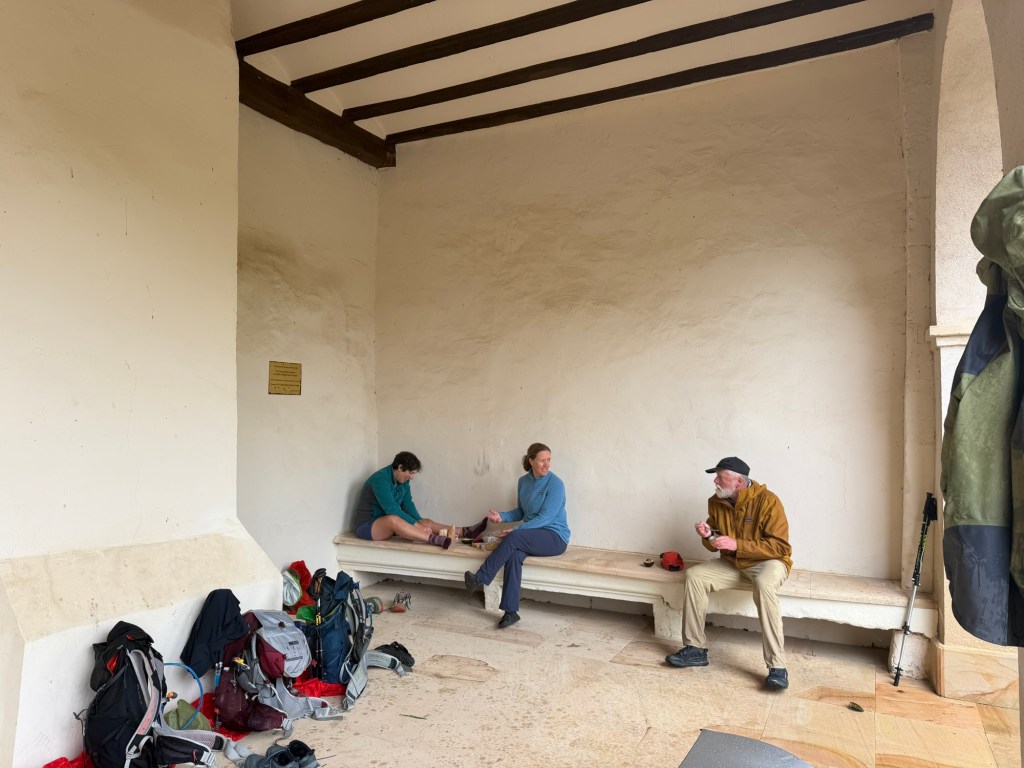
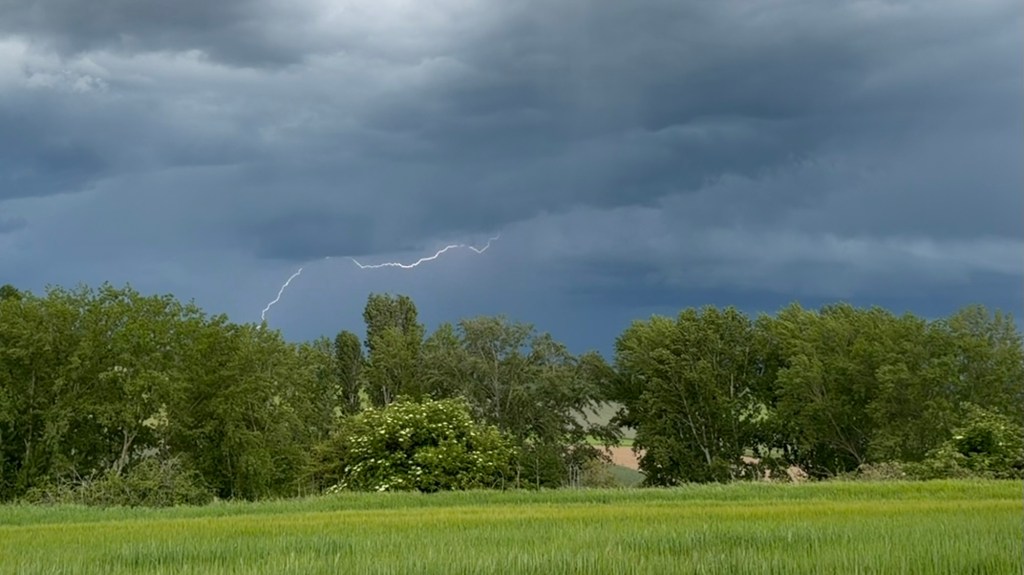
The storms were back the next day, only this time they did not just cast a shadow but erupted right on top of us. We ate lunch under the roof of a church as the rain came down and we thanked God for his protection. I pondered whether he saw right through me though. Perhaps he did because not long after leaving that town the storm came (storm appropriately translates to tormenta in Spanish) and there was nowhere to hide. For two and half kilometres it poured down, lightning crackled and thunder rippled. The water was cold as it wet our feet, the only part of Emma and me not wrapped in waterproof fibres. Then the rain became hail biting into Khia’s bare legs and face. I felt calm. Strange for me in such a circumstance. Emma grinned from ear to ear. Khia moved quickly, powered by adrenaline and Paul had fallen behind playing with his umbrella.
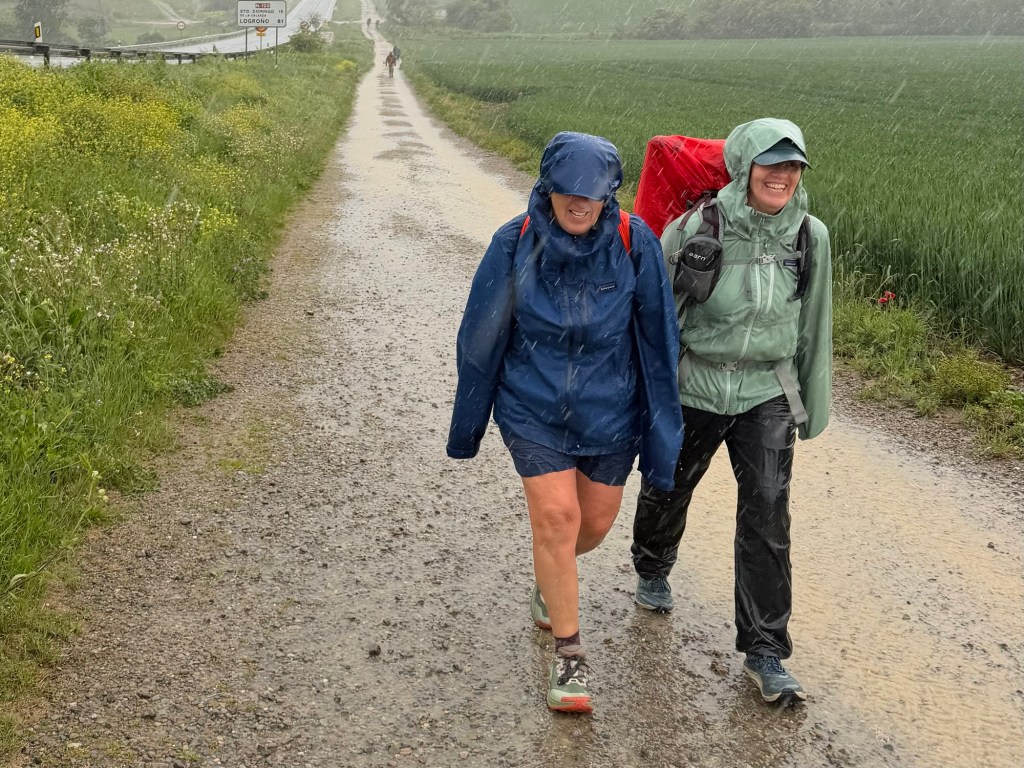
We arrived into Belorado not long after the tormenta had passed and chose a restaurant for dinner, which of course happened to be where Danae was staying. Of course we bumped into Danae for dinner – this is the Camino!
The next day was Khia’s birthday. She awoke with a giggle with thanks to balloons by Emma and stayed behind in town for a massage with thanks to Paul. Could there be a better gift on the Camino?
The day we walked into Burgos got off to a rough start. It was a Sunday and our beautiful albergue in San Juan de Ortega did not serve breakfast that morning. Nor did the town after that, or the one after that! Yikes. I promised myself I would increase our donations to Plan International. It sucks being hungry and caffeine deprived. Three hours without food and we were beginning to get desperate! Finally we stumbled into Villalval where there were cafe chairs with umbrellas hoisted high. Our hopes rose and then our hearts surged as we saw every peregrino on the conveyor belt of Saint James seated, eating and drinking in this otherwise blink and you will miss it little town.
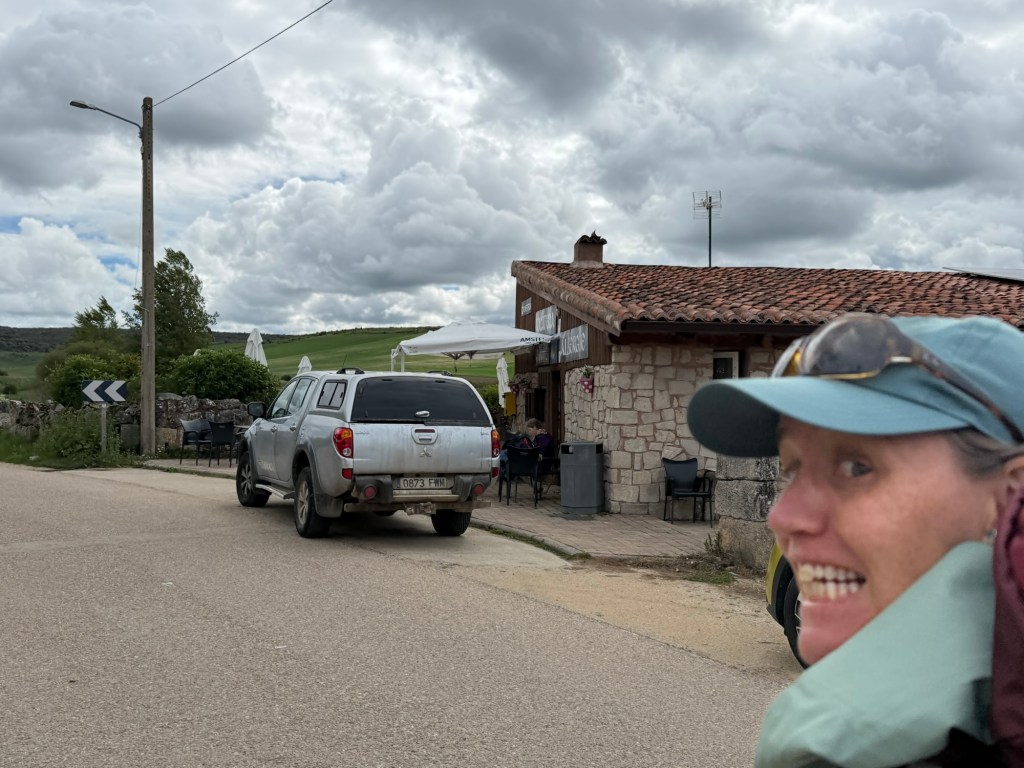
We went on, across a bridge over a highway where Emma and I stopped and waved at the cars and trucks and motor bikes whizzing by below. To my delight the trucks and cars and motor bikes nearly all waved back, flashed their lights and honked their horns. There is love for peregrinos in Spain. Many more locals than not look up, smile and wish you a Buen Camino.
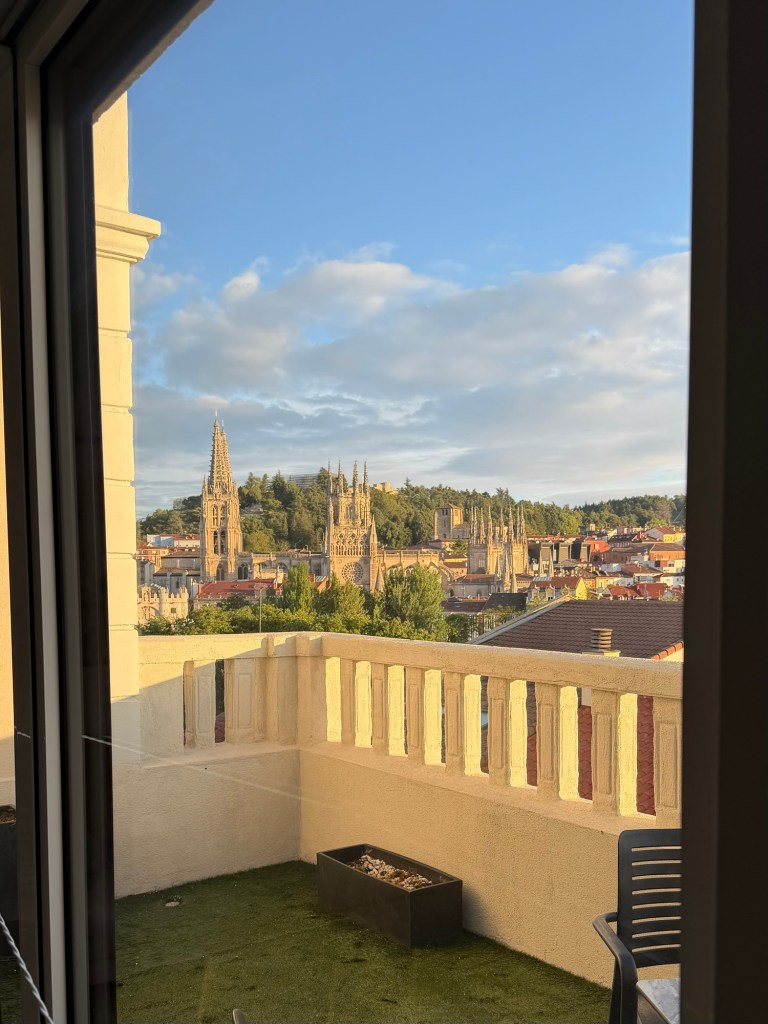
As it is, I am sitting on the fifth floor of an apartment building with views over a magnificent gothic cathedral in the centre of Burgos. My feet are not as tired as the day before. Which is good. It’s 180 kilometres across the high plains of the meseta before our next rest day in León. We’ll get there. Slowly.
And just for fun, a few more photos from my cats of the Camino collection.
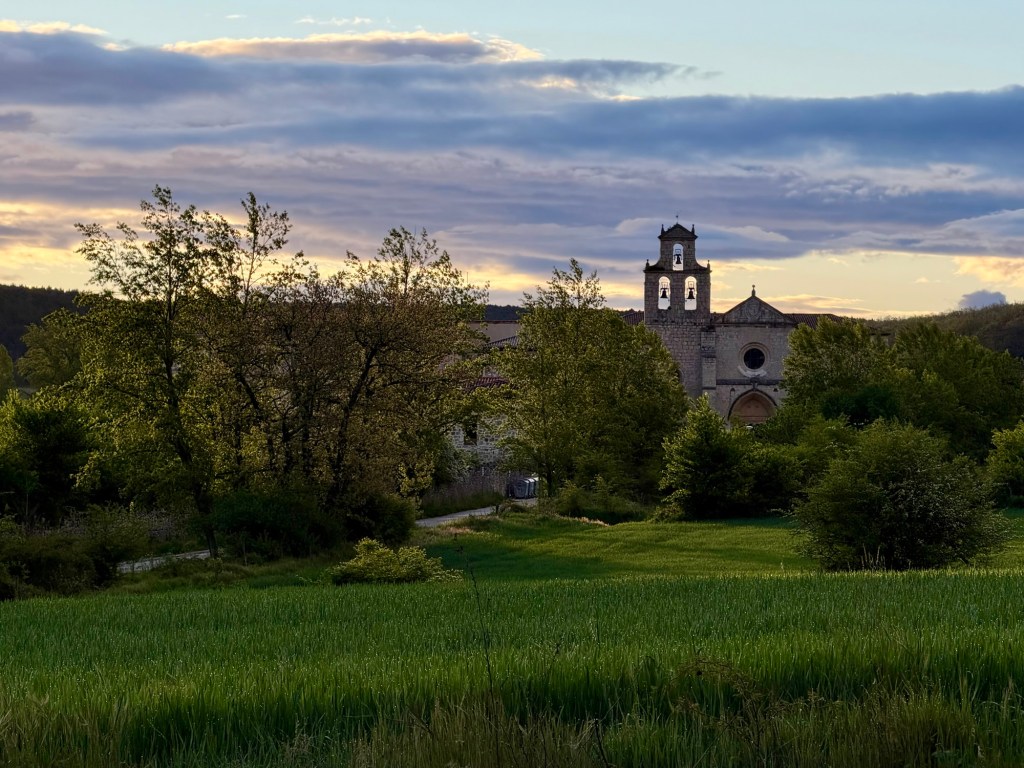
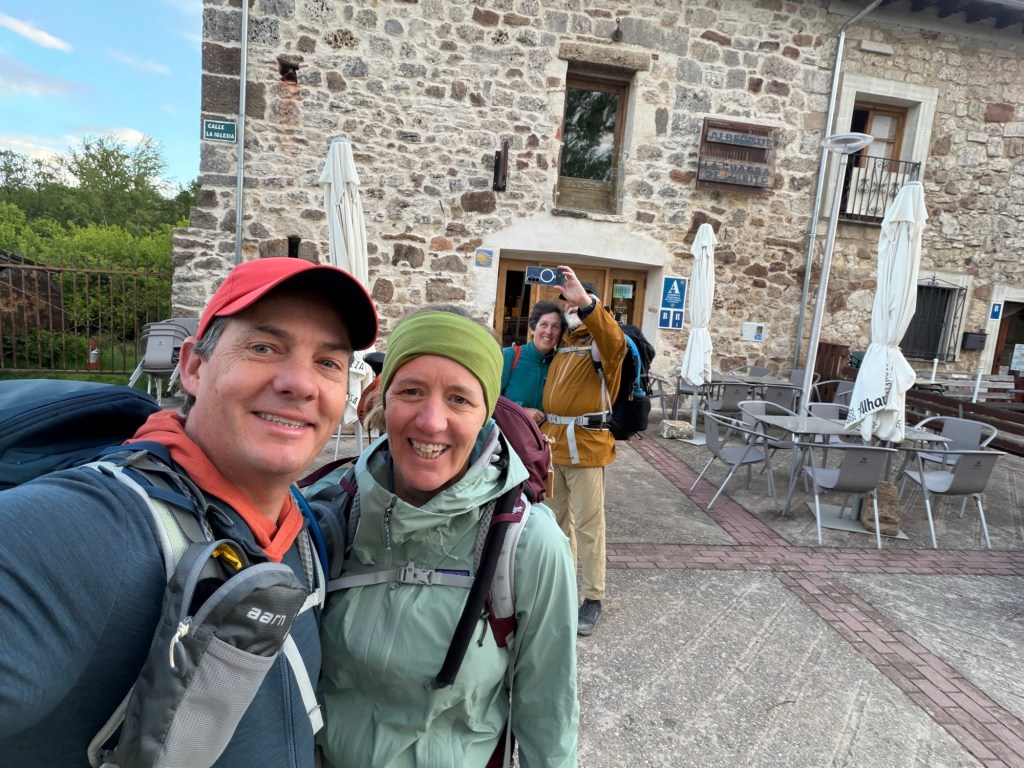
And for even more fun a few photos that I just wanted to post.
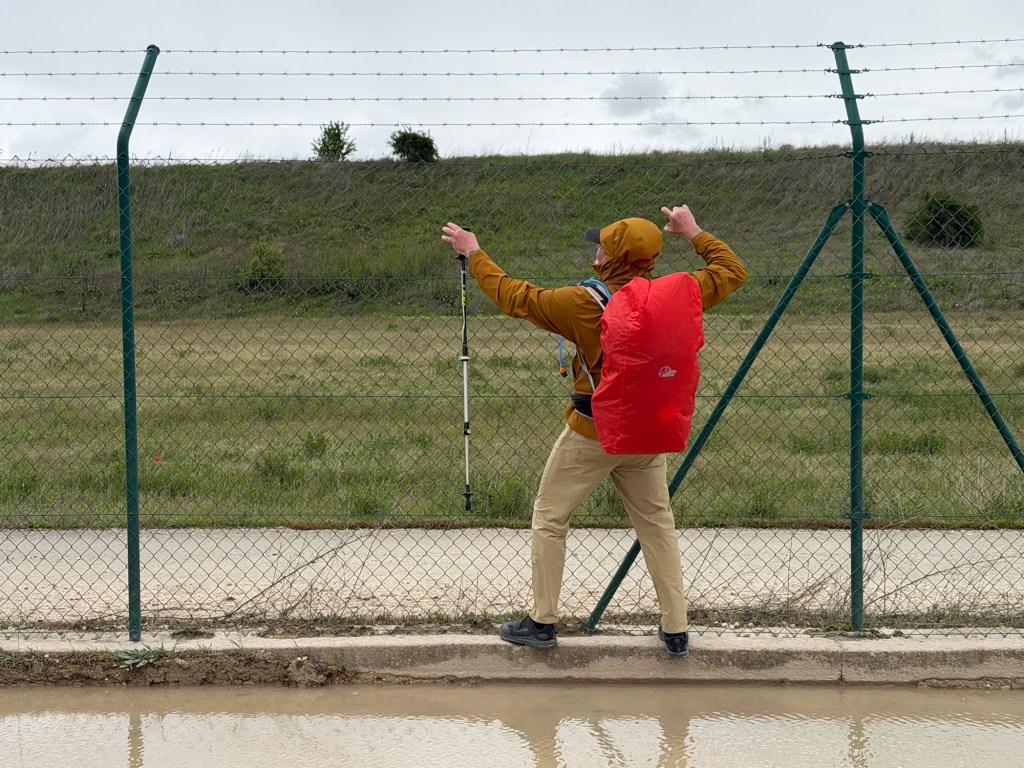
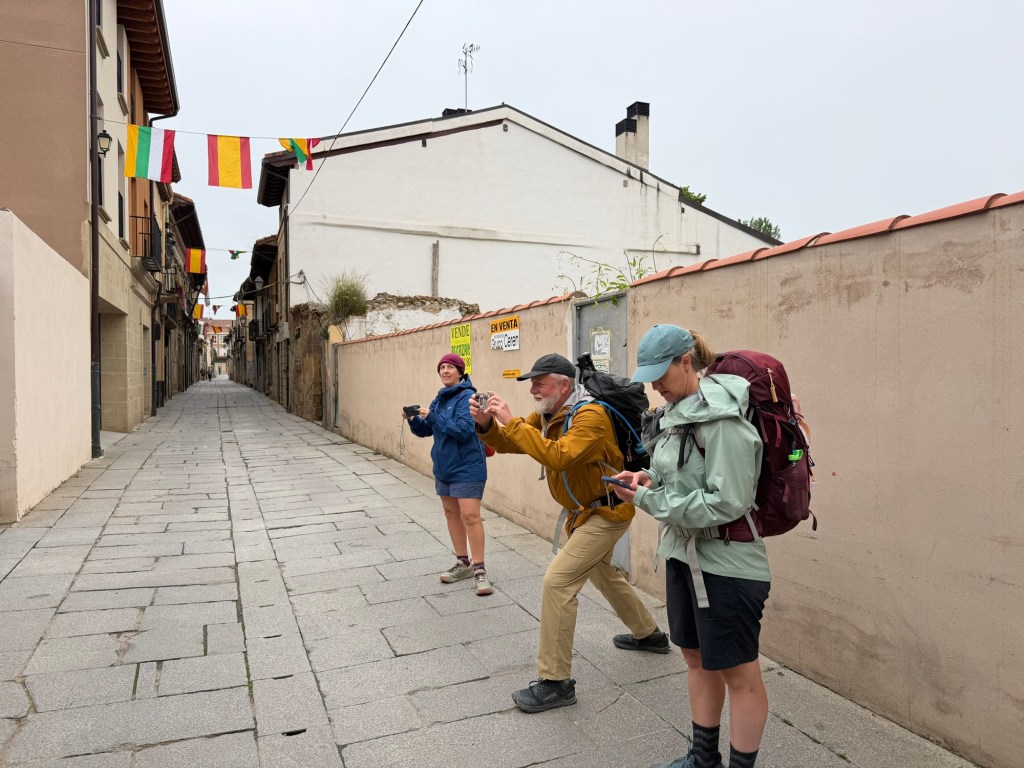
‘I’ll be the bull and you be the runner’, I said to Paul. ‘And Emma, can you film us?’.
We were on Calle del la Estefeta in Pamplona. The bull running street. The street where each year those who feel life is just a little too safe throw caution by the by and race before a hoard of marauding bulls. And here we were, on that street! It’s so fun going places you’ve heard of all your life yet never expected to visit.
I raised pointed index fingers atop my head, lent forward and stomped my foot menacingly. As menacingly that is as a middle age man in an orange cap pretending to be a bull on the streets of Pamplona, can muster. Paul let out a shriek (not really but it makes a better story). I leapt forward and Paul ran until guffaws of laughter left us breathless.
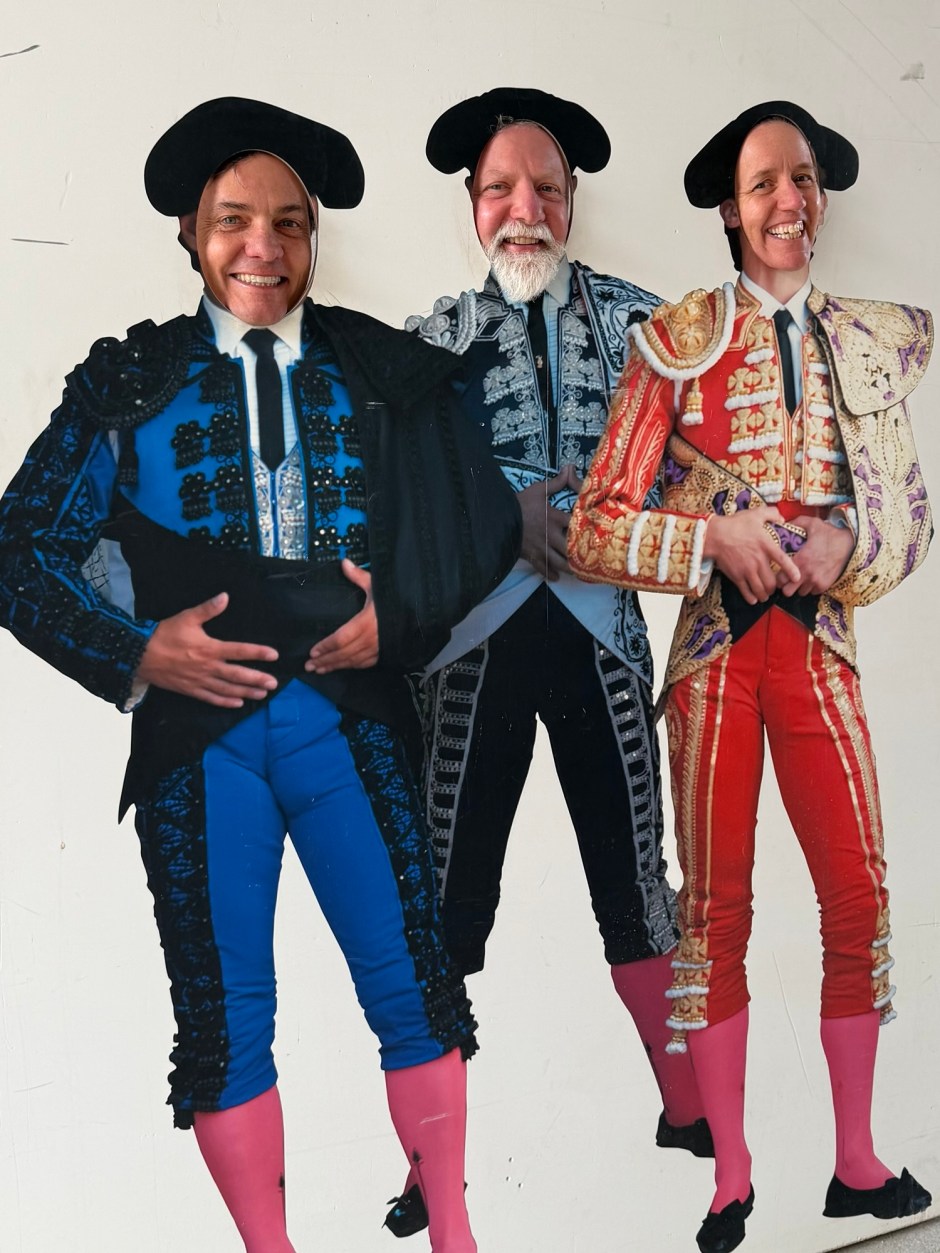
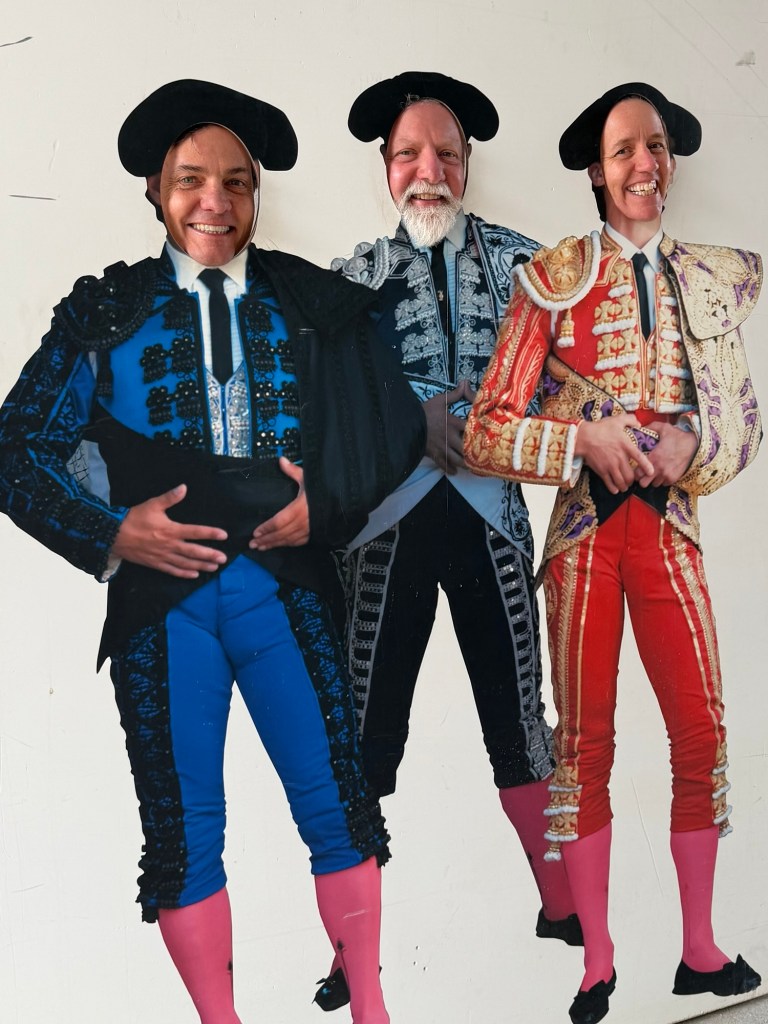
Later that day Paul, Emma and I (Khia was actually resting on our rest day) visited Plaza del Torro. The famous bull fighting ring where matadors (alpha males dressed to the nines) majestically wave their coloured capes before the large horned beasts, all the while stabbing them with barbed spears. It was fascinating, even if I had to call upon my quest to walk the Camino with equanimity to suppress my inclination to judge the brutal sport as entirely unnecessary exploitation of beasts who would, I suspect, prefer to eat grass in a peaceful paddock. We watched the running of the bulls in action on large surrounding screens and took photos of ourselves poking our heads through boards making us look like matadors. All of this though paled in comparison to the fun to be had in the middle of the bull ring itself where there was a bulls head perched on a wheel with handles like a wheel barrow and a selection of capes for use by ‘the matador’. Once again, I was the bull and Paul the matador as I lunged at his waving cape. Hilarious. And possibly the most fun you can have on a rest day along the Camino de Santiago.
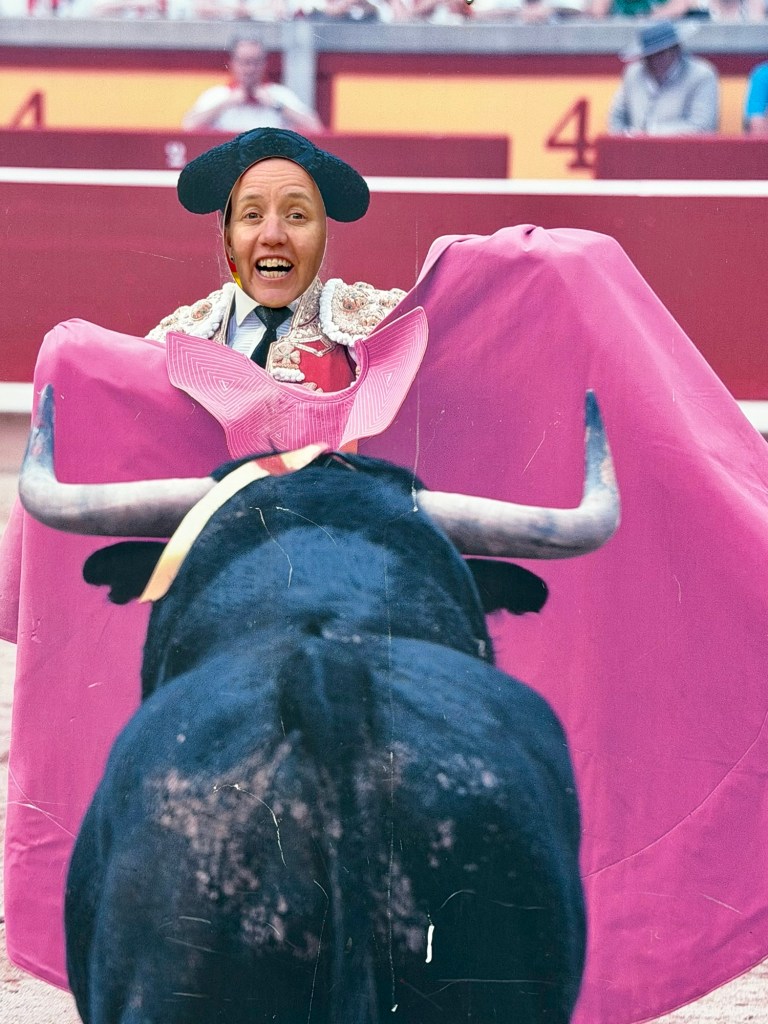
Although maybe there is competition for that title. That evening in the main square of Pamplona, together with our pilgrim friends Pippa from NZ and Beck from Tuggeranong (in Canberra!) we bumped into JuJu, chief of the TuTu tribe. We met JuJu on our first day, a third of the way up the Pyrenees. An American lady with a selfie stick, walking in a purple tutu and recording videos about the Camino for the interweb. Juju and her friend Margot invited us to join the Tutu tribe.
How could we say no? I mean really. It would have been awkward. So we said yes! After which we each took turns donning the purple tutu and twirling before the large gazebo in front of Ernest Hemingways favourite haunt (the Cafe Iruña) while Juju took a still photo and a video of each of us.
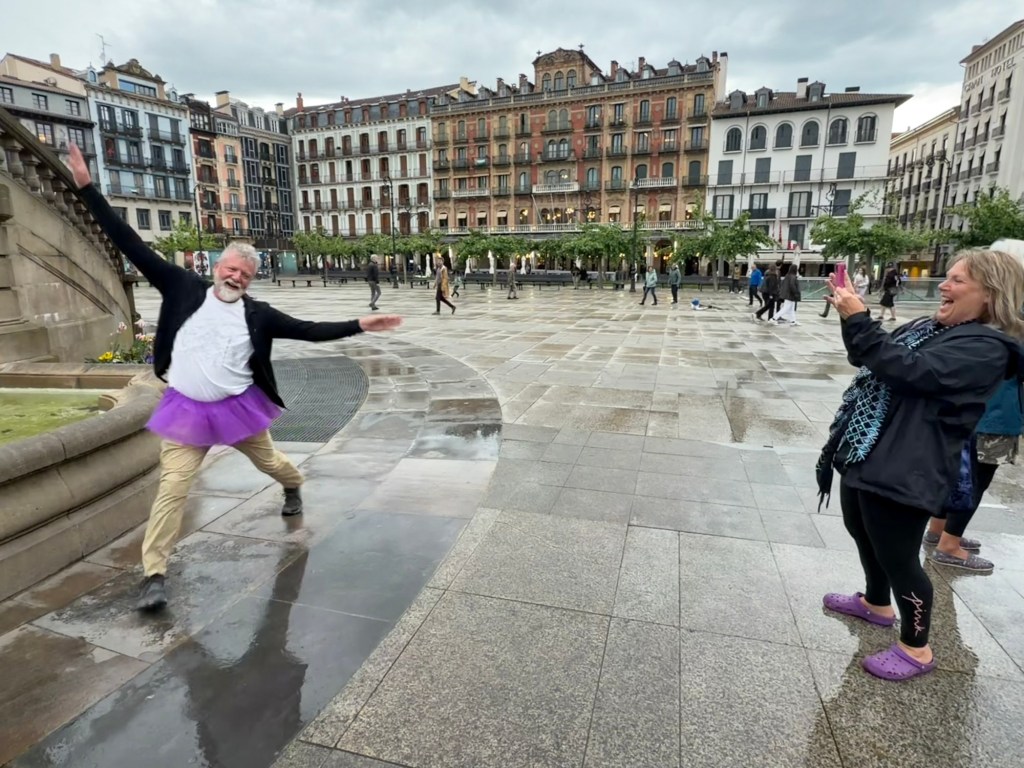
Margot asked Paul what he did for a living to which Paul replied that he teaches leadership. Margot however did not hear ‘leadership’, she heard ‘ladyship’ and looked at Paul quizzically. You teach ladyship? Paul suggested he would need to seek advice from Emma and Khia before taking his first class.
So now we’re members of the Tu Tu tribe, a membership which has yielded a warm hug on all subsequent engagements.
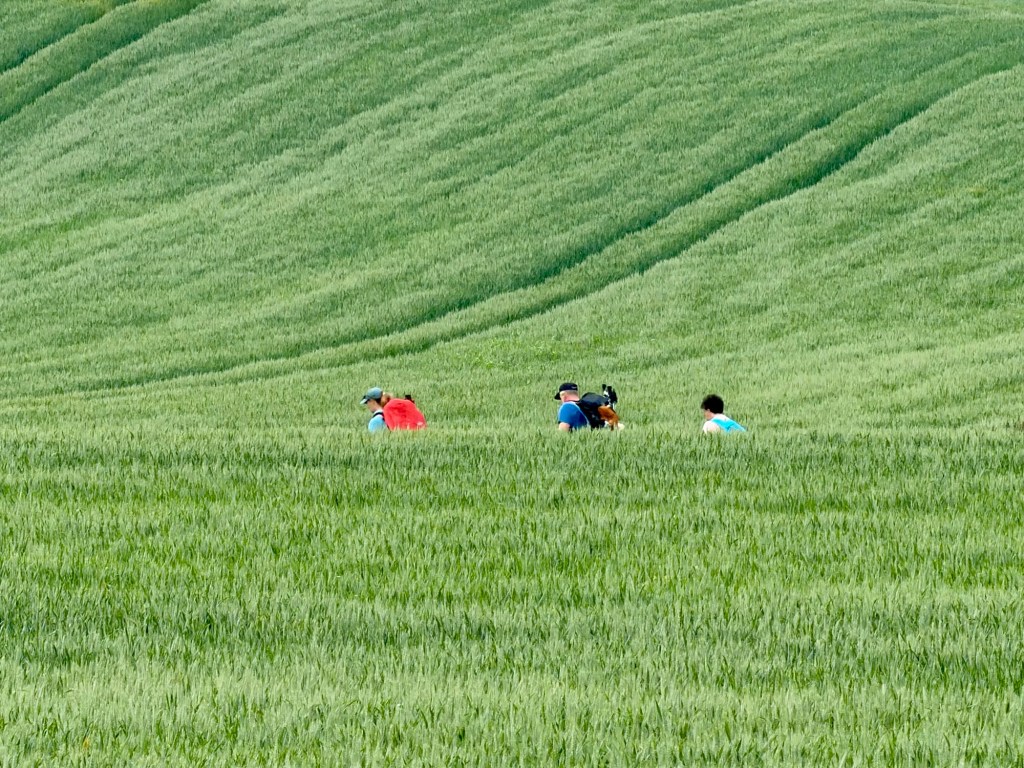
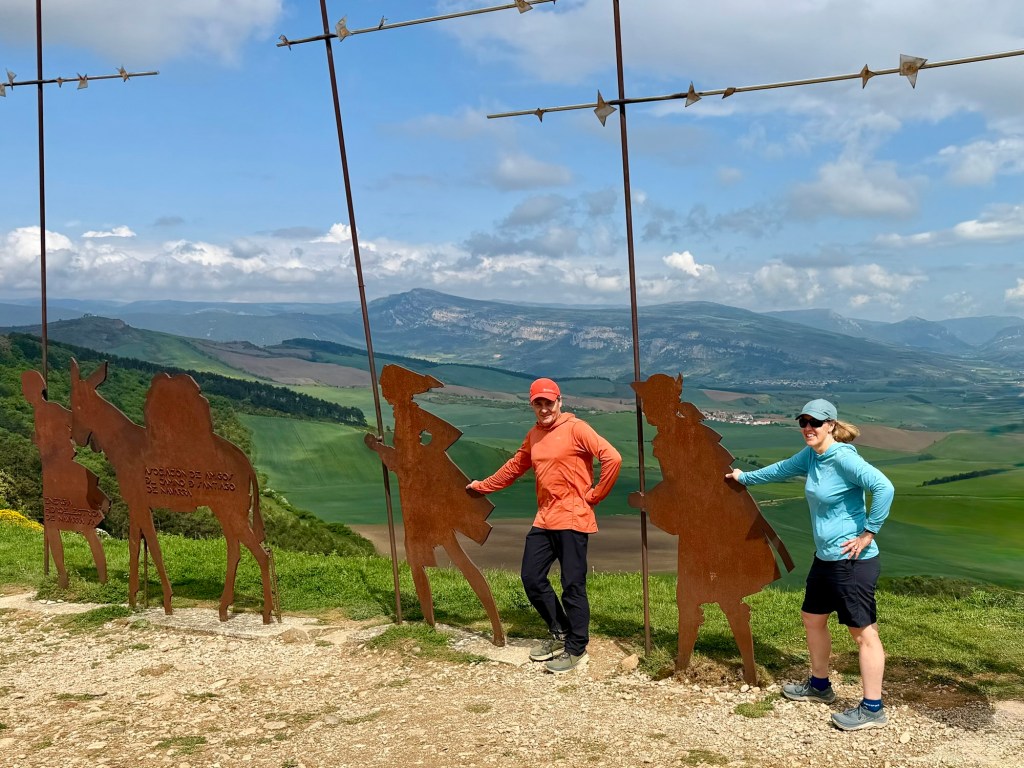
We left Pamplona after our rest day, making our way through the outskirts of town and back into the countryside. The path gradually climbed and then climbed some more through fields of wheat and barley splashed with red poppies before reaching Alto de Peron, the Mount of Forgiveness.
It’s an iconic milestone on the road to Santiago. An inscription reads, ‘Donde se cruza el camino del viento con el de las estrellas’ — “where the path of the wind crosses with that of the stars.” In fact the sculpture is intended to represent different eras of the pilgrimage over the ages. From its beginning in the middle ages up to the present day. We lingered. We took photos and then to no ones surprise, we kept walking.
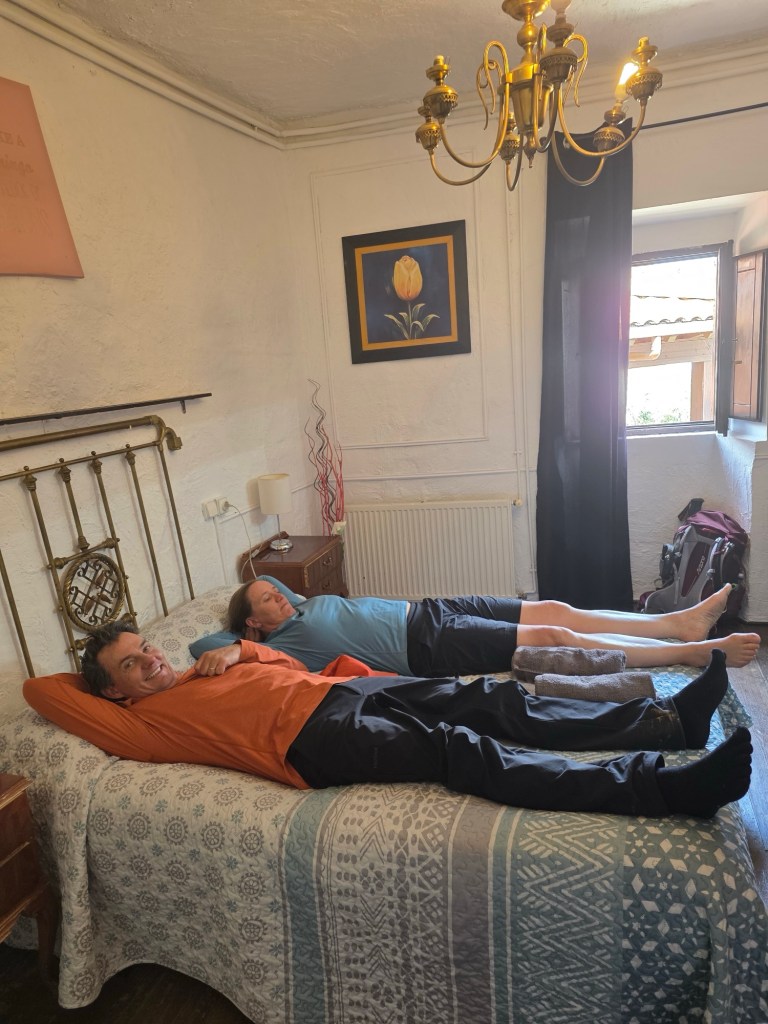
Onto Uterga and a tiny albergue in my favourite kind of building. The kind where nothing is straight. The walls, the floor, the doorway, the stairs all of it wonky as all get out. Emma and I lay out on our bed and the blood slowly drained towards our heads. The floor wasn’t flat, but good to have your feet in the air I suppose.
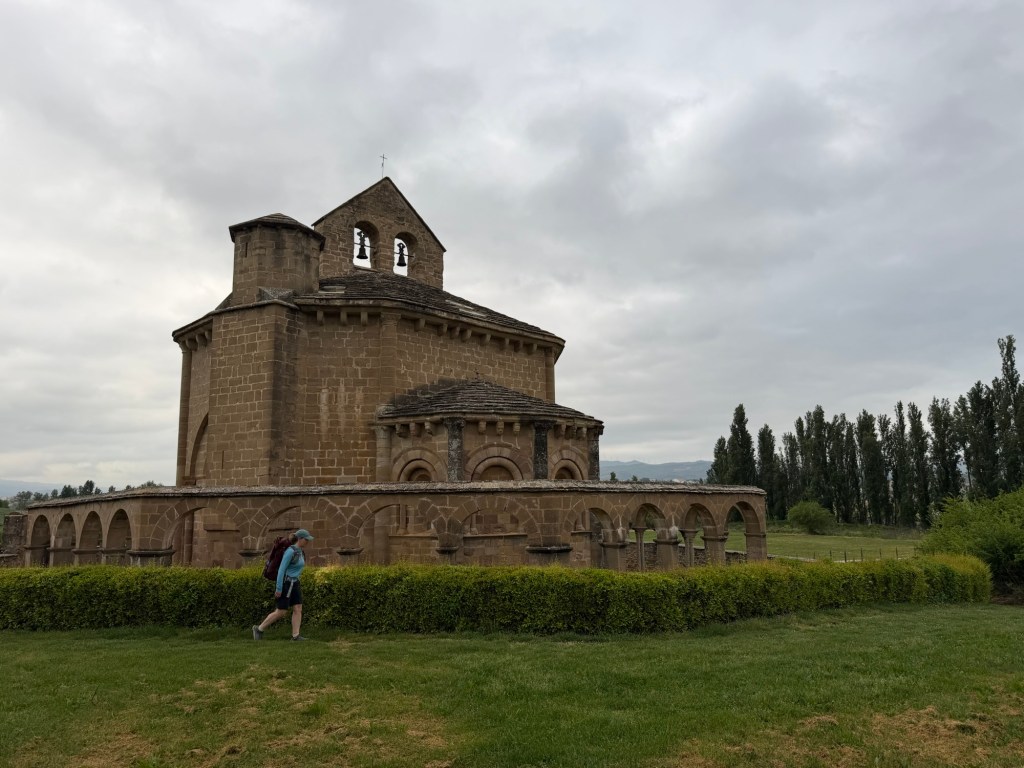
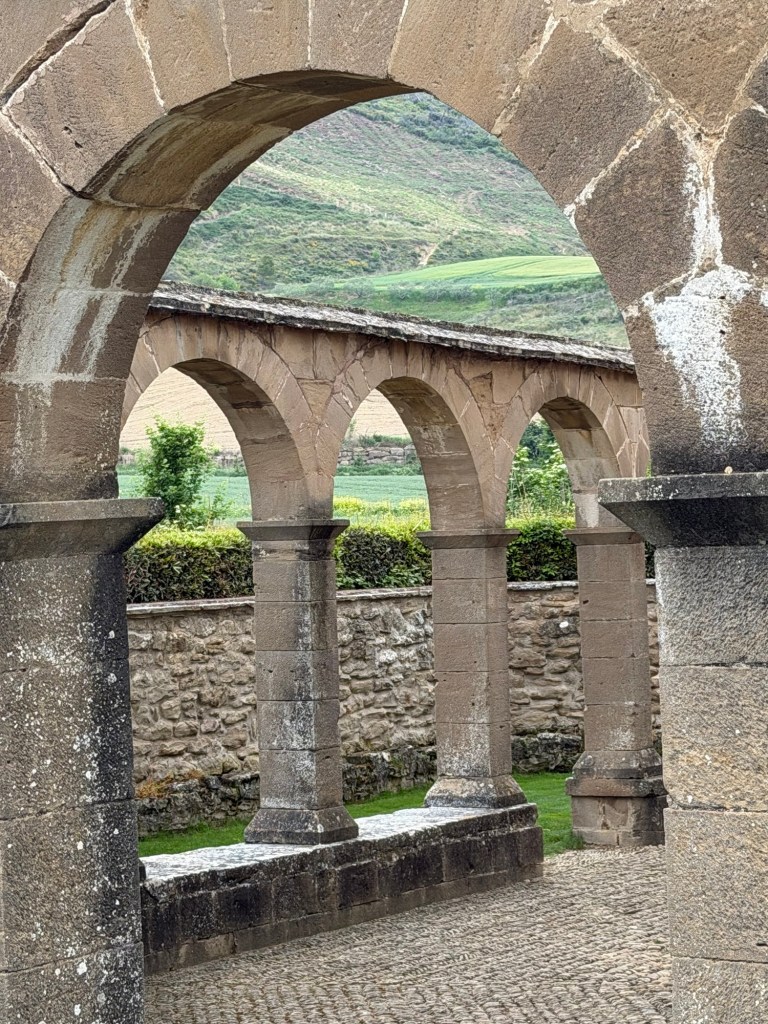
The next morning we took a detour, out to the Eunate. An octagonal church built in the 1100s; by whom however no one seems to know. The Templars perhaps? The Templars mission of course (I say of course but I had to look this up) ‘was to protect pilgrims travelling to the Holy Land, who were often beset by thieves and marauders intent on robbing them of the large amounts of money they needed for the journey’ (https://historiamag.com/ten-fascinating-facts-about-the-knights-templar/). The Eunate (translates to 100 gates) is surrounded by 33 arches around which you’re supposed to walk 3 times, taking you to 99 arches, with the 100th being the entry itself. Which we didn’t go through because we didn’t do our homework and had arrived before it was open. So, we kept walking.
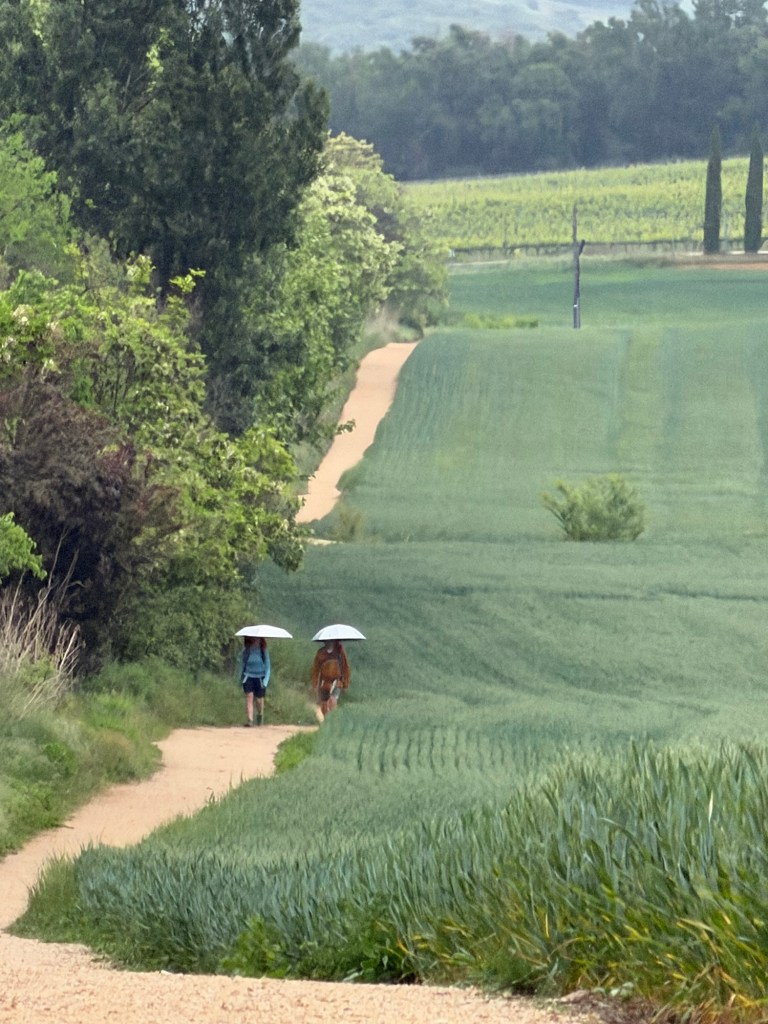
Then it rained. I mean, I think that’s when it rained. The days are blurring together. Hills, vistas, towns, flowers and people are all becoming one. It’s an effort to work out what happened when and what we saw in what order. But at some point it started raining. And kept raining. Thunder and lightning too.
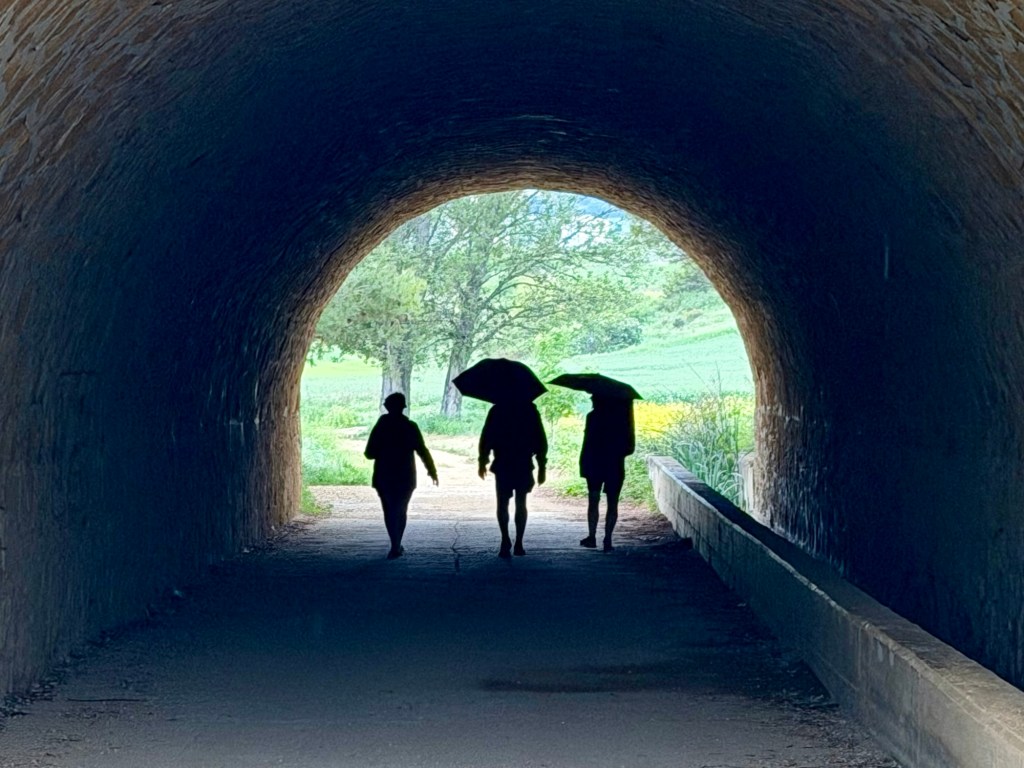
Khia walks fast when there is thunder and lightning, but Paul and Emma were cool like cucumbers. They have umbrellas and special little attachment do-dads so that they don’t have to hold them by hand. Very effective, but it is hard to take them seriously with their go-go-gadget brellas!
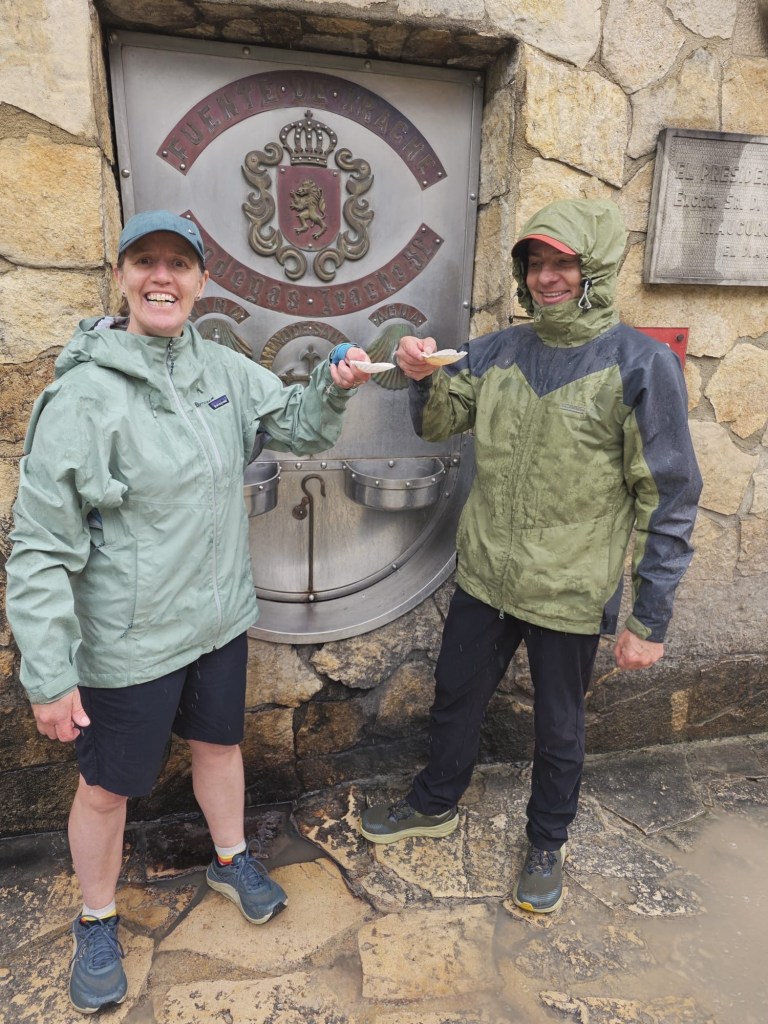
We stopped, as pilgrims do, at the Bodega Irache wine fountain on the other side of the town of Estella. The winery provides 200 litres a day of free wine from a fountain mounted in the wall. We pretended to sip the wine from our pilgrim shells because that’s what pilgrims do and frankly it was raining too hard to stop and actually enjoy the experience the traditional way. That is by actually drinking it. The days walk finished at the Oasis Trails Albergue. It had a pilgrim’s room warmed by a wood stove. The whole place was run by volunteers, most of them from the US and Canada.
They believed in God and it was striking to me. A young woman by the name of Mary Anne wandered into the pilgrim room and we began chatting. She was delightful. Warm and engaging and seemingly interested in us. She talked about God, in all seriousness, as having arranged things for her to come and volunteer here to assist and help passing pilgrims. It was the same for Dan, and Mitch and two others whose names I am sorry to say I now can’t recall.
They prepared a meal for us that evening in a cozy common room. Nothing was too much trouble and the food was fantastic. A Mexican salad followed by a vegetable or chicken chilli. In conversation over dinner I met another volunteer who also talked about how God had arranged things for her to come and spend two weeks here volunteering, though she wasn’t quite sure why he (God) had done that. I got the impression she thought he (God) was being a bit cheeky.
I’m dwelling on this, I don’t why. These people were genuinely lovely. They didn’t need to be here doing this, but here they were and the atmosphere they created was a delight. We laughed and talked. It was like being back at our first albergue at Borda. So easy to talk and chat with total strangers. And yet as a devout (but still searching) atheist, I just couldn’t reconcile their familiarity with an interventionist God, a being they so clearly spoke about not just as real but as benevolently and actively guiding their life. My lack of faith sat in contrast to the palpable sense of service they brought and the atmosphere of community created by their belief. It was one of the most enjoyable evenings of the trip so far.
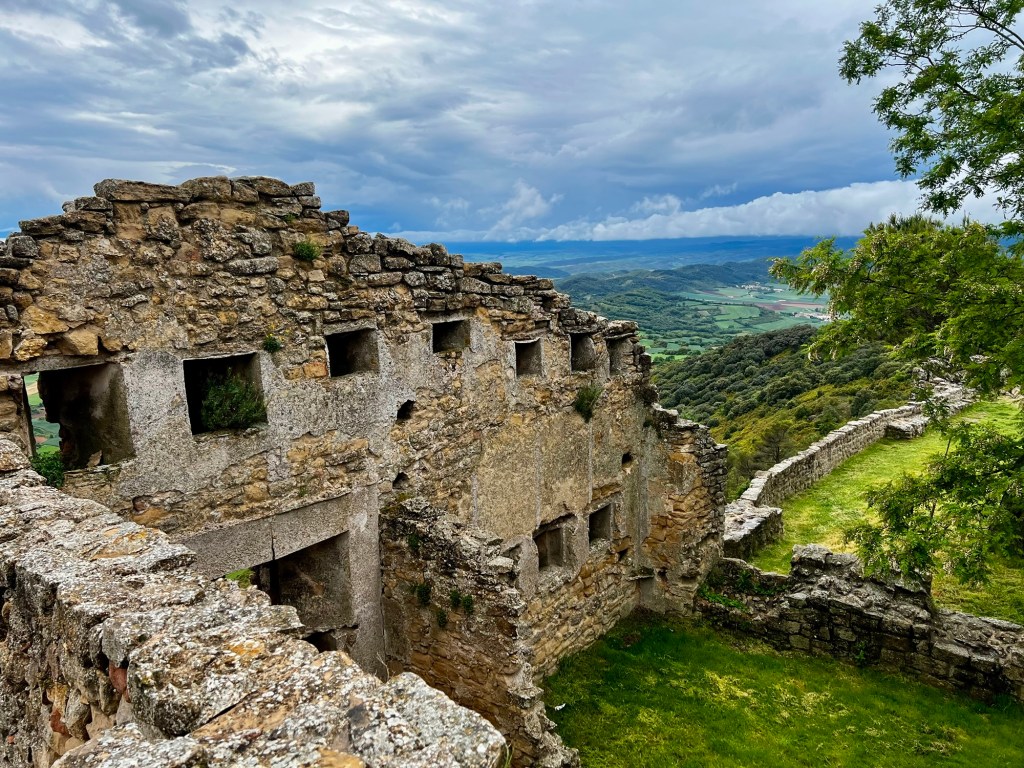
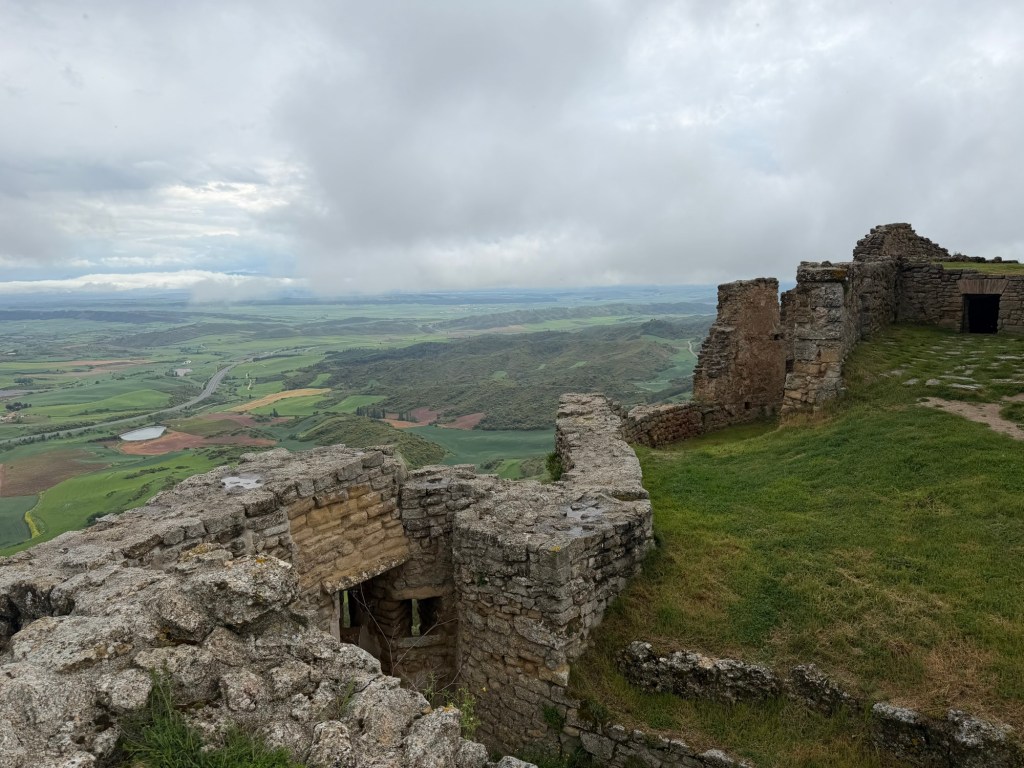
Before dinner that evening Emma and I went on a side trip. Sitting on a hill, high above the Oasis Trails Albergue at Villamayor de Monjardín was the ruins of a castle originally dating back to Roman times. The view at the top was of stormy skies over a patch work landscape of forest and fields. It was just stunning. The ruins had a functioning bell which Emma rung, the sound carrying to our albergue below. On the way back we watched a thunder storm on the horizon and followed its progress across the valley towards us. It bucketed down less than a minute after we made it inside.
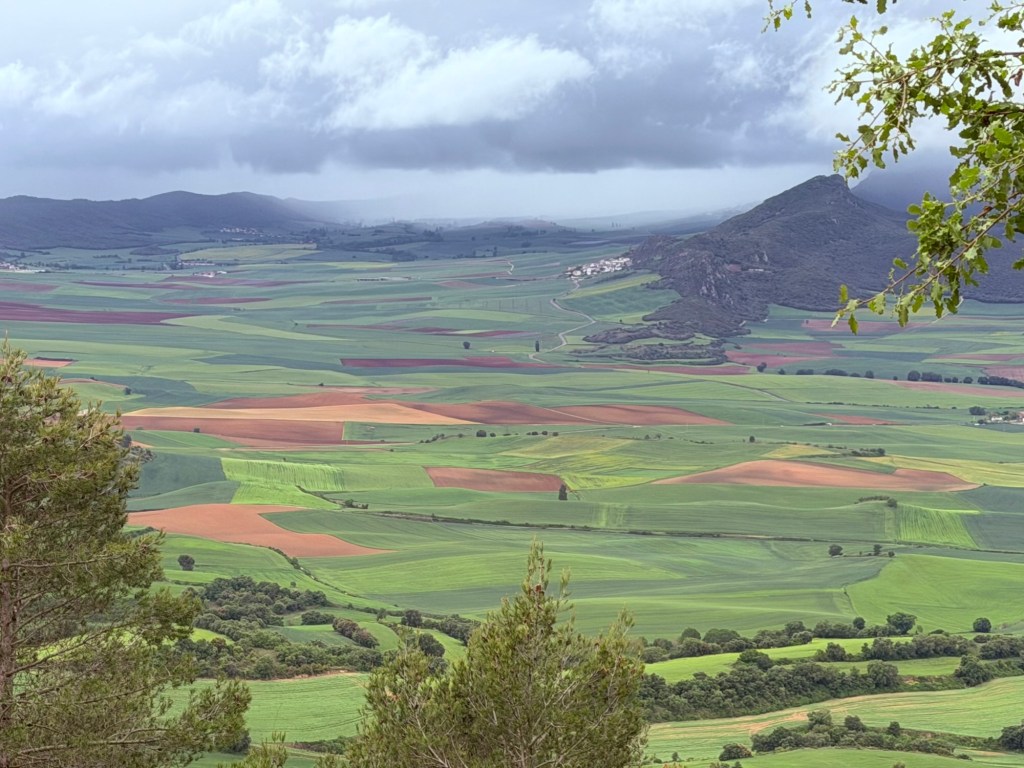
The next day? You guessed it, we kept walking. A rhythm is forming and the days just seem to go by. This country frankly is not fussed about breakfast and we often find ourselves walking 10 kilometres or more before we eat. We are usually pretty hungry by that time and it’s an odds on bet as to whether the next town will have a cafe and if they do, whether it will be open. And yet, we still haven’t actually gone hungry. One day, I think it was the rainy one, the best we could find was a cafe without much charm attached to a large supermarket. Oh my God (maybe he is real) the tortillas de potatas was amazing. We had one serve followed by another before stocking up on supplies to avoid any possibility of future low blood sugar levels.
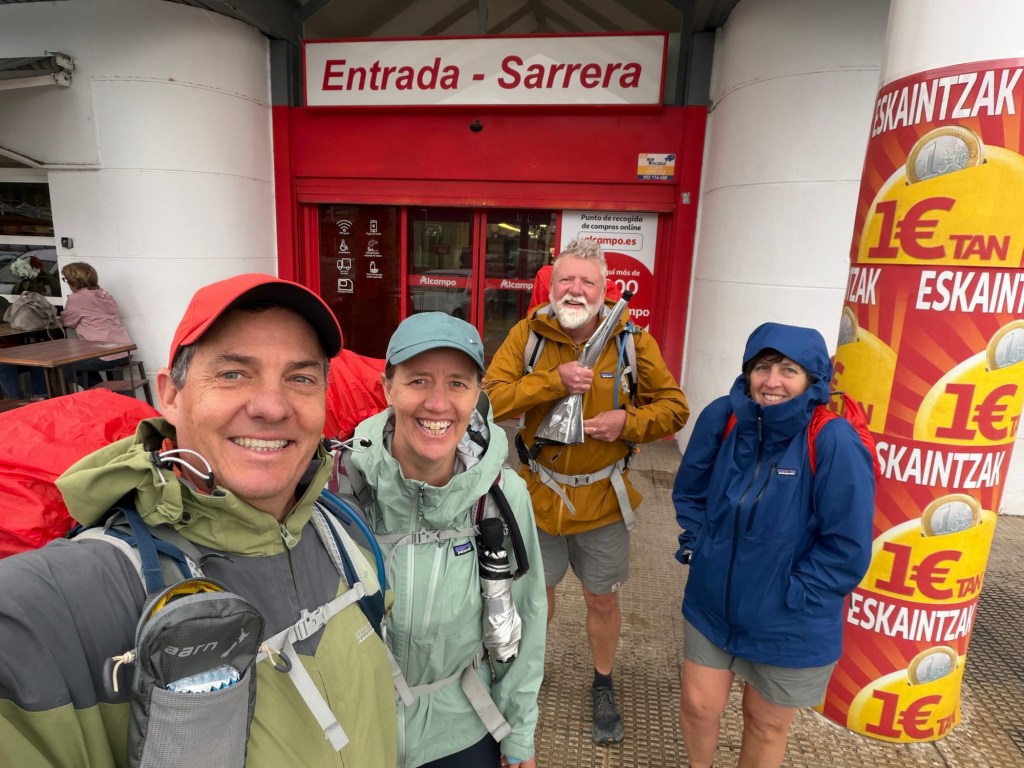
Paul got some toothpaste as well because he was running low. That night when he brushed his teeth he said the taste was off. It was a bit floury. Then it started to gum up his mouth, so he started trying to rub it off with his fingers, which started sticking. Increasingly desperate he searched for real toothpaste to remedy the situation. When he pulled out his google translate it turned out he had actually purchased dental adhesive! So funny. Paul said he would have laughed himself if his gums weren’t glued together.
Reminded me of Khia’s request for sparkling water back in Paris when the bottle we purchased turned out to be menthol water. Which happened again today only this time the sparkling water turned out to be sugar free lemonade! In Paul’s defence he did translate the label on this second bottle. It translated as soda. He coupled that with the badge indicating zero calories and figured that could only be water.
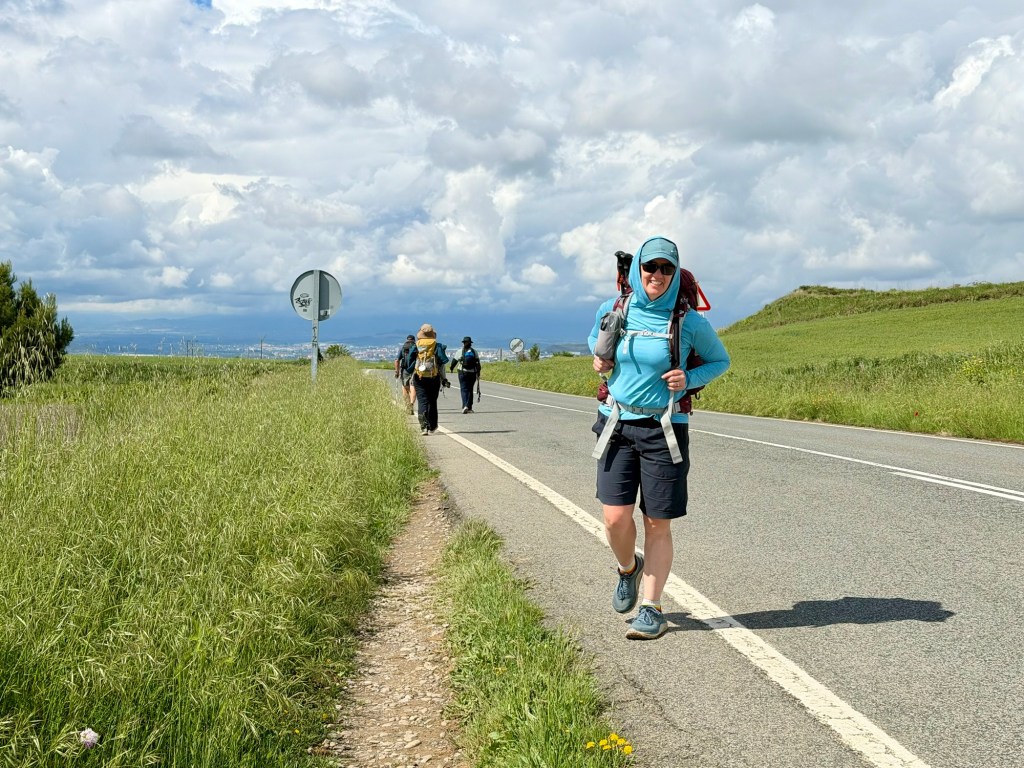
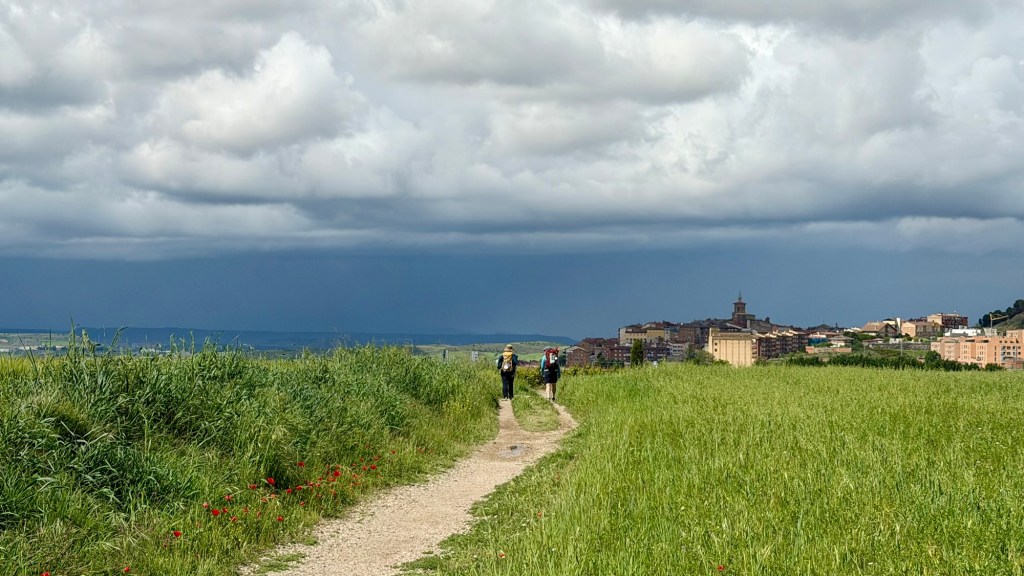
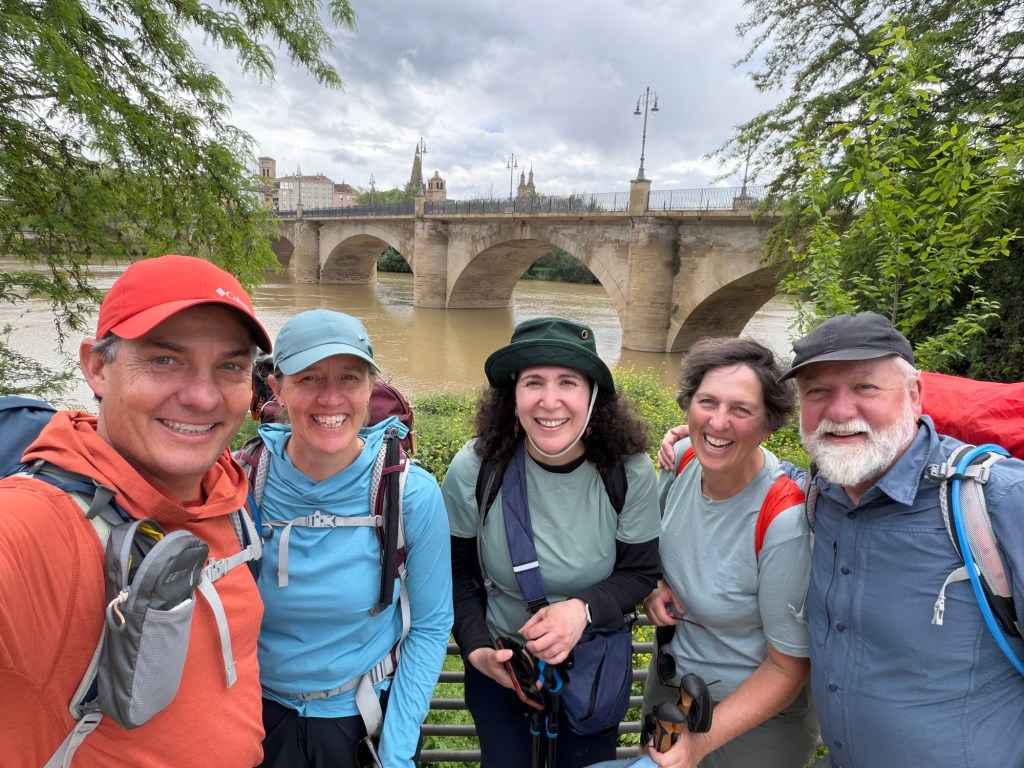
We are currently in Logroño. Having our second rest day. We got here by… walking. Another delightful day in which Robyne from Borda had caught us up and walked with us. We also met Gina from Canada who we also walked with for the day. It is one of the most delightful things about this experience, just bumping into people, meeting new people, walking with people for a while and then letting them drift away, and later bumping into them again.
The skies were stunning on the walk into Logroño. The rain had cleared but the skies were still moody, presenting my most favourite scene of all, a sunlit foreground with dark and stormy clouds behind. I fell behind, my camera paying homage to the scenery of The Way of Saint James, and whoever or whatever created it.
And finally. I’ve been collecting photos of cats of the Camino. Here is the selection so far.