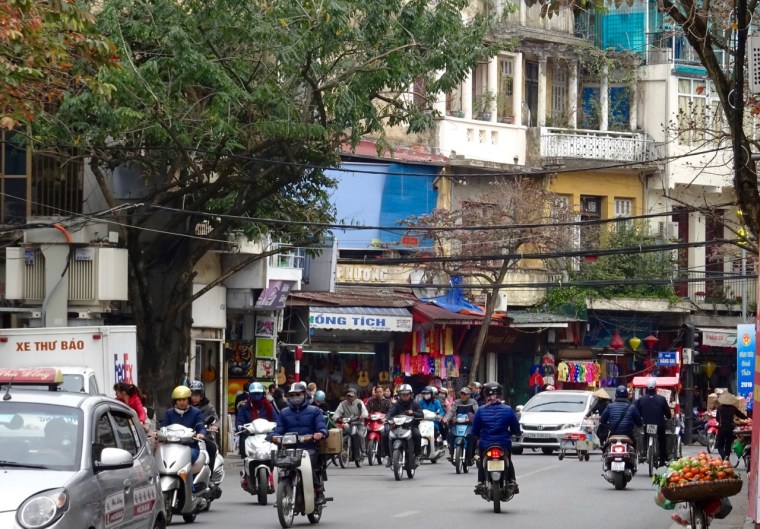
Wow! Hanoi hits with you with a punch. A bedazzling load of sensory input that left us reeling as soon as our taxi entered the Old Quarter, having arrived late in the evening from the serene and decidedly first world Hanoi International Airport. The view was not more than a hundred metres in any direction as the narrow streets twisted off and away. There was however more to see than could be taken in as we cast our eyes around to get our bearings and find somewhere to eat.
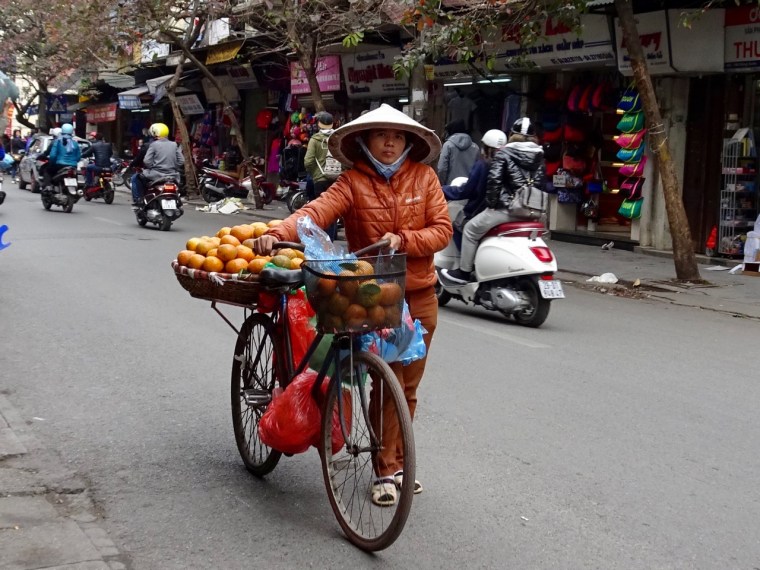
The streets are a river of scooters, the footpaths are either packed with eateries or performing as a parking lot for yet more scooters, and people, people and more people fill the spaces in between. It’s an obstacle course, with most journeys requiring twice the number of steps you would ordinarily take to get somewhere. Buildings on either side of the streets had the feel of brightly lit canyons and businesses of every form fills in the blanks.
The footpath obstacles of HanoiHanoi streetscape – it is busier than it looks here
Like other visitors to Hanoi, when we weren’t trying to escape it we were totally mesmerized by the traffic. Llewellyn King of The Huffington Post describes it as one of the wonders of the world.
‘Looking at the traffic is like watching a column of ants, going hither and thither in a courteously chaotic way. The only absolute rule on the roads is to keep to the right. Everything else is improvisation. Central to the Hanoi traffic triumph are scooters and very light motorcycles (some of them electric), the occasional moped and even bicycles.
To the more than three million scooters, most of which take to the streets daily, add the skill, courtesy and physical courage of the riders. They weave, dodge, brake, swerve, swoop, accelerate and slow in what, to American (or Australian) eyes, is an unscripted ballet with a cast of millions. The dance is known, but the choreography is new by the split-second.’ (Lewellyn King – The Huffington Post)
The whole thing is a triumph of chaos over system. On more than one occasion we stopped and stood on the corner of two intersecting streets and watched as the opposing streams of traffic met. It was fascinating because nobody stops, the traffic just merges through itself.
Then there is the honking. A cacophony (I love that word) that greets your ears with a level of sensory input to match that provided for the eyes. Scooter drivers are just like bats and whales. They navigate and communicate by sending out sound waves to the other drivers to let each other know they are there. Honking also seems to be correlated with speed. The faster you go the more you honk. Those exceeding the speed limit, if there was one, just ride through town sending out honks to rival any master of Morse code. It’s wearing. So wearing Oliver started to fight back. Yelling out his own ‘beeps’ to warn the scooters that there were now pedestrians that needed to be accommodated on the asphalt.
Into this scene we inserted ourselves each day, bracing as we left the sanctuary of the Hanoi Hotel3B. When we were in Bangkok, Paul (my older brother that is) told us a story about a driver he had once in India. Paul had asked this driver how he negotiated India’s traffic chaos, to which the Indian Driver had replied, ‘Be confident’! I imagined this coming out in a thick Indian accent.
So, ‘Be confident!’ became our street crossing mantra. There is no point waiting for a break in traffic. There are none. There is no point waiting for the lights to change, there are very few. Rather you must have
‘…the patience and boldness to know that the river of motorcycles, a river that ebbs and rises, but never ceases, will accommodate you’. (Lewellyn King – The Huffington Post)
Be confident!
So we were. Sort of. Perhaps we were boldly timid, or timidly bold. Emma and I gripped Amy and Oliver’s hands tightly and probably issued ten times more instructions on where and when to step than they were ok with. Hanoi is a tough place to give the freedom to grow and still ensure everyone makes it home in one piece.
We did however get better at it with each foray away from our hotel. We shopped, successfully purchasing four new beanies to keep us warm in the cool Hanoi weather, but unsuccessfully searching for new sandals for Amy. We tracked down familiar banking institutions; we took in the sites including Hoan Kiem Lake, the Ngoc Son temple (built in the 14th Century in honour of a war hero, Tran Hung Dao, who thrice repelled the mongol hordes from China in the 12th century) and its famous red bridge and the Vietnam Military museum; and we navigated our way to the Indochina Junk offices to finalise arrangements for our trip to Halong Bay.
Beanie selfieHow could we not find anything suitable here?? Cinderella?At the Ngoc Son TempleRed Bridge to Ngoc Son TempleMilitary museum sculpture from bomber wreckageEverywhere there is an opportunity for commerce
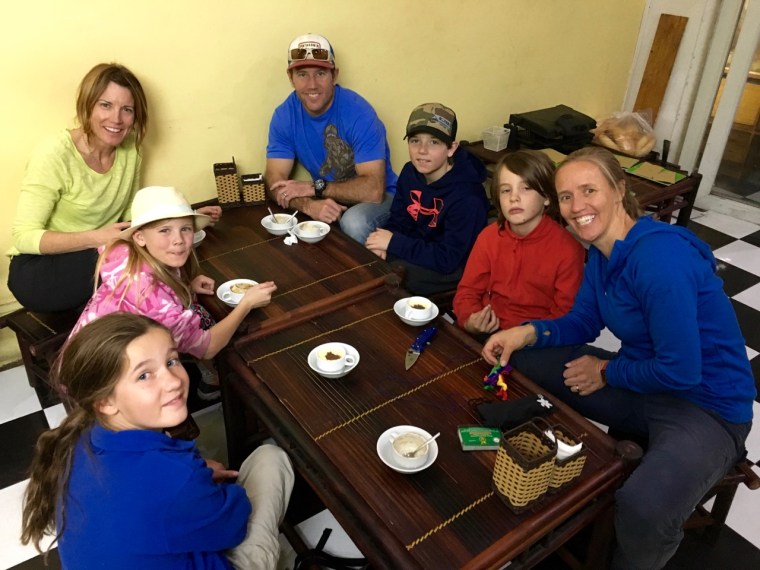
After our Halong Bay visit, and with new friends at our side we explored the street food scene. Ryan and Kami, and their children Sage and Indy had been on a street foods tour before we met them and we soon found ourselves benefitting from their local knowledge. We ate some amazing food, including this indescribably good chocolate egg nog type drink (I dunno how else to describe it), in places that we would not have given a second glance, or even found for that matter.
Chocolate egg nog surprise (Oliver didn’t want to stop eating for a photo)Watching a street performance with new friends
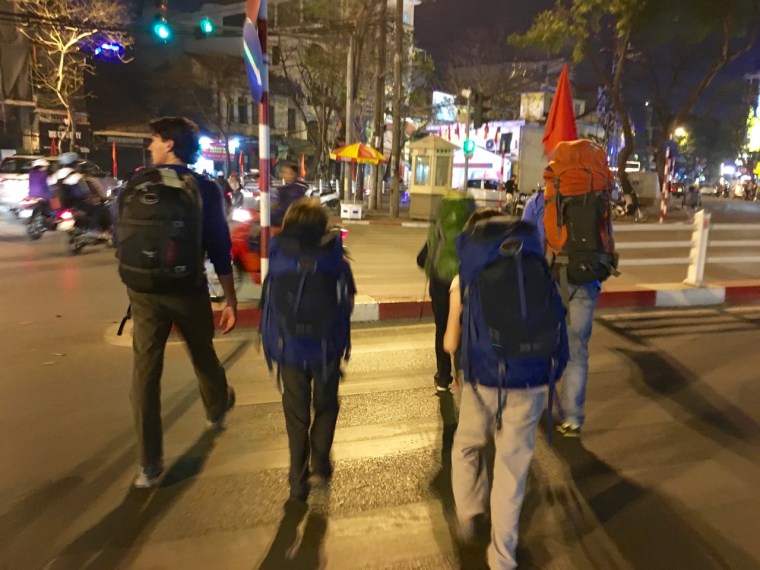
We left Hanoi at 10.00pm on our last day, catching the sleeper train to Danang. So adept were we at navigating the chaos we walked all the way to the train station with packs on and Amy and Oliver unrestrained for the most part by their parent’s hands. We were becoming (a bit more) confident!
Hanoi train station – waiting for 10pm to comeIntrepid urban hikers of Hanoi
Laos is sometimes referred to as the land of a million elephants. Regrettably there are no longer anything like that number of the large beasties left. In fact, we were advised that there is probably less than a thousand altogether, including something like 500 wild and a touch under 500 domesticated – all up. Elephants are still revered and loved by the populace but there is increasingly less land available to accommodate them.
On Emma’s South East Asia to-do-list was a visit with some elephants. We had hoped to do so while in Chiang Mai, Thailand but the only elephant parks we were interested in were all booked out. There are a lot of elephant opportunities for travelers but only a few of them make a genuine effort to do what we would consider the right thing by the elephants. We are not into circus tricks, elephant riding (it’s really bad for their backs) or exhausting work day after day supporting the tourist trade.
So it was that we landed upon a visit to the Elephant Conservation Centre about two hours drive out of Luang Prabang, Laos. The ECC elephants are not wild, they are well and truly domesticated. But for a domesticated elephant in Laos, this is elephant heaven. No working 12 hours a day dragging logs out of steep forests with chains around your neck and no beatings with canes around the legs to tell you what to do. Nope, these elephants have an onsite elephant hospital, they are trained with positive re-enforcement, they are fed or provided access to the 200kg of food they need every day, get four or so hours a day to themselves just to hang out and be elephants and have their lives ‘enriched’ with elephant puzzles and games.
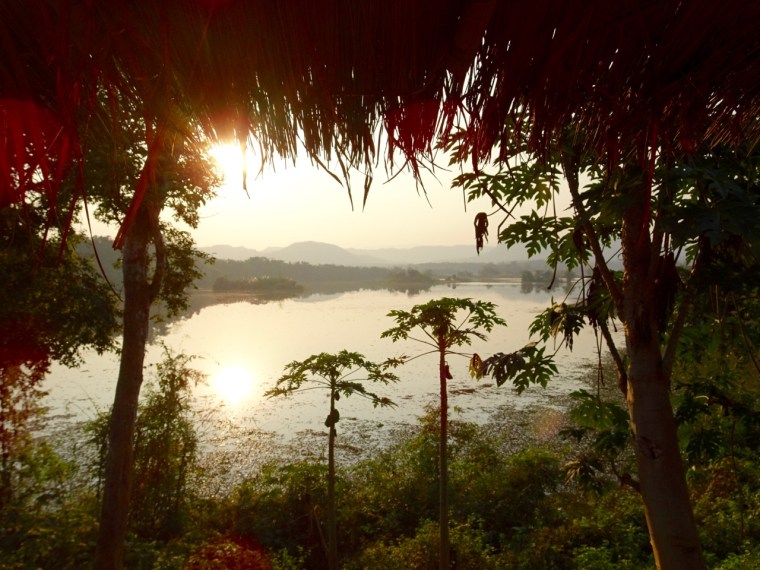
We arrived at the centre by ‘speedboat’ across an artificial lake created by the damming of the Nam Khan River. It is a stunning spot, with the Centre’s bamboo huts and restaurant perched on a little peninsula jutting out into the lake.
The ‘speedboat’Our accomodation
Lah, our guide greeted us with his flamboyant accent and slightly camp ways. He was great, extremely knowledgeable and finished every burst of information with, “ya, it is like this’.
Our guide Lah – this was his usual method of feeding the elephants
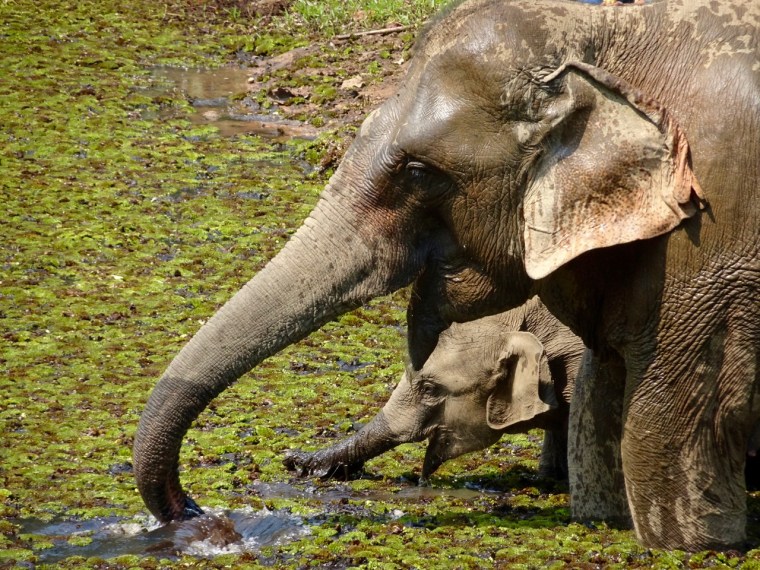
The Centre was set up in 2007 by a couple of French guys and a Laos business man. They currently own 7 elephants including one big male, 5 females and baby boy. Two other mothers and babies are also there on a contract with the centre which has 106 hectares of land. This contract ensures the elephants owners and mahouts are paid while the mothers are on maternity leave – they actually call it the baby bonus program! So while after the contract is complete the elephants may go back to work in the community, at least the babies will have longer to grow up in a natural setting with their mothers. If the centre would like the mothers and babies to stay they would need to pay around US$60,000 for each pair and they would need more land. The current site is only just big enough to support those elephants already there. Getting more land is a complex and delicate process of working with Laos government officials.
One of the babies enjoying time with her mother
The young Belgium fellow running the place explained the games required to cultivate relationships within the government and the difficulty competing with Chinese interests in land in the area. Influence comes with privileges bestowed and the Centre can’t afford to pay for the Laos official’s children’s education the way the Chinese can. We got the impression the rug could be pulled out from the centre at anytime.
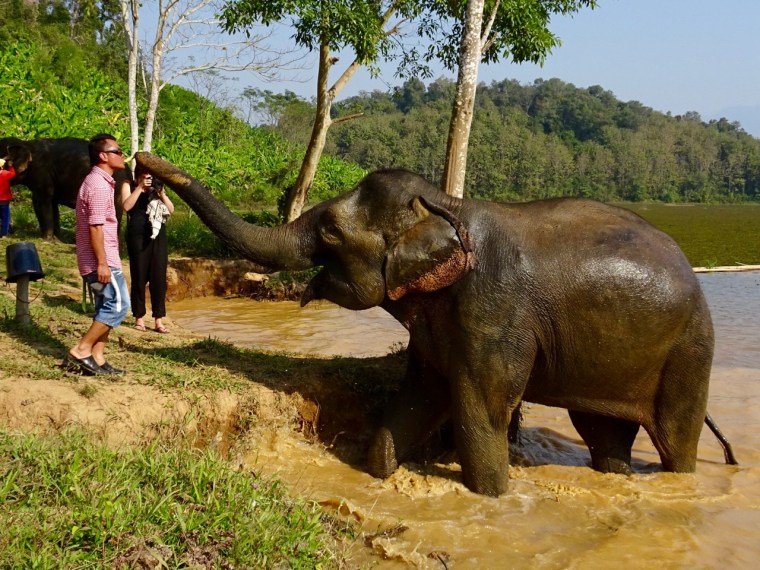
We first met the elephants for their afternoon bath. We wandered down the hill and right in an amongst them as their mahouts urged them into the water. It was a thrill to be up so close to them and a pleasure to watch them roll and loll about in the water, suck water up with their trunks and spray it all over themselves and to play around. One elephant sat down on its haunches and used its trunk just to continually splash the water in front of it, just like people would in a pool.
Group drink before bathBeautiful elephants
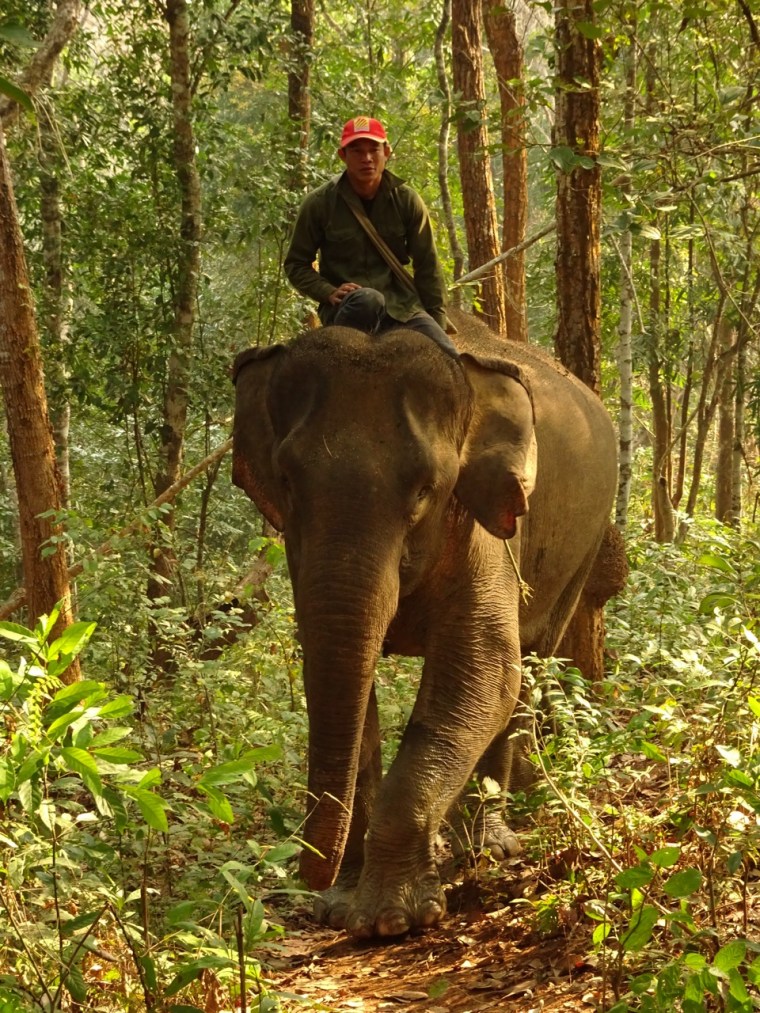
At the mahouts urging they all climbed out of the water, some more gracefully than others, where we fed them from a platform, trunks coming at us like… I’m not sure what it was like, snakes squirming in mid-air maybe? Then we walked with them up into the hills where they spend each night. The mahouts were lifted effortlessly up to sit on their heads as they marched off into the forest. We watched the sun set over the lake from our little bamboo huts and looked forward to what tomorrow would bring.
The step out was pretty big for the little guy!
Amy says hello to Phu SuryaYikes!
The elephants head to the hills for the nightOur accomodationThe view from the hammock
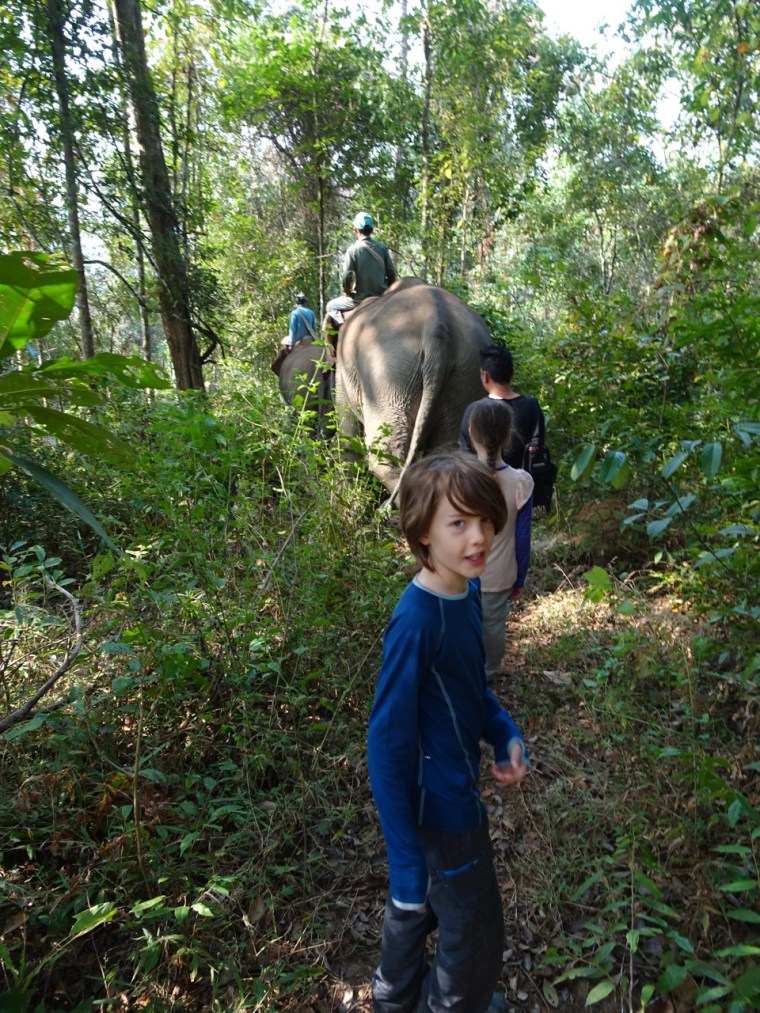
It brought a trek into the hills to find the elephants. We hiked up hill and down dale, following along with the mahouts. One of whom had a thing for singing loudly which was entertaining. The elephants are chained at night. Long chains loosely applied around the leg so they can graze a fair sized area. The centre cannot be fully enclosed and the elephants can’t be left to roam for their own safety. If they drift off into the surrounding farms the centre has to compensate for the damage done or worse still, there is a good chance they would be shot.
We retrieved the large beasties and walked with them again through the forest. At one point Mae Dok, the oldest elephant of the herd stopped grabbed a small tree and unceremoniously ripped it from the ground no doubt using most of the 150,000 muscles in her trunk. Amazing. We all laughed and she set about devouring her prize.
Walking with the elephantsWalking with the elephants
Down by the waters edge the elephants took another bath, before we were unexpectedly offered a chance to sit up on their necks for just a minute or two. This we understand is fine, and quite unlike the chairs used to carry multiple people on other elephant’s backs.
The elephants were then turned out to play. Free time for elephant socialising. We watched from platforms high on the hillside above, one of them high in tree across a suspended bridge. This was uneventful, quiet grazing, until elephant trumpeting rang out across the forest. The elephants hurried to group together where more trumpeting followed. For large animals without predators they are remarkably flighty. We later discovered that the obnoxious American we had shied away from at dinner the night before had just left on his motorbike with two or three others, freaking the elephants out in the process.
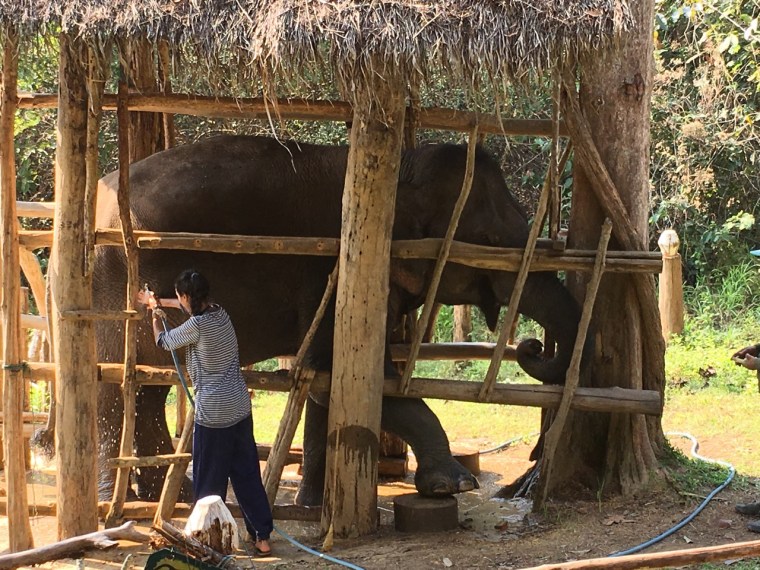
We spent time in the afternoon watching and learning how they train the elephants. This training is not circus tricks, but useful skills to enable them to be checked over and treated if the need arises. For such big animals it is important to be able to safely check under their feet and behind their ears. Emma used to use very similar techniques with her horse. The trainer would request a foot with a tap and if the elephant correctly placed the foot where it was supposed to go the mahout offered food rewards – we marveled at how fast an elephant can eat!
A ‘hand’ placed on the target
Our last morning with the elephants we were put to work setting up the ‘elephant enrichment’ area. Elephants are smart and as was explained to us, looking after their physical health is only half the challenge. Without mental stimulation they can still suffer enormously with impacts including that they won’t breed. This is a problem given only two elephants are being born at the moment for every ten that die.
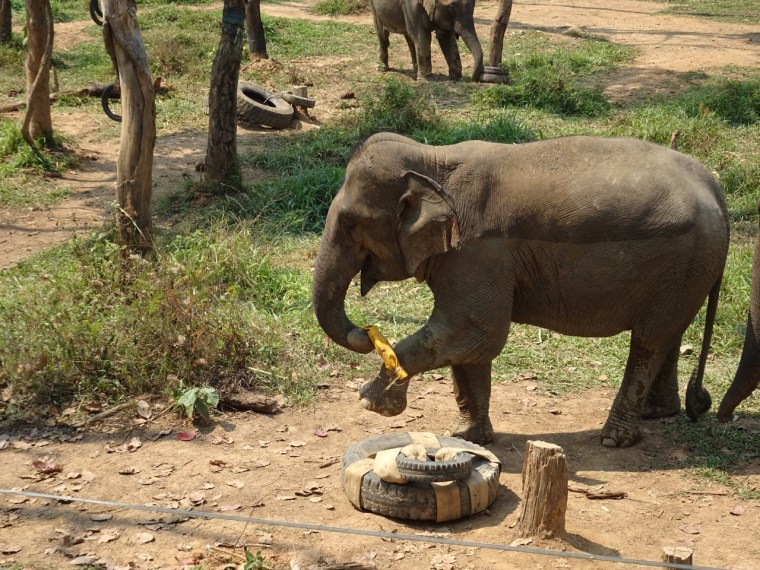
We were dealing with clever elephants we were told. They had been playing these games for quite a while and needed a challenge. ‘Be mean’ the Spanish biologist Annabel told us ‘these are level 10 elephants’. We tied pieces of sugar cane up in long yellow bags made from old firehose, hid them in tyres, and then jammed the tyres inside other tyres and put them over stumps. We hid the cane in barrels suspended in trees and scattered food throughout the area. Then we sat back as the elephants were let in and they set about, with almost visible smiles on their face, tackling the problems we had set them.
Oliver setting up elephant challenges
Smiling A ‘level 10’ challenge – she whacked this bag on her foot many times
The care for the elephants wellbeing, the relationship they have with their mahouts, the experience for visitors without compromising the elephants’ welfare all made this a special stop. Wild elephants would be better, but they’re not all wild and they never will be. We wish the ECC all the best in their efforts show that elephants don’t need to be exploited to provide a sustainable livelihood.
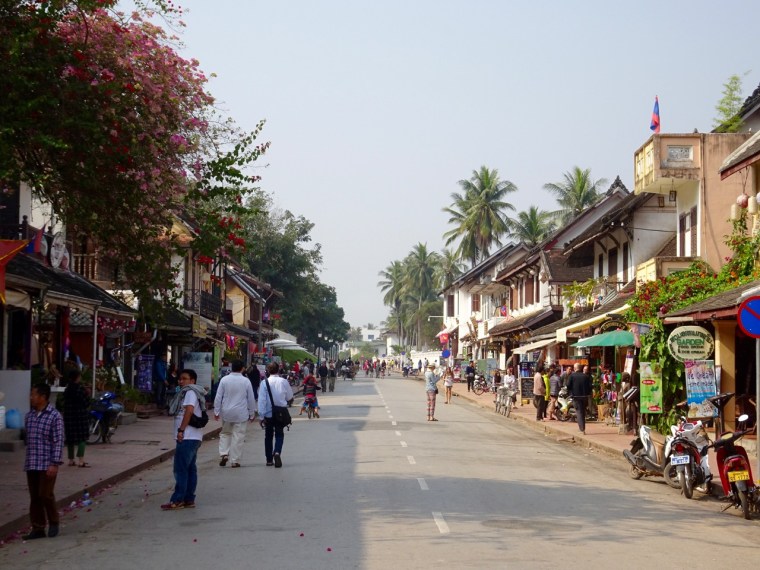
Luang Prabang, Laos. It almost felt like home. We spent 8 days there all up in two different stints. Below are some snippets from our stays.
Luang Prabang old town main street
The ATM debacle
‘No, I want my money’, I said strongly to a young Lao man. ‘You took $445 US dollars out of my account and only gave me 3 million kip!’
Then I showed him the math’s. $445 times the going Lao Kip exchange rate added up to 3.6 million kip (I know – crazy). Subtract the 4% commission and I figured I was out of pocket somewhere in the vicinity of 475,000 kip (about $80 Aussie dollars). The young man just looked at me blankly and insisted he didn’t know anything about it. He wanted me to leave, but I wasn’t going anywhere. I wanted my money.
It started out simply enough. We were low on cash and leaving town the next morning, so I wandered up the street to find an ATM. I found four, but none of them worked. No cash in a country that barely recognises a credit card does nothing for my blood pressure, so I tried one of the many money exchange windows scattered around town.
I asked if I could withdraw money using my debit card and receive the cash in Lao Kip. They nodded agreement. I asked for 3 million Kip worth. They put through a withdrawal for US $445, before slapping down a pile of cash about an inch thick. Just then two American guys walked past behind me. ‘Count your money carefully – they ripped us off’, they warned in strident tones. Hmm, I thought. So I counted carefully. Sure enough the pile of cash was a million Kip short. The money changers looked unimpressed as I pointed this out, but added another three quarters of an inch of cash to my pile. More counting, more calculating.
Off I went back our hotel where, with Emma’s assistance, I realised I had used the wrong US exchange rate in my calculations. I was short 600,000 Kip! Back I marched determined to right this wrong. When I got back to the window, the lights were turned out and the shop door was all but closed and locked. I stuck my foot in the door, collared the young attendant and set about berating him for what felt like thirty minutes, insisting I had been ripped off. I wanted my money and I wasn’t going anywhere until I got it! But it was late now. Shops were closing up and down the street.
I eventually yielded. I was getting nowhere. The young man looked like a rabbit trapped in the headlights and either didn’t or wouldn’t speak English. So I left. Then my heart sunk, even further, as I realised my mistake. The young man I had been haranguing did not work at the money window where I made the original transaction! I felt like a worm as I quickly found the right place just fifteen metres down the street. The two windows looked so similar and my mind was clouded by emotion.
Ten minutes later, and after repeating my now well practiced rendition about how I had been rorted, the whole deal was reversed. I wound up back at our hotel two hours after I first set off and still without any cash in hand. I did go back to the place where I had wrongly accused the poor young man to apologise. Profusely, which at least appeased my guilt. I went to bed telling myself the ATMs must surely be working in the morning.
Into the night markets
‘Can Seigne and I visit the night markets together?’ Amy asked Emma and I one afternoon. Seigne is Amy’s Danish (almost) twin, the eleven-year-old daughter of our now Danish friends Morten and Britt from the cruise down the Mekong. We ended up spending a number of thoroughly enjoyable days hanging out with them and their three children, exploring the sites of Luang Prabang.
But that would involve you, being separated from me, in a strange and foreign land. That was the first thought that went through my head. Before I could say anything though, Britt had said in a relaxed and casual voice that it would be fine with her as long as it was fine with us? ‘Um, sure, I guess’ one of us must have replied.
So off the two of them went into the bustling Luang Prabang night market. What could go wrong? Not much I told myself. We strolled the market entrance ourselves, quiet calls of, ‘Froo (fruit) shake Mister, froo shake madame?’ greeting us every few paces from the food stalls that lined the area.
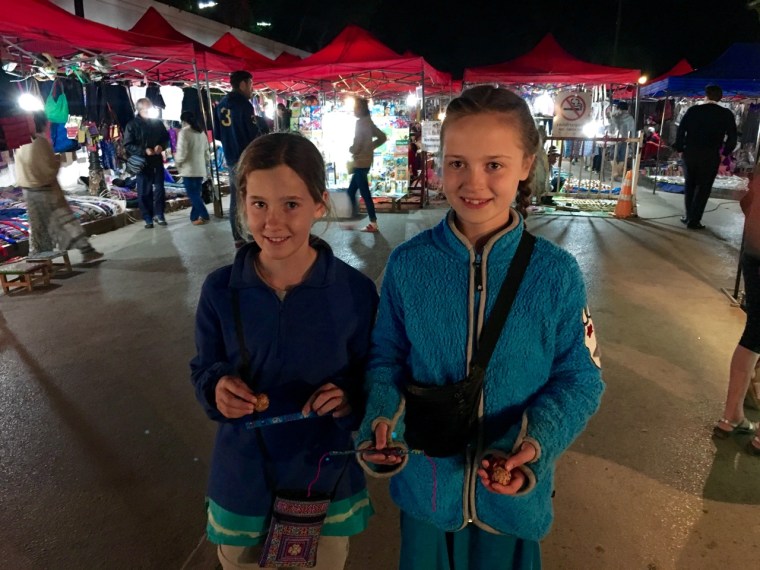
They returned 30 minutes later, Amy with a slightly grown-up air about her and me with an inaudible sigh of relief. She had bought a couple of small items and even bargained with the shop keeps to reach a price. ‘Can we go again tomorrow?’ they both implored. ‘Isn’t once enough’, I didn’t say.
They did go again, two nights later. This time for an hour! Oliver went too and I was without both my offspring. Emma comforted me with a chocolate croissant. They all returned, on time, feeling well pleased with themselves, but substantially poorer.
Success at the night marketsOliver and Sebastian keeping entertained while the girls shopped
Photo bombing in the temple
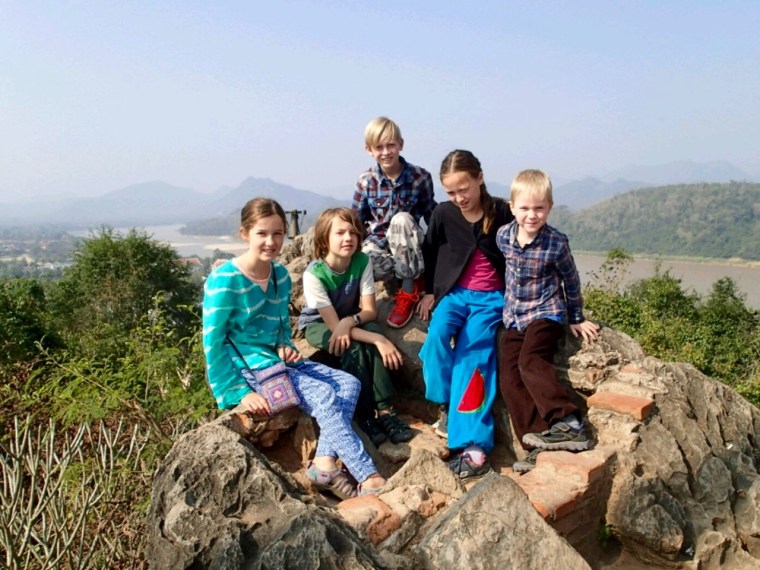
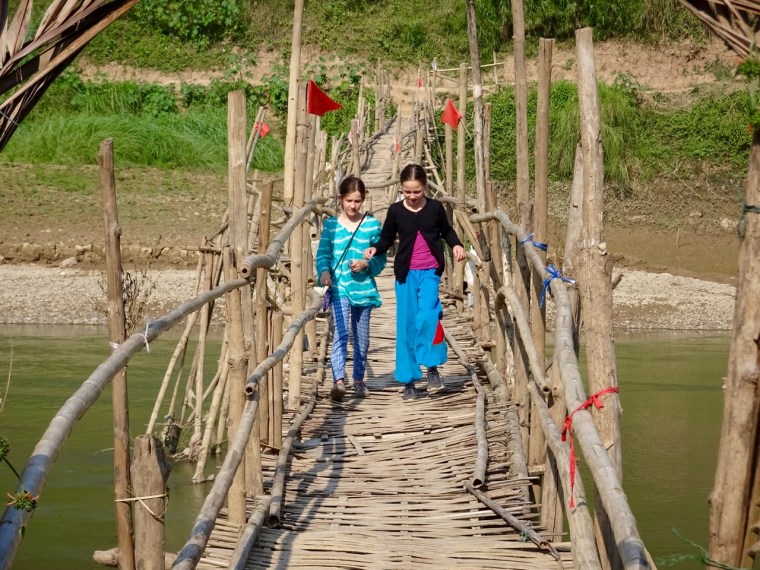
We left Morten and Britt’s lovely, spacious, apartment early one evening after spending a thoroughly enjoyable day meandering through the streets of Luang Prabang. We had been skimming stones and launching rocks from Oliver and Sebastian’s (Oliver’s Danish alter-ego) sling shots across the Nam Khan river (with a local who came and put us all to shame); exploring Buddha shrines and temples on Mt Phousi; crossing rickety bamboo bridges over same said river; and lunching on baguettes in the markets.
On the top of Mt PhousiBuilt annually as they don’t survive the wet seasonFriends
Out the front door was one of many temples in Luang Prabang and on this occasion evening prayer was underway. The rhythmical chanting of the monks robed in orange at the foot of a large Buddha lured us in for a closer look. All of us, except Oliver and Sebastian sat ourselves quietly at the rear of the temple to observe a wonderful cultural opportunity.
As the chanting went on, it became clear not all monks are as diligent as others. Young men all of them, a few towards the back passed notes to each other distractedly like naughty kids in a classroom, while the leaders at the front lead the chorus. I cast my eyes back to check on Oliver and Sebastian just in time to see them streaking across the temple grounds and launching themselves in the air, arms outstretched. Curious, I thought. So I got up to investigate.
‘What were you doing?’ I asked as I came outside, but I didn’t need a reply. Across the temple grounds a Japanese man had a camera set up on a tripod and in front of that his family was posing for a photo. Oliver and Sebastian had been waiting until he set the timer running on his camera before streaking across in the background to ‘photo-bomb’ their photo and giggling delightedly. I laughed. What else can you do?
The prettiest falls in South East Asia
Black bears? I thought we were here to see waterfalls? We were, but the black bears, or moon bears more accurately, were a wonderful addition. The Kuang Si waterfalls are one of Luang Prabang’s main attractions, single handedly employing a large fleet of tuk-tuk drivers to ferry ‘farangs’ thirty kilometres into the countryside.
The falls are also home to, ‘Free the Bears’, an organisation we had read about even before leaving home. They rescue the bears from one by one metre cages where they are kept often for their entire lives, catheters in their stomachs to extract bile, which isn’t even good for you. Free the Bears rescues as many as they can and provides them a vastly improved, if still captive, life. Wild and free is just no longer an option for moon bears in this part of the world. Keep up the good work we said and made a small donation to show our support.
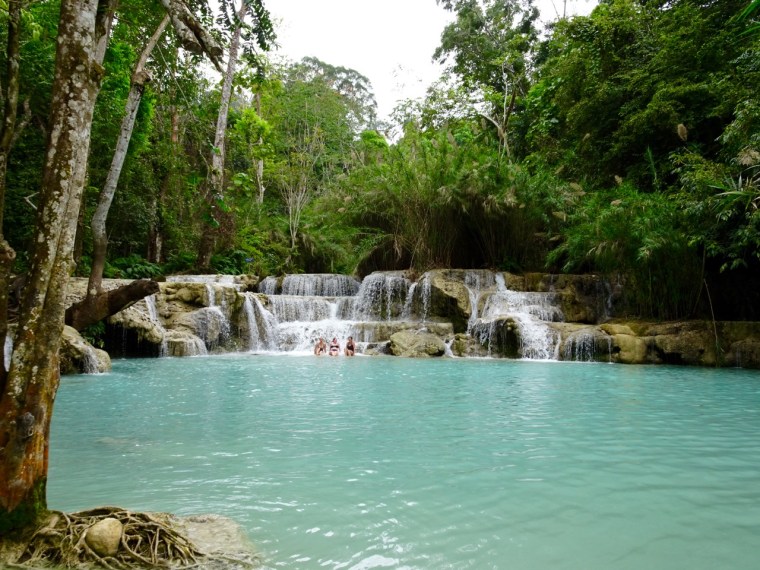
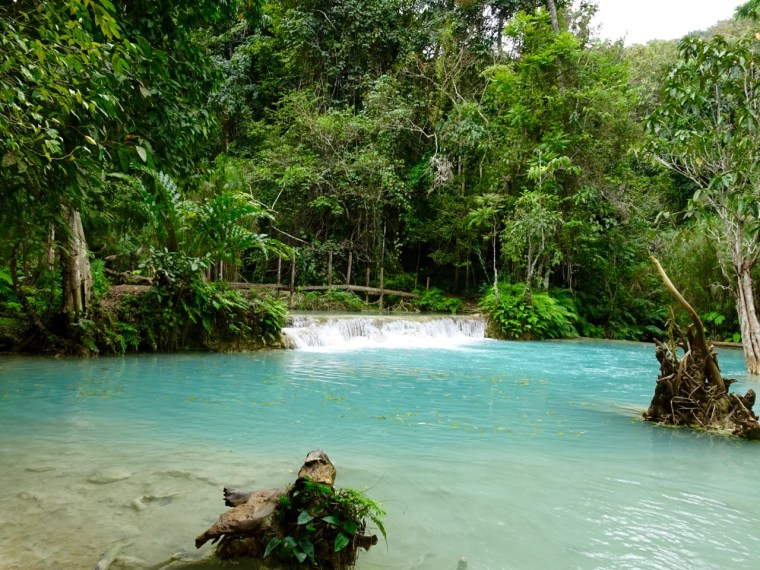
Beyond the bears lay one of the prettiest waterfalls we’ve seen. Minerals in the water ensure that rather than eroding the landscape these waterfalls gradually build it up. The result is a series of beautiful cascading falls tumbling over curved rock shelves into pools of unusually blue water. It was cloudy and really quite cool this particular day, but we swam anyway because it just looked so good.
Kuang Si fallsNot many other swimmers, but we couldn’t resistLike a fairylandWaterfall showerEmma and BrittSuch an unexpected colour in the jungle
Fondue by the river
‘This place was recommended to us by some Canadians we met’, Morten and Britt told us. ‘Goodo, lets eat here then’. So we did, in a scenic little restaurant hidden under the bamboo on the other side of the Nam Khan River just across, and with views of, one of the two rickety bamboo bridges in town. Lunch took hours, cooking up delicious food on a fondue over our own bucket of hot coals perched in the middle of the table. So good.
The best Lao food we found
Lao Royalty
‘That’s the kings throne’, I said to Oliver while looking at an ornately carved, large, golden and uncomfortable looking seat. We were in the royal palace museum. Who knew Laos had a king? I have much to learn when it comes to Asian history. Laos no longer has one by the way.
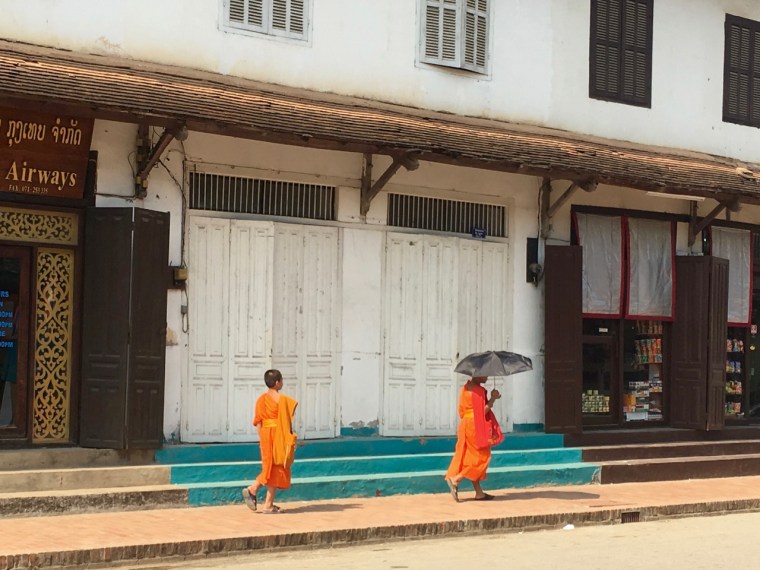
The town of Luang Prabang however is a world heritage site, recognized for the fact that is was the royal and religious capital of Laos from 1893 to 1946 and for, ‘…the fusion of French colonial and traditional Lao urban architecture’. It’s an easy place to be with a great vibe, classy restaurants and bakeries, art galleries, temples and saffron robed monks, foreigners and Lao locals all mixing together in almost equal numbers.
Main street in Luang PrabangTemple in the museum grounds contains PraBang Buddha statue
Oliver however was more interested in the gold scabbards holding the king’s swords. One was splotched with red, so we assumed it was the blood of some poor servant or foreign soldiers sliced down for failing to answer the King’s whims quickly enough. What else could it be? Ceramic, mirrored murals covered the walls of the throne room depicting all kinds of terrible battles complete with hundreds of de-capitated men, so we may not have been too far from the truth.
We wandered around the palace making ‘swoosht’ noises, pretending to slice down servants who failed to respond quickly enough to our fickle demands and amusing ourselves in the process – which was all that really mattered.
Big Brother Mouse
I met Pai-Lee at Big Brother Mouse. Big Brother Mouse is centre where English speaking foreigners like us are encouraged to spend a couple of hours helping Lao locals practice their English. I chatted with Pai-Lee while Emma spoke with a young man by the name of Sor. Amy and Oliver hung back, listening and drawing pictures with labels to help us explain certain words.
Helping at Big Brother Mouse
Pai-Lee is twenty and studying to be a teacher. He is learning English because he wants to go back to his village (2 hours from Luang Prabang) and help them learn English – for free – because he was inspired by a fellow villager who had gotten really upset at her lack of English skills. After an hour and half we had to finish up. Pai-Lee asked if we could come every day for a month! Regrettably not.
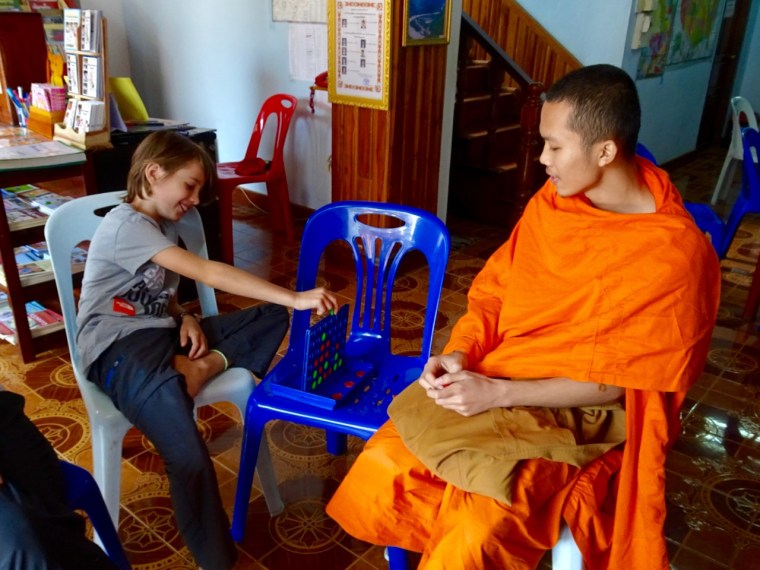
We spent another half an hour at the centre though while Oliver and I were thrashed in game after game of Connect-4 by Lam, one of the monks from a nearby temple, who clearly practiced his English and Connect-4 on a daily basis.
Connect-4Oliver said afterward – ‘it’s like he can think 3 moves ahead!’
UXO – Unexploded ordinance
Laos has the unwanted distinction of being the most heavily bombed country in the world. So we learnt at the Lao UXO (unexploded ordinance) Centre. During the Indochina war, the United States flew more than 500,000 bombing runs over Laos, dropping close to 240 million bombs.
It is estimated that approximately 80 million of the bombs dropped failed to explode and remain scattered throughout the country. Cluster bombs are particularly problematic. A single cluster bomb contained about 680 smaller ‘bombies’ each with a killing radius of about 30m. About 30% of bombies failed to explode on impact and therefore remain scattered across the country. More bombs were dropped on Laos than were dropped during the entire Second World War!
Cluster bomb, the bombies are often be mistaken for balls by children
The people of Laos have learned to a certain degree to cope with this legacy although hundreds still die or are maimed every year. Bomb casings are used for fences, bbqs, candlestick holders and even lamp shades. Despite government bans the UXO scrap metal industry is booming, with the additional income outweighing the risk of death. A single 700-pound bomb will return about two thirds of the average Laos income.
How fine it is that unexploded ordinance education is not on Amy and Oliver’s curriculum as it is for the children of Laos. I don’t know what to make of it all. What forces have pushed and pulled and shaped this country.
Ock Pop Tok
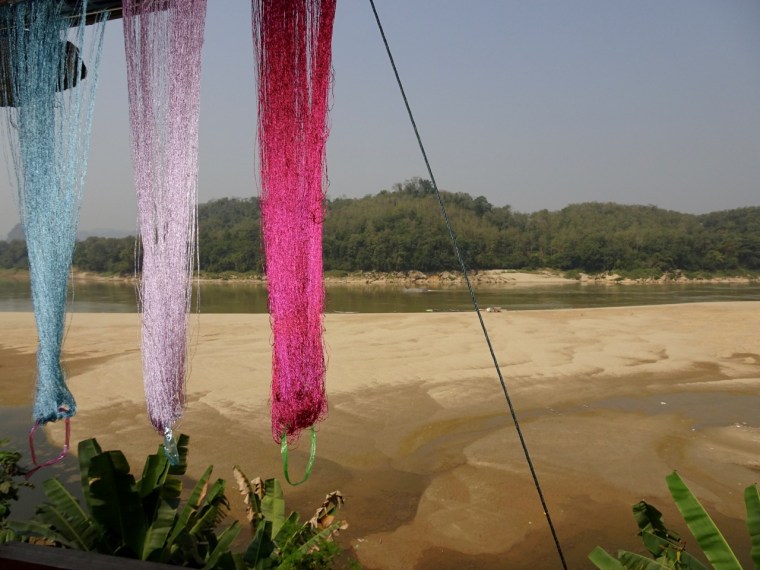
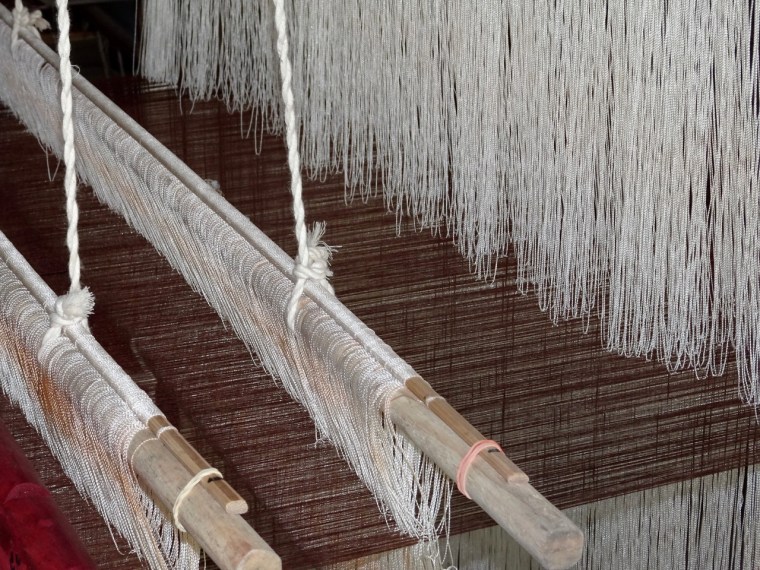
Oct Pop Tok. It means east meets west and is a Lao legacy diametrically opposed in nature to the UXO. Ock Pop Tok is keeping alive the silk weaving skills of Lao people across the provinces by providing them with an outlet to make sell their wares to wealthy foreigners like us. The fabrics are stunning, and that from me who really has no interest in such things. The weaving looms are even more amazing. We took a tour where they explained how it was done. I smiled and took photos of the looms. It went in one ear and out the other, but I love the product!
They use natural dyes to colour the silk, here it is drying by the MekongOne of the intricate patternsA loom
Farewell Luang Prabang
We bid a fond farewell to Morten, Britt, Seigne, Sebastian and Siegward on our last evening of our first stay in Luang Prabang (we returned for two more days after visiting the elephants). Like so many of you, our good friends back home, there are some people you just get along with. These Danes are such people and Denmark is now looking increasingly like a great place to visit when we make it to Europe. Happy travels our Danish friends we hope to see you again mid year.
Farewell to the lovely Luang Prabang – so many great memories.
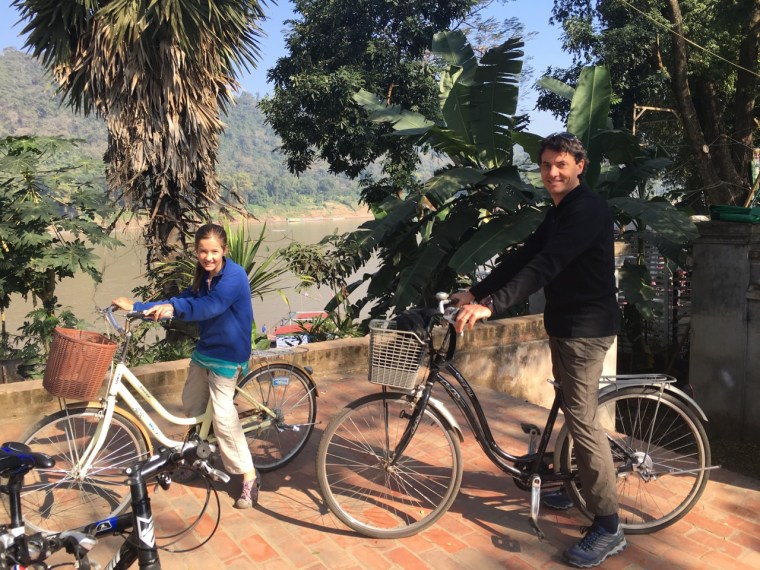
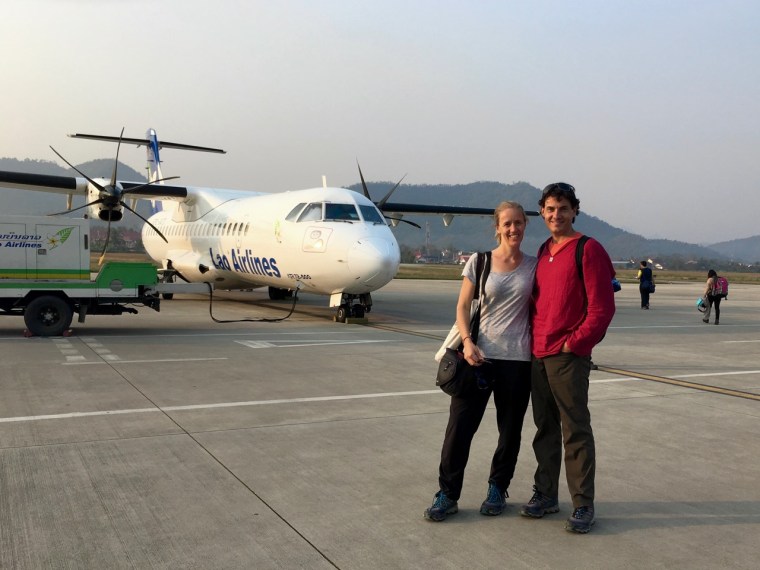
CyclingTouring Mt PhousiCycling by the MekongFarewell LaosFarewell beautiful streetsFarewell good freinds


























 8 itchy feet